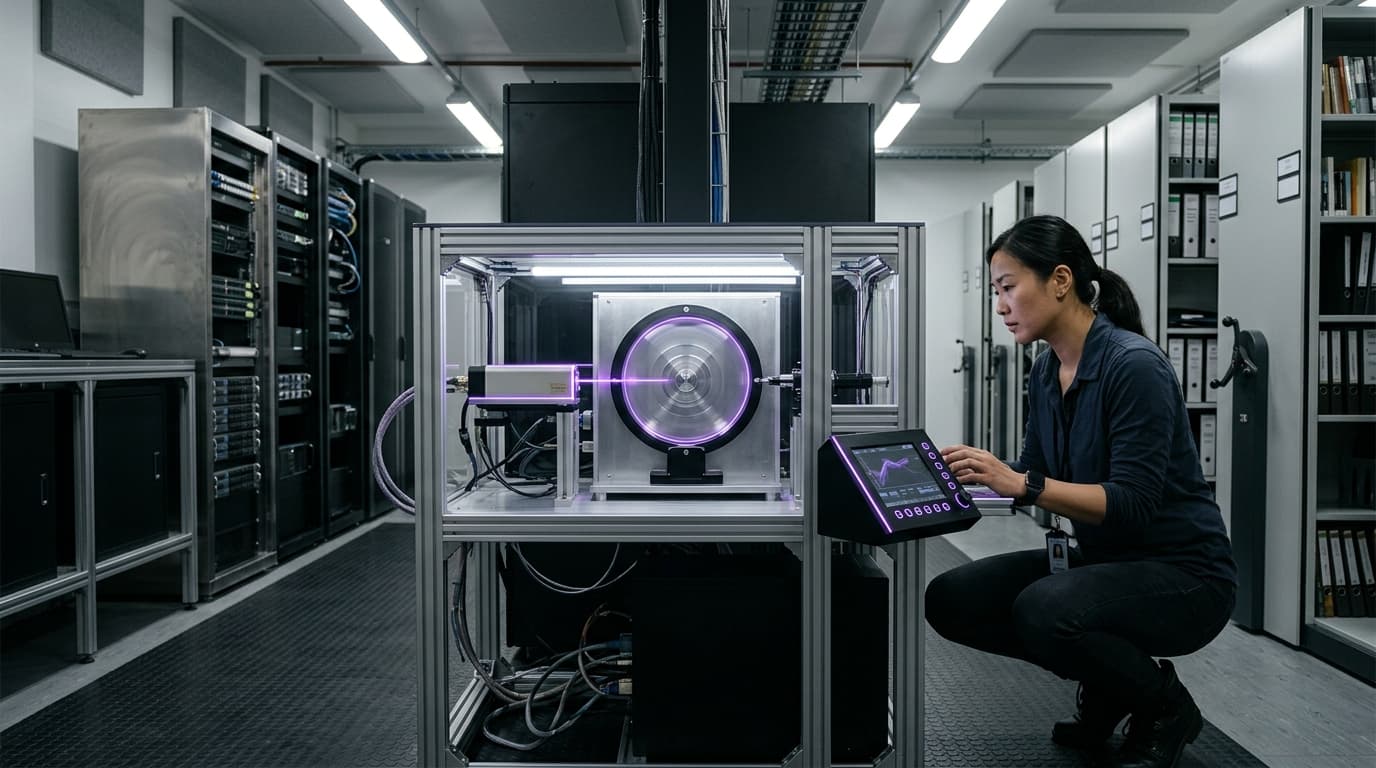
5D Optical Data Storage
5D optical data storage encodes information in fused silica using ultrafast lasers that create nanostructures with five dimensions: three spatial (x, y, z) plus two optical (birefringence orientation and retardance). This allows far higher data density than conventional optical discs and potentially thousands of years of stability at room temperature. The technique was demonstrated for small datasets—including the Universal Declaration of Human Rights—with readout using polarizing microscopy. Applications could include long-term archival storage for museums, archives, and institutions requiring data persistence across centuries.
Traditional storage media—magnetic tape, optical discs, solid-state drives—degrade over decades. 5D optical storage offers potentially millennia-scale stability in a compact, passive medium. Significant challenges include write and read speeds—currently far slower than conventional storage—and scalability of manufacturing. Research continues into faster writing techniques, parallel readout, and error correction. The technology remains experimental; practical deployment would require substantial advances in throughput and cost.
Research this in Signals
Signals turns a topic into a sourced research record you can inspect and rerun. Your first scan is free, and this one starts with 5D Optical Data Storage already loaded, so edit it or scan as is.