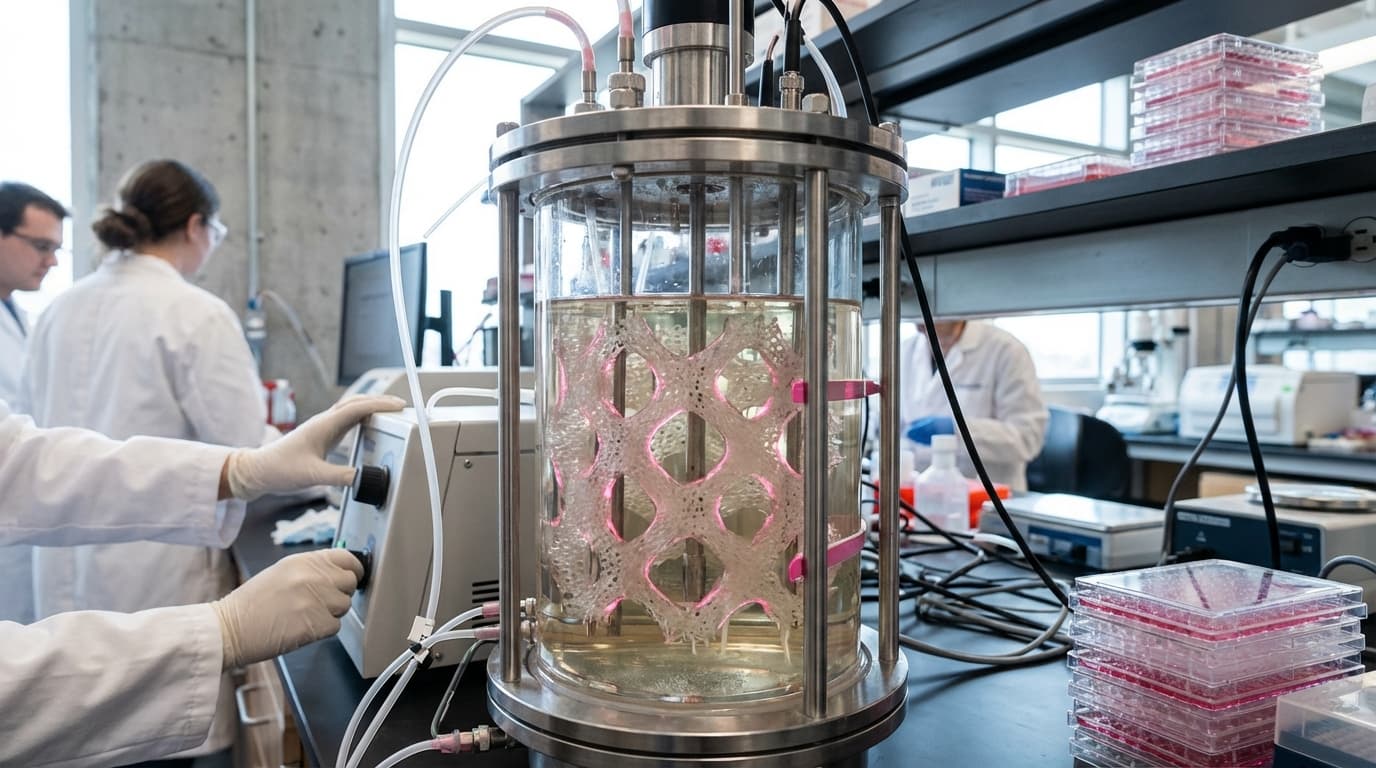
Regenerative Scaffolds & Smart Biomaterials
Regenerative scaffolds and smart biomaterials are dynamic, self-healing three-dimensional structures seeded with autologous (patient's own) stem cells that can respond to biochemical cues from the host tissue, providing a supportive environment for tissue regeneration that adapts to the changing needs of the healing process. These smart biomaterials can change their properties in response to local conditions, release growth factors or other therapeutic molecules, and provide structural support while promoting tissue regeneration, creating an interactive system that guides and supports the body's natural healing processes. Companies and research institutions are developing these materials for applications in tissue engineering and regenerative medicine.
This innovation addresses the challenge of tissue regeneration, where providing the right environment for cells to grow and organize into functional tissue is critical. By creating responsive, adaptive scaffolds, these materials can better support regeneration. The approach represents an evolution in tissue engineering toward more sophisticated, interactive materials.
The technology is particularly valuable for tissue engineering and regenerative medicine, where creating functional replacement tissues requires sophisticated materials. As the technology improves, it could enable better outcomes in tissue regeneration. However, ensuring biocompatibility, managing complexity, and achieving functional tissue formation remain challenges. The technology represents an important evolution in biomaterials, but requires continued development to achieve the sophistication needed for complex tissue regeneration. Success could enable better tissue engineering outcomes and support regenerative medicine applications, but the path to clinical use requires careful development and validation.
Related Organizations
United States · Startup
A biotech company growing personalized bone and cartilage grafts using patient stem cells seeded onto 3D scaffolds.

Develops universally implantable bioengineered human tissues, specifically acellular tissue engineered vessels (ATEVs) that act as scaffolds for host cell repopulation.
United States · University
World-renowned institute that developed the Integrated Tissue and Organ Printing System (ITOP).

Develops rhCollagen bioinks and partners with 3D Systems to print breast implants and other tissue scaffolds.
Israel · Startup
Combines hydrogels and cell therapy to manufacture autologous neural implants for spinal cord injury.
Singapore · Company
Specializes in 3D printed bioresorbable implants that function as scaffolds for natural bone regeneration.

Developed the SWIFT (Sacrificial Writing into Functional Tissue) method for 3D printing vascular channels in living matrices.
Switzerland · Company
Manufactures 3D bioprinting systems used to fabricate complex tissue models and regenerative scaffolds.
France · Startup
Develops biomorphic programmable polymers for tissue reconstruction, creating materials that adapt to the tissue environment.
United States · Company
Engineers advanced biomaterials and textile structures (scaffolds) for the medical device and pharmaceutical industries.
Supporting Evidence
Research this in Signals
Signals turns a topic into a sourced research record you can inspect and rerun. Your first scan is free, and this one starts with Regenerative Scaffolds & Smart Biomaterials already loaded, so edit it or scan as is.