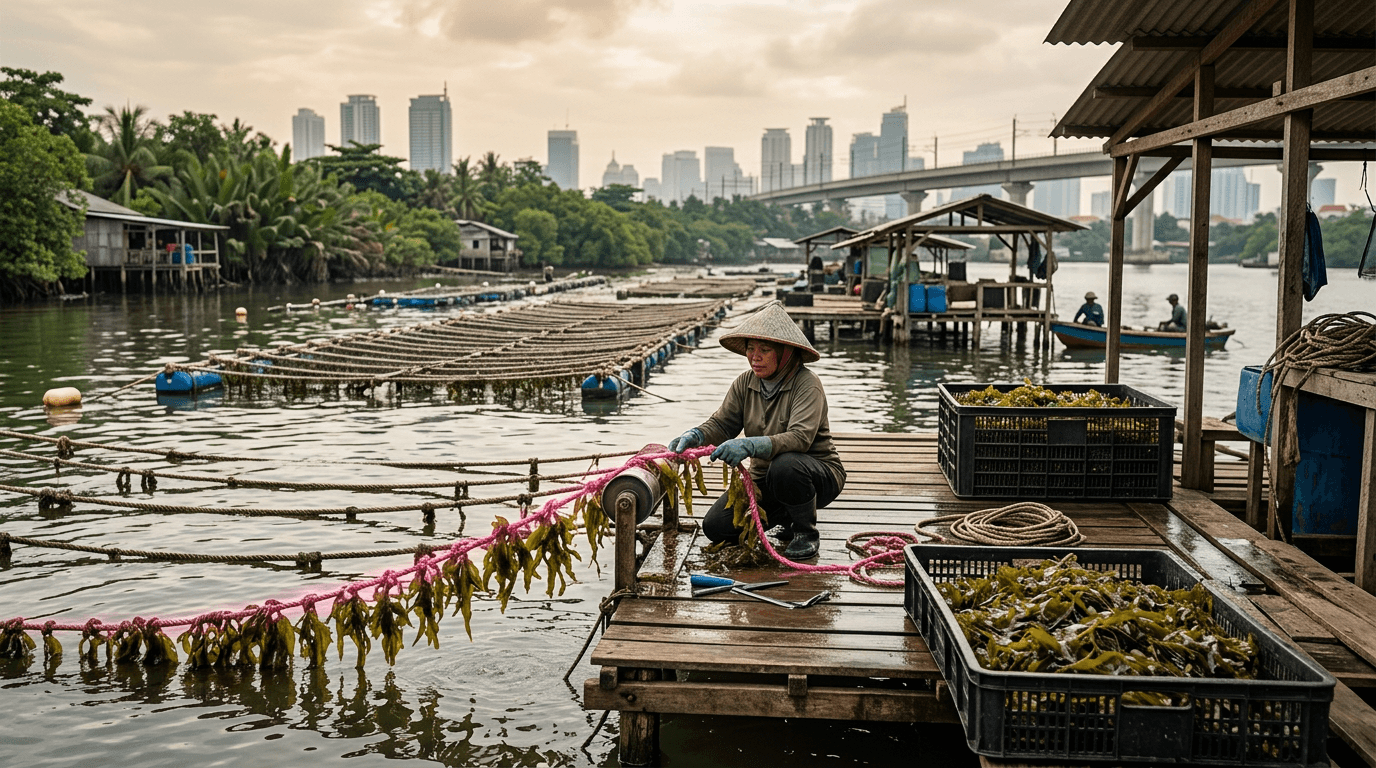
Industrial-Scale Seaweed Cultivation & Processing
Geography: Asia Pacific · Southeast Asia · Southeast Asia
Indonesia — Indonesia is the world's largest seaweed producer, harvesting over 10 million tonnes annually across its 17,000-island archipelago. Traditional use is carrageenan extraction for food and cosmetics, but new applications are emerging: seaweed-based bioplastics, carbon credit generation through ocean carbon sequestration, and algae-derived alternative proteins.
Startups like Evoware (seaweed-based packaging) and Sway (biomaterials) are developing seaweed into plastic alternatives. The carbon sequestration angle is particularly compelling: seaweed farms absorb CO2 while providing livelihoods for coastal communities. Indonesia's vast coastline and warm waters make it the ideal geography for scaling ocean-based carbon removal.
The processing gap is the main challenge: most Indonesian seaweed is exported raw to China for processing, capturing minimal value. Building domestic carrageenan, agar, and alginate processing capacity — plus next-generation bioplastic and carbon credit facilities — would multiply the industry's economic value. Indonesia's seaweed sector could become a model for blue economy development if processing technology scales domestically.
Research this in Signals
Signals turns a topic into a sourced research record you can inspect and rerun. Your first scan is free, and this one starts with Industrial-Scale Seaweed Cultivation & Processing already loaded, so edit it or scan as is.