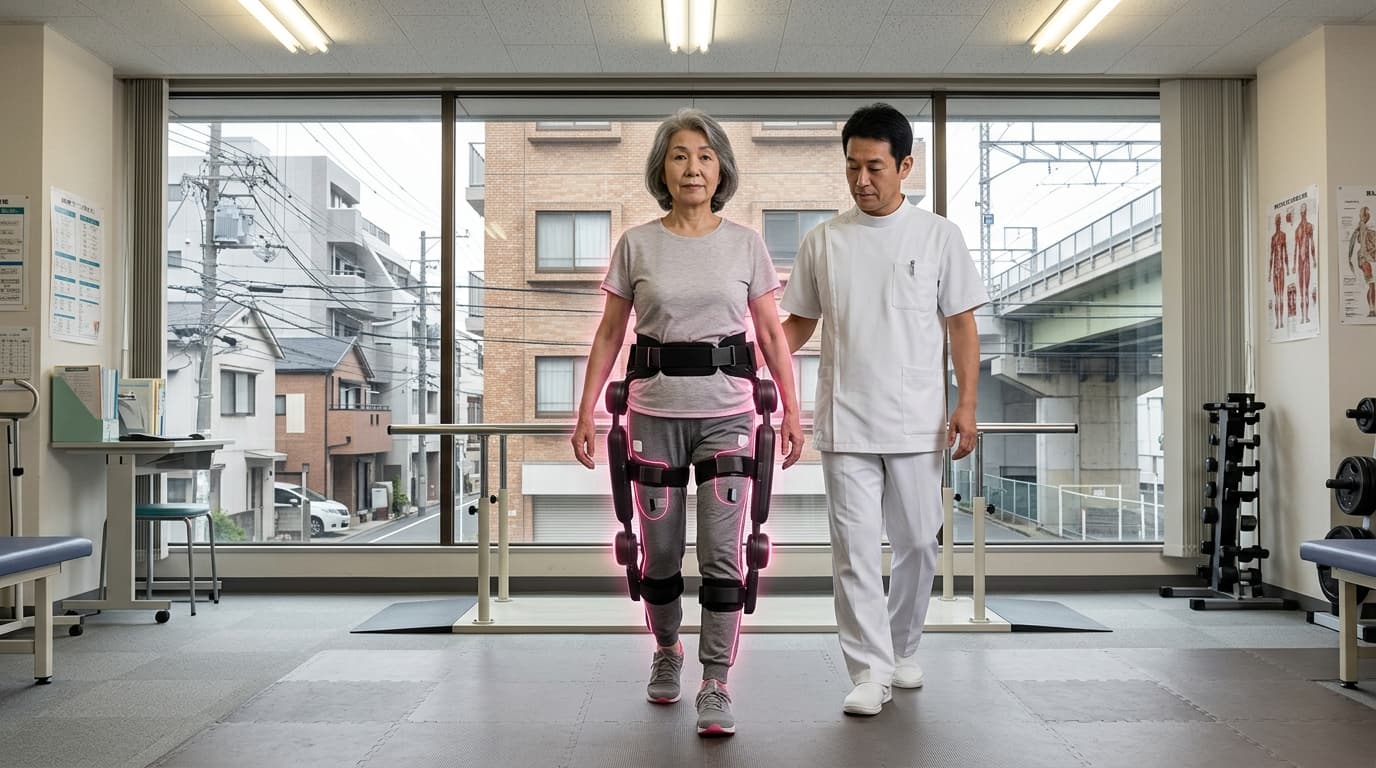
Wearable Medical Exoskeletons
Geography: Asia Pacific · East Asia · Japan
Cyberdyne Inc., founded by University of Tsukuba professor Yoshiyuki Sankai, produces the Hybrid Assistive Limb (HAL) — the world's first wearable cyborg-type robot certified as a medical device. HAL detects faint bioelectric signals (as low as microvolts) from the skin surface above muscles, interprets the wearer's intended movements, and assists hip and knee joint motion in real-time. Unlike passive exoskeletons that simply provide mechanical support, HAL creates a neural feedback loop: the patient's brain sends movement signals, HAL assists the motion, and the successful movement reinforces neural pathways — a process clinically demonstrated to induce neuroplasticity.
In 2025, a systematic review published in the Global Spine Journal identified HAL as the only exoskeleton device proven to induce neuroplasticity and provide comprehensive therapeutic benefits. HAL received expanded medical approval for treating HAM (HTLV-1-associated myelopathy) and hereditary spastic paraplegia. The device is deployed in medical facilities across Japan, Germany, and other countries, with insurance coverage for specific neurological conditions. Cyberdyne also offers non-medical HAL variants for elderly care support and industrial lifting assistance.
Japan's leadership in medical exoskeletons reflects the convergence of its robotics expertise, aging society needs, and biomedical engineering tradition. The global medical exoskeleton market is projected to exceed $3 billion by 2030, driven by stroke rehabilitation, spinal cord injury treatment, and elderly mobility support. Cyberdyne's bioelectric signal approach — treating the exoskeleton as a neural interface rather than a mechanical brace — represents a fundamentally different philosophy from Western competitors like Ekso Bionics or ReWalk, and Japan's regulatory framework for medical robots (developed through HAL's certification process) provides a template for other countries.
Research this in Signals
Signals turns a topic into a sourced research record you can inspect and rerun. Your first scan is free, and this one starts with Wearable Medical Exoskeletons already loaded, so edit it or scan as is.