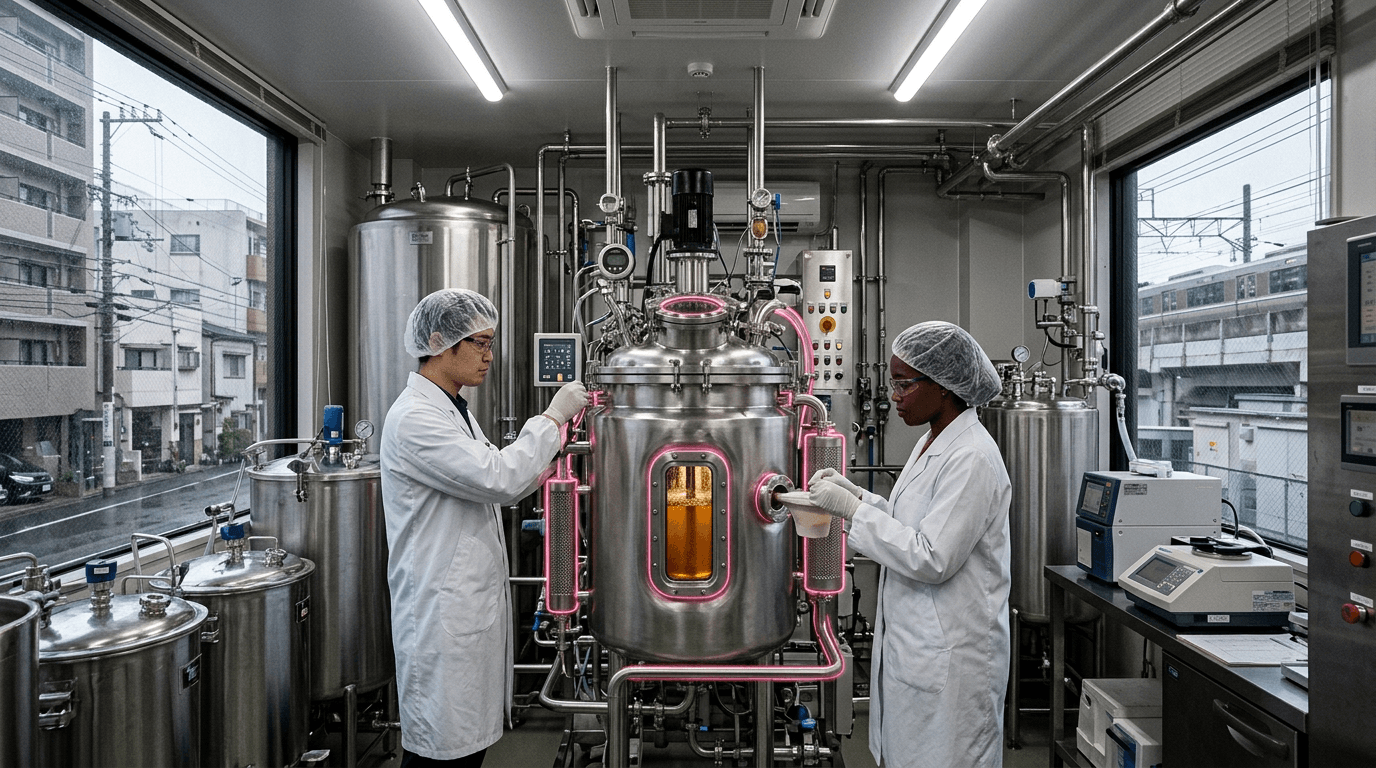
Precision Fermentation and Umami Science
Geography: Asia Pacific · East Asia · Japan
Japan's mastery of fermentation science — refined over centuries through sake, miso, soy sauce, and koji culture — has produced one of the world's most unexpected technology crossovers. Ajinomoto Group, founded in 1909 to commercialize umami (the fifth taste, discovered by Japanese chemist Kikunae Ikeda in 1908), is now the world's largest amino acid producer and — remarkably — a critical semiconductor materials supplier. Ajinomoto Build-up Film (ABF), derived from the company's amino acid chemistry expertise, holds nearly 100% of the global market for interlayer insulation in advanced semiconductor packages. Every Intel, AMD, and NVIDIA CPU relies on ABF.
The food technology side is equally dominant. Ajinomoto controls approximately 30% of the global amino acid market, and Japanese companies lead in koji-based fermentation, enzyme engineering, and precision flavor compounds. The global umami ingredients market exceeds $6 billion annually, with Japanese companies (Ajinomoto, Kikkoman, Yamasa) providing foundational ingredients and technology. Japan's 'koji culture' — the cultivation of Aspergillus oryzae mold — was designated a national fungus and represents biotechnology knowledge refined over 1,000+ years.
The strategic insight is that Japan's food science and semiconductor materials are connected through the same underlying capability: precision control of biological and chemical processes at molecular scale. Ajinomoto's journey from MSG producer to semiconductor materials monopolist illustrates how deep domain expertise in one area can create chokepoint positions in seemingly unrelated industries. The company is now investing ¥25 billion to expand ABF production capacity by 50% by 2030, with the ABF substrate market projected to reach $4.4 billion by 2032.
Research this in Signals
Signals turns a topic into a sourced research record you can inspect and rerun. Your first scan is free, and this one starts with Precision Fermentation and Umami Science already loaded, so edit it or scan as is.