Nanotechnology-Based Affordable Water Purification
Geography: Asia Pacific · South Asia · India
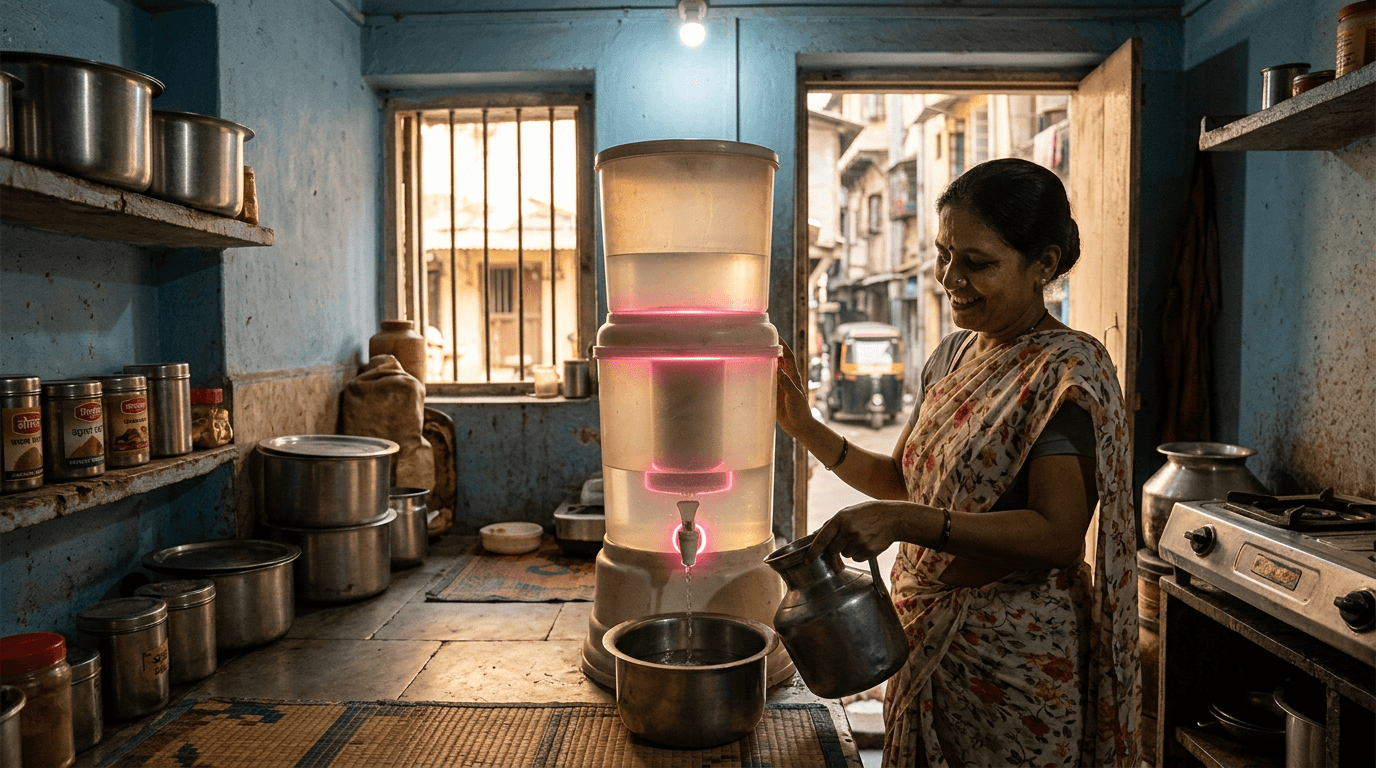
India faces a water contamination crisis that has spawned uniquely Indian nanotechnology solutions. Over 60 million people drink arsenic-contaminated groundwater (primarily in West Bengal and Bangladesh border regions) and 66 million are exposed to excess fluoride (across 20 states). Researchers at IIT Madras, led by Professor T. Pradeep, developed confined metastable 2-line ferrihydrite nanoparticles that remove arsenic to below WHO-safe levels. The Tata Swach water purifier, developed by TCS Innovation Labs, uses rice husk ash impregnated with nano-silver particles to purify water and destroy bacteria — priced at approximately $20, requiring no electricity or running water.
What makes India's water purification nanotechnology distinctive is the design constraint: solutions must work without electricity, without running water, without maintenance, and must cost pennies per litre. This forces radically different engineering compared to Western membrane filtration or UV systems. Indian researchers have developed composite adsorbents combining locally available materials (rice husk ash, activated alumina, laterite soil) with nanoparticles to create point-of-use filters that work passively by gravity. CSIR and IIT labs have published extensively on novel nanomaterials for simultaneous removal of arsenic, fluoride, iron, and microbial contaminants.
The Jal Jeevan Mission — which has connected 15.8 crore (158 million) rural households with piped tap water by 2025 — is the infrastructure complement. But for the hundreds of millions still depending on groundwater, point-of-use nano-purification bridges the gap. India's water purification nanotechnology research has produced solutions exportable to arsenic-affected regions across South and Southeast Asia and fluoride-affected regions across Africa — areas with the same constraints of no electricity, no infrastructure, and extreme cost sensitivity.
Research this in Signals
Signals turns a topic into a sourced research record you can inspect and rerun. Your first scan is free, and this one starts with Nanotechnology-Based Affordable Water Purification already loaded, so edit it or scan as is.