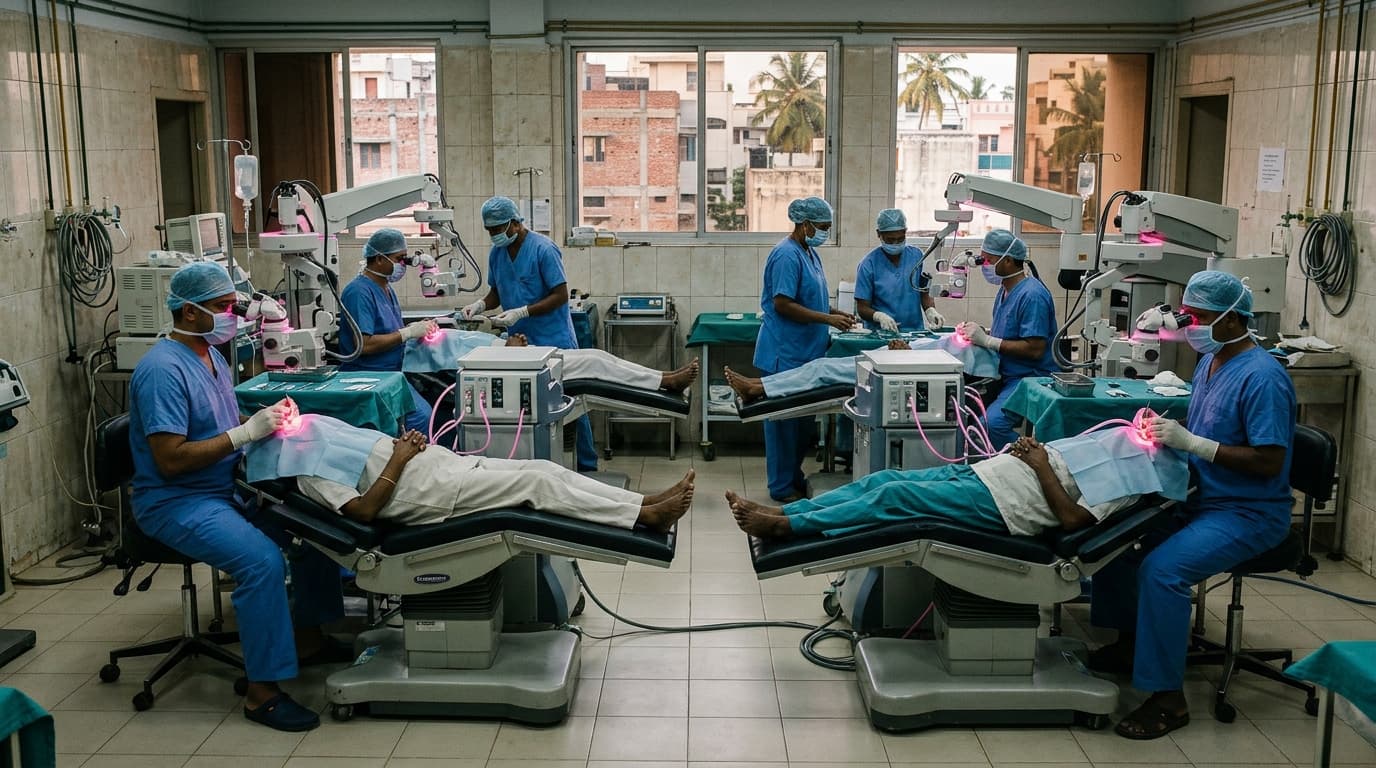
Aravind Eye Care Assembly-Line Surgery Model
Geography: Asia Pacific · South Asia · India
Aravind Eye Care System, founded by Dr. Govindappa Venkataswamy in 1976 in Madurai, has become the world's largest and most productive eye care facility, performing over 500,000 surgeries annually across its network of hospitals. The revolutionary insight was applying manufacturing principles to surgery: surgeons operate in theatres with two operating tables, moving between patients while trained ophthalmic assistants prepare and recover patients. A surgeon at Aravind performs 2,000+ cataract surgeries per year vs. the Indian average of 220 — a 10x productivity improvement. The model was explicitly inspired by McDonald's assembly-line efficiency.
The cost structure is what astonishes: cataract surgery at Aravind costs $12-$100, compared to $3,500+ in the United States, with comparable or better clinical outcomes. Aravind achieves this not through cheap materials or lower standards, but through extreme process optimization, volume economics, and a cross-subsidy model where paying patients fund free surgeries for the poor. Aravind's subsidiary, Aurolab, manufactures intraocular lenses for $2 each (vs. $200 imported), supplying not just India but hospitals across the developing world.
Aravind's model has been studied at Harvard Business School, replicated in eye care systems across Africa and Asia, and recognized as one of the most impactful healthcare innovations in history. It demonstrates a broader Indian healthcare innovation pattern: take a procedure that Western medicine prices at thousands of dollars, radically re-engineer the delivery system (not the medicine itself), and achieve comparable quality at 1/10th to 1/100th the cost. Narayana Health (heart surgery for $2,000 vs. $100,000), LifeSpring Hospitals (maternal care), and others have applied similar principles. This isn't charity — Aravind is financially self-sustaining. It's a fundamentally different model for healthcare delivery.
Research this in Signals
Signals turns a topic into a sourced research record you can inspect and rerun. Your first scan is free, and this one starts with Aravind Eye Care Assembly-Line Surgery Model already loaded, so edit it or scan as is.