







Biodegradable and Edible Packaging
This page is a narrower case of it.
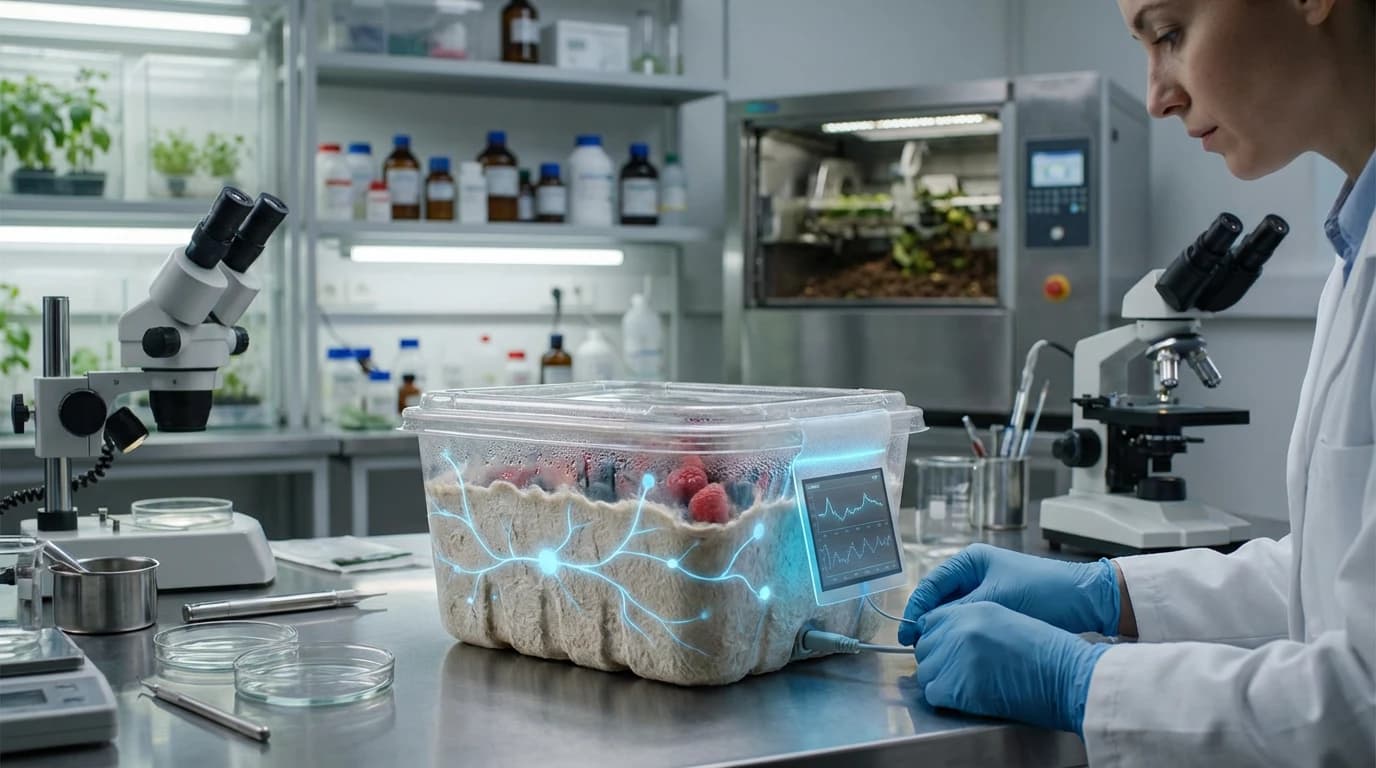
Bio-integrated and living packaging represents a fundamental shift from conventional manufacturing to biological cultivation, where packaging materials are grown from living organisms such as mycelium, algae, or bacteria. Unlike traditional packaging that relies on petroleum-based plastics or energy-intensive production processes, these materials are cultivated in controlled environments where organisms naturally form structural matrices. Mycelium, the root structure of fungi, can be grown into specific shapes by feeding agricultural waste to fungal networks, which bind the substrate into rigid, protective forms. Similarly, algae-based films can be cultivated in bioreactors, while bacterial cellulose can be grown in nutrient-rich solutions to create flexible, transparent sheets. The biological nature of these materials means they retain living or bioactive properties even after harvest, enabling them to respond dynamically to environmental conditions such as temperature, humidity, or the presence of specific chemical compounds.
The supply chain and logistics industry faces mounting pressure to reduce plastic waste while maintaining product integrity throughout increasingly complex distribution networks. Traditional packaging solutions create a stark trade-off: robust protection often means non-biodegradable materials that persist in landfills for centuries, while biodegradable alternatives frequently lack the structural integrity or barrier properties needed for sensitive goods. Bio-integrated packaging addresses this challenge by offering materials that can match or exceed the protective qualities of conventional options while remaining fully compostable in home or industrial settings. The bioactive capabilities of these materials introduce entirely new functionalities—packaging that changes color when the contents begin to spoil, releases natural antimicrobial compounds to extend shelf life, or adjusts its permeability in response to humidity levels. For cold chain logistics, where maintaining precise temperature and freshness is critical, these responsive properties can reduce food waste by providing real-time quality indicators and active preservation without synthetic additives.
Early commercial deployments indicate growing viability across multiple sectors, with companies exploring applications ranging from protective packaging for electronics to insulated containers for perishable foods. Research suggests that mycelium-based packaging can be grown to specification in as little as one week, offering production timelines competitive with traditional manufacturing while consuming significantly less energy. The materials' ability to decompose completely within weeks when composted addresses the mounting crisis of packaging waste in urban centers and remote distribution points alike. Industry analysts note that as cultivation techniques become more refined and production scales up, bio-integrated packaging could transform not only the environmental footprint of logistics but also the fundamental economics of the supply chain, where end-of-life disposal costs currently represent a significant hidden expense. This convergence of biological innovation and practical logistics needs positions living packaging as a cornerstone technology for circular economy models, where materials flow through use cycles without generating persistent waste streams.
The pioneer of mycelium technology, developing the 'MycoComposite' platform used to grow sustainable building materials and packaging.
Sustainable packaging company creating materials from seaweed and plants that disappear naturally.
A licensee of Ecovative's technology in Europe, producing mycelium packaging and interior design products.
A large-scale manufacturer of mycelium-based biodegradable packaging.
Creates home-compostable replacements for thin-film plastic packaging using seaweed.
A biotech startup creating plastic-free packaging from microbes.
A circular materials company producing bio-based foam packaging.
A materials science company replacing single-use plastics with seaweed-derived alternatives.
Conducts extensive research on living materials, including fungal mycelium for sensing and responsive surfaces.
Biomaterials company transforming algae waste into carbon-negative black pigments and inks.
Published forecasts about this technology, graded against what happened in Hindsight.
Biodegradable and Edible Packaging
This page is a narrower case of it.
Biomolecule-Based Packaging
This page is a narrower case of it.
Signals turns a topic into a sourced research record you can inspect and rerun. Your first scan is free, and this one starts with Bio-Integrated and Living Packaging already loaded, so edit it or scan as is.