








Improved Food Provenance Validation
Agri-Food Blockchain
Distributed ledger tracking food products from farm to table
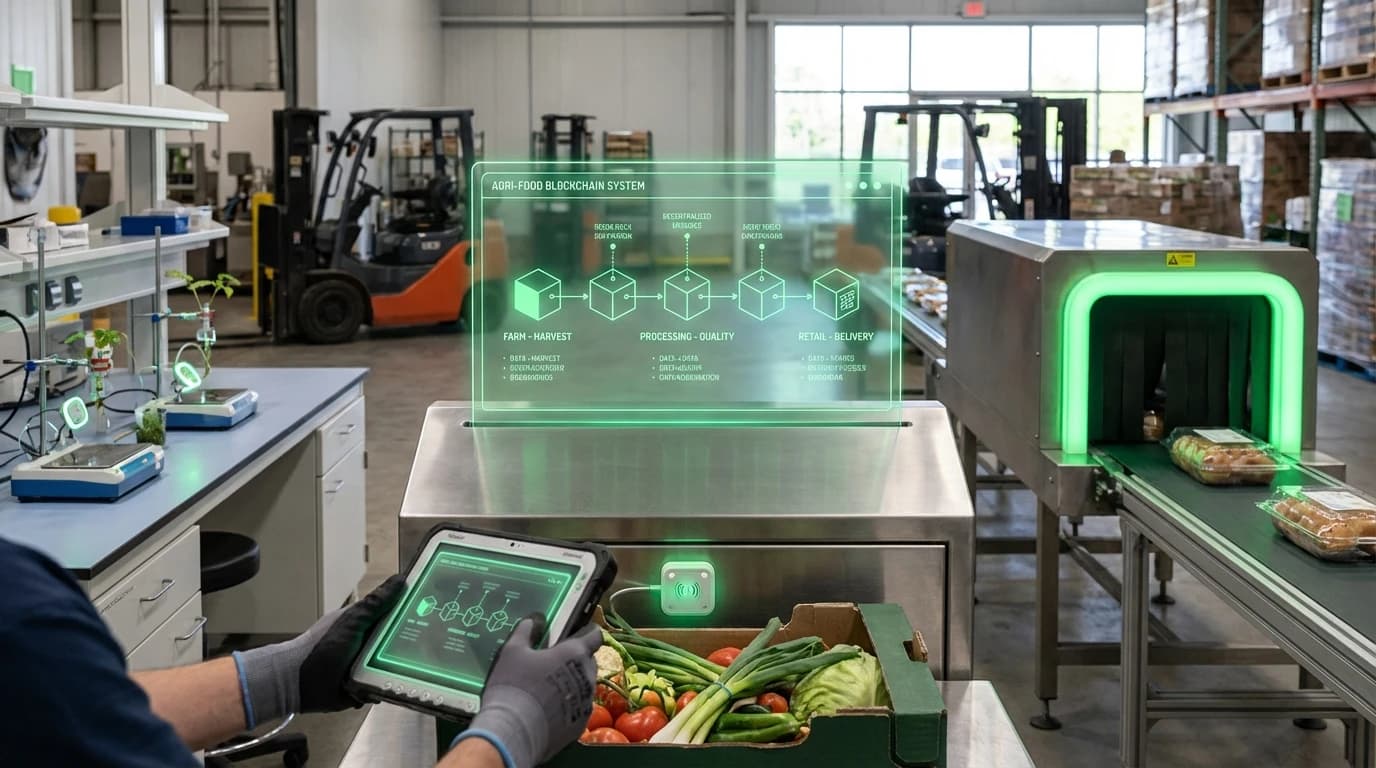
Agri-food blockchain represents a distributed ledger technology specifically adapted for agricultural and food supply chains, creating an immutable record of every transaction, movement, and transformation a food product undergoes from production to consumption. Unlike traditional centralized databases managed by single entities, blockchain operates as a decentralized network where multiple participants—farmers, processors, distributors, retailers, and regulators—maintain synchronized copies of the same ledger. Each transaction or data point, whether it's a harvest timestamp, a temperature reading during transport, or a quality inspection result, is cryptographically sealed into sequential "blocks" that cannot be altered retroactively without detection. This architecture relies on consensus mechanisms where network participants must validate new entries before they're permanently recorded, ensuring data integrity without requiring trust in any single authority. The technology can integrate with IoT sensors, GPS trackers, and other monitoring devices to automatically capture environmental conditions, location data, and handling practices throughout the supply chain.
The food industry faces persistent challenges around traceability, authenticity, and safety that traditional paper-based or siloed digital systems struggle to address effectively. When contamination incidents occur, identifying the precise source and scope of affected products can take days or weeks using conventional methods, during which time contaminated goods may reach consumers or safe products may be unnecessarily destroyed. Food fraud—including mislabeling of organic products, country-of-origin deception, and adulteration—costs the global food industry billions annually while eroding consumer trust. Agri-food blockchain addresses these problems by creating a single source of truth accessible to all authorized supply chain participants, enabling recalls to be executed in hours rather than days by precisely identifying affected batches. The technology also empowers consumers to verify claims about organic certification, fair trade practices, or sustainable sourcing by scanning product codes that reveal the complete journey of their food. For producers, particularly smallholder farmers in developing regions, blockchain-based provenance systems can command premium prices by providing verifiable proof of quality standards and ethical practices that might otherwise go unrecognized in complex global supply chains.
Several major food companies and retailers have moved beyond pilot programs to operational deployments of blockchain-based traceability systems, particularly for high-value or fraud-prone products like organic produce, seafood, and premium meats. Industry consortia have emerged to establish interoperability standards, recognizing that fragmented blockchain networks would simply recreate the data silos they aim to eliminate. Current applications range from tracking coffee beans from specific farms in Colombia to verifying the authenticity of Italian olive oil and monitoring cold chain compliance for pharmaceutical-grade food ingredients. The technology shows particular promise in supporting sustainability initiatives, as it can provide transparent documentation of carbon footprints, water usage, and biodiversity impacts throughout production cycles. Looking forward, the integration of blockchain with artificial intelligence and predictive analytics may enable not just reactive traceability but proactive supply chain optimization, while smart contracts could automate payments to farmers upon verified delivery or trigger insurance claims when environmental sensors detect spoilage conditions. As regulatory frameworks increasingly demand greater supply chain transparency and consumers continue to prioritize food safety and ethical sourcing, blockchain-based systems are positioned to evolve from competitive differentiators to baseline expectations across the agri-food sector.
TRL
8/9Deployed
Impact
4/5
Investment
4/5
Category
Software
Related Organizations
A blockchain initiative founded by global agribusiness giants (ADM, Bunge, Cargill, COFCO, Louis Dreyfus, Viterra) to modernize global trade execution.
Developer
A blockchain-based ecosystem allowing growers, processors, and retailers to trace food provenance.
Developer
Provides a blockchain-based transaction platform for the agricultural industry, facilitating prompt payment and traceability for farmers.
Developer
Multinational retail corporation investing heavily in supply chain AI and direct-to-fridge/home delivery.
Deployer

OriginTrail
Slovenia · Company
A Decentralized Knowledge Graph (DKG) used to organize and verify assets, increasingly focused on 'Verifiable Internet for AI' to track information provenance.
Developer

Carrefour
France · Company
One of the world's largest retailers.
Deployer
Provides farm-to-table food traceability solutions using blockchain, used widely in emerging markets and by major retailers.
Developer
Enterprise blockchain platform focusing on supply chain management and IoT integration for product lifecycle tracking.
Developer
A digital grain management platform that uses blockchain to manage title transfer and payments.
Developer
Uses blockchain, AI, and machine vision to trace commodities like coffee, cotton, and palm oil from the source.
Developer
A European blockchain platform for food transparency, auditing real-time compliance with product specifications.
Developer
An ecosystem combining IoT sensors and blockchain to ensure the quality, safety, and origins of products, specifically food and pharma.
Developer
Provides an operating system for smallholder farmers that utilizes blockchain for supply chain transparency and deforestation compliance.
Developer
Ripe.io
United States · Startup
Builds the 'Blockchain of Food' to provide transparency and data integrity across the supply chain.
Developer
What was expected
Published forecasts about this technology, graded against what happened in Hindsight.
Supporting Evidence
Paper
Blockchain and Megatrends in Agri-Food Systems: A Multi-Source Evidence ApproachFoods · Jan 27, 2026
Investigates how blockchain technology can reinforce sustainable, inclusive, and resilient food systems under the effect of major global megatrends, using a structured literature review of peer-reviewed and industry sources.
Support 95%Confidence 98%
Paper
Digitalization in the European agri-food supply chain: a scoping review of traceability, transparency, and sustainabilityFrontiers in Blockchain · Nov 21, 2025
A scoping review analyzing how digital tools like blockchain enhance traceability, transparency, and sustainability in the European agri-food supply chain, noting adoption differences based on technological readiness.
Support 92%Confidence 95%
Paper
Applications of blockchain technology for enhancing traceability and food safety management in the beef supply chainEmirates Journal of Food and Agriculture · Oct 15, 2025
Reviews the use of blockchain for farm-to-fork tracking in the beef industry, highlighting its ability to deter fraud and accelerate product recalls when integrated with IoT.
Support 92%Confidence 95%
Paper
Blockchain and Megatrends in Agri-Food Systems: A Multi-Source Evidence ApproachFoods (MDPI) · Jan 27, 2026
This study explores the intersection of blockchain technology and megatrends in agri-food systems, utilizing a multi-source evidence approach to validate the technology's role in future food logistics.
Support 90%Confidence 95%
Paper
Digital Transformation of Food Supply Chain Management Using Blockchain: A Systematic Literature Review Towards Food Safety and TraceabilityBusiness & Information Systems Engineering · Jun 12, 2025
A systematic review exploring blockchain's role in food supply chain management, emphasizing its potential to solve transparency issues, food loss, and safety concerns through decentralized tracking.
Support 88%Confidence 90%
Research this in Signals
Scan Agri-Food Blockchain for yourself.
Signals turns a topic into a sourced research record you can inspect and rerun. Your first scan is free, and this one starts with Agri-Food Blockchain already loaded, so edit it or scan as is.