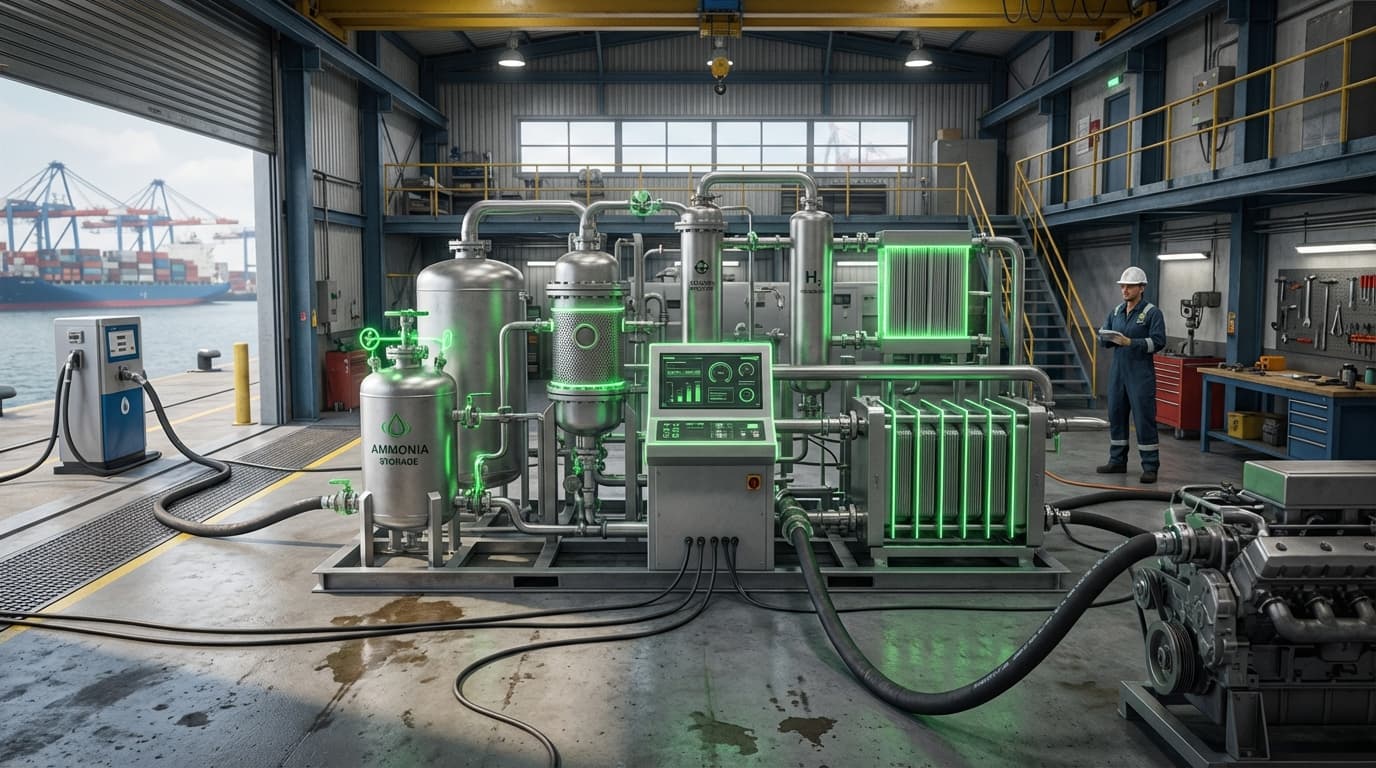
Ammonia as Energy Carrier
Ammonia has emerged as a promising solution to one of the most persistent challenges in the global energy transition: how to efficiently transport hydrogen across long distances and store it at scale. While hydrogen itself is difficult to move and store due to its low density and the need for extreme compression or cryogenic cooling, ammonia offers a more practical alternative. Composed of nitrogen and hydrogen, ammonia can be synthesized through the Haber-Bosch process using renewable electricity to split water into hydrogen and capture nitrogen from the air. This "green ammonia" contains no carbon and can be liquefied at relatively modest pressures, making it far easier to store and transport using existing infrastructure such as pipelines, tankers, and storage facilities originally designed for conventional ammonia. The energy density of liquid ammonia is significantly higher than that of compressed or liquefied hydrogen, enabling more economical shipping across oceans and continents.
The energy sector faces mounting pressure to decarbonize not only electricity generation but also hard-to-abate industries like shipping, where conventional batteries and direct electrification remain impractical. Ammonia addresses this challenge by serving dual roles: as both a hydrogen carrier that can be cracked back into pure hydrogen at the destination and as a direct fuel that combusts without producing carbon dioxide. Maritime shipping, responsible for approximately three percent of global emissions, has identified ammonia as one of the few viable pathways to zero-emission vessels capable of transoceanic voyages. The technology also enables countries rich in renewable energy resources but distant from major demand centers to participate in the global hydrogen economy, transforming stranded wind and solar potential into exportable energy commodities.
Several shipping companies and port authorities have already begun pilot programs to test ammonia-fueled vessels and bunkering infrastructure, with the first commercial ammonia-powered container ships expected to enter service within the next few years. Beyond maritime applications, power plants in regions like Japan and South Korea are exploring ammonia co-firing with natural gas as a transitional strategy toward carbon-free electricity generation, while research continues into improving ammonia fuel cells for distributed power applications. The International Energy Agency projects that ammonia could account for a substantial portion of international hydrogen trade by mid-century, particularly along routes connecting renewable-rich regions in Australia, the Middle East, and South America with energy-importing nations in Asia and Europe. As production costs decline and safety protocols mature, ammonia's role as an energy carrier positions it as a critical enabler of the global hydrogen economy, bridging the gap between renewable generation sites and end-use markets thousands of kilometers away.
Related Organizations

Develops compact ammonia-to-power systems that crack ammonia into hydrogen for use in fuel cells.

A global crop nutrition company and a provider of environmental solutions.

Global metals and green energy company developing massive green hydrogen and ammonia projects worldwide through its energy division.

Japan's largest power generator, actively testing ammonia co-firing in coal power plants.

Produces large-scale industrial heat pumps using CO2 and other refrigerants for district heating and process steam.

Japanese heavy industry and aero-engine manufacturer heavily investing in CMC R&D.

An integrated container logistics company working to connect and simplify its customers' supply chains.

Chemical engineering company providing solid oxide electrolyzers and synthesis technologies for e-fuels.

A company providing science, technology, and engineering solutions to governments and companies.

Major Japanese shipping company leading the MEGURI 2040 consortium to establish fully autonomous ship technologies.
Supporting Evidence
Research this in Signals
Signals turns a topic into a sourced research record you can inspect and rerun. Your first scan is free, and this one starts with Ammonia as Energy Carrier already loaded, so edit it or scan as is.