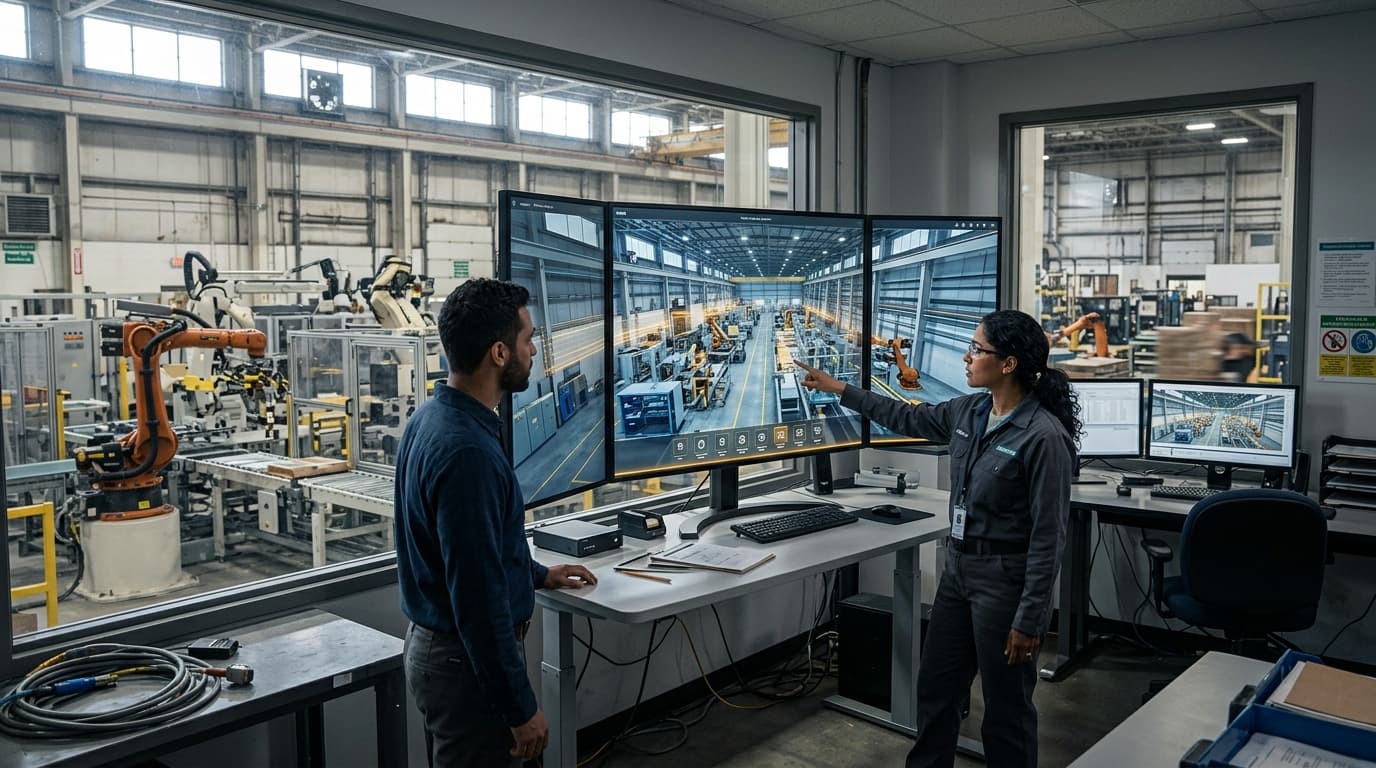
Industrial Digital Twins
Geography: Americas · North America · United States
Industrial digital twins are real-time, physics-based simulations of physical systems — factories, power plants, supply chains, cities — that mirror their real-world counterparts using live sensor data. NVIDIA's Omniverse platform enables photorealistic, physics-accurate simulation. Siemens, GE, and PTC provide industry-specific digital twin platforms. These systems can simulate 'what-if' scenarios: testing a new factory layout, predicting equipment failure, or optimizing energy usage.
Digital twins reduce the cost of experimentation from physical prototyping (expensive, slow, risky) to computational simulation (cheap, fast, reversible). A manufacturer can test 1,000 different production line configurations in simulation before implementing the best one. A utility can simulate how a grid responds to extreme weather before it occurs.
The convergence of AI, simulation, and IoT sensor data makes digital twins increasingly accurate and useful. US companies lead in the platform layer (NVIDIA, GE, PTC) while adoption is expanding across manufacturing, energy, defense, and urban planning. The technology is particularly valuable for complex systems where physical experimentation is dangerous or impossible.
Research this in Signals
Signals turns a topic into a sourced research record you can inspect and rerun. Your first scan is free, and this one starts with Industrial Digital Twins already loaded, so edit it or scan as is.