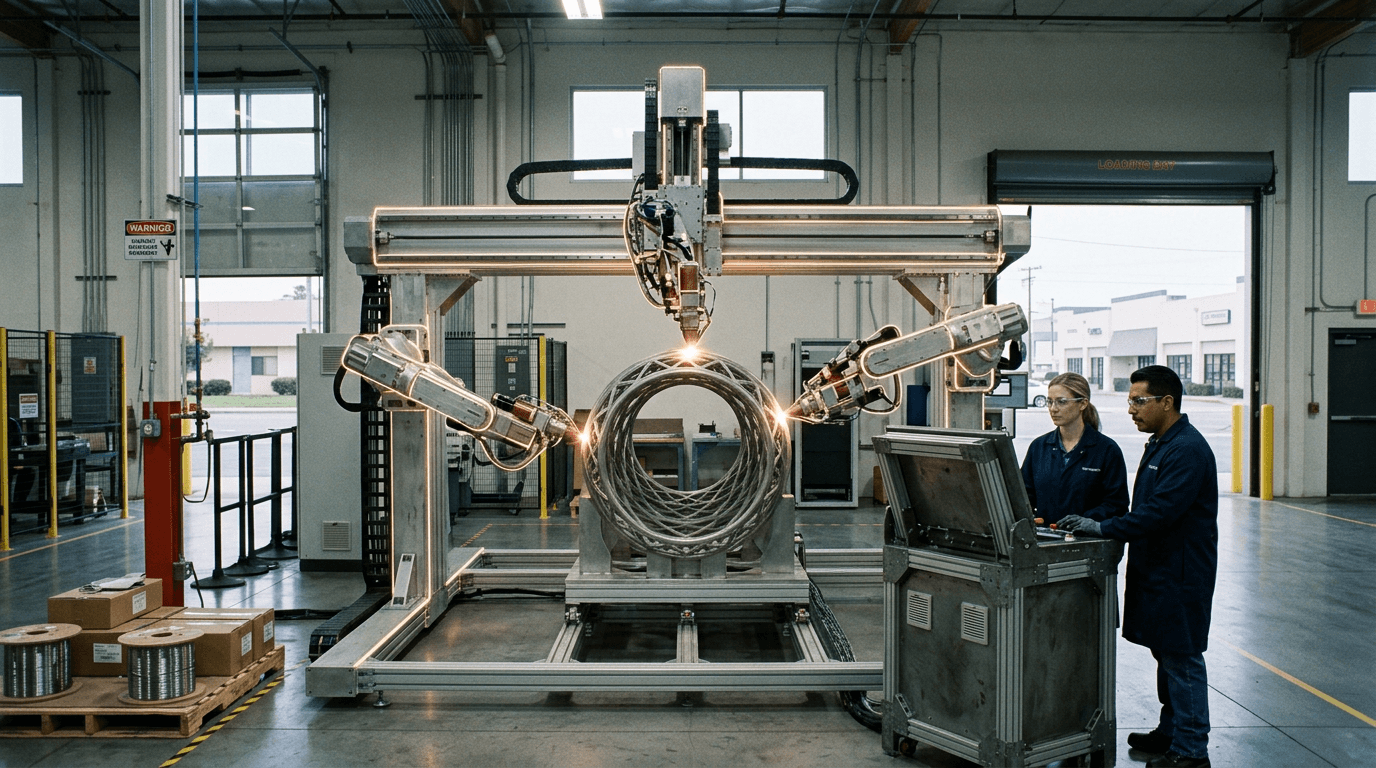
Industrial-Scale Metal Additive Manufacturing
Geography: Americas · North America · United States
Metal additive manufacturing (3D printing) has moved from prototyping to production of flight-critical aerospace components. Relativity Space's Stargate printer is the world's largest 3D metal printer, producing entire rocket stages. GE Aviation 3D-prints fuel nozzles for its LEAP jet engines — a part that previously required 20 separate components welded together is now printed as a single piece. Boeing and Lockheed Martin use metal AM for satellite brackets, missile components, and aircraft parts.
Metal AM enables geometries impossible with traditional machining: internal cooling channels, lattice structures for weight reduction, and topology-optimized shapes. It also dramatically reduces lead times — from months of tooling and machining to days of printing. For defense and space applications where production volumes are small and performance requirements extreme, AM is often superior to conventional manufacturing.
The US leads in metal AM through both technology providers (Desktop Metal, Velo3D, 3D Systems) and major adopters (GE, Boeing, Lockheed). The technology has strategic implications for defense supply chains: critical spare parts can be printed on-demand at forward operating bases or aboard ships, reducing the logistics tail that constrains military operations.
Research this in Signals
Signals turns a topic into a sourced research record you can inspect and rerun. Your first scan is free, and this one starts with Industrial-Scale Metal Additive Manufacturing already loaded, so edit it or scan as is.