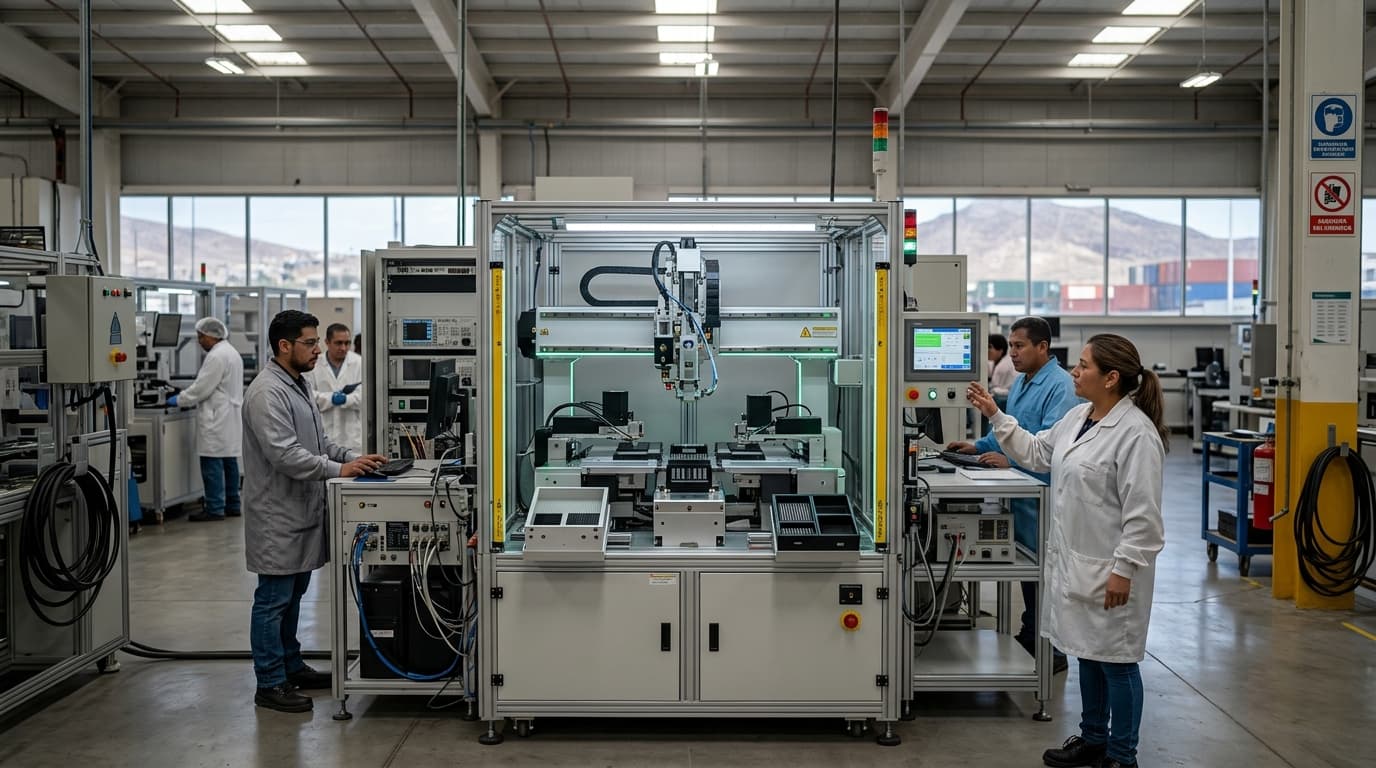
Semiconductor Back-End Packaging & Test
Geography: Americas · South America · Latin America
Mexico is positioning itself as a critical node in the global semiconductor supply chain, focusing on back-end assembly, testing, and packaging (ATP) rather than front-end fabrication. The Sheinbaum Administration's January 2025 presidential decree introduced incentives for companies nearshoring semiconductor operations, while Baja California's Semiconductor Master Plan — developed with CANIETI and the US Embassy — targets packaging facilities near the US border. Qualcomm, Skyworks, and Infineon already operate design and test facilities in the region.
The strategic logic is compelling: Mexico's semiconductor market reached $10.4 billion in 2024, projected to hit $18.4 billion by 2033. The broader electronics manufacturing services market is even larger — $53.2 billion in 2025, projected to reach $97.4 billion by 2031. Foxconn's $690 million investment includes an AI server facility partnered with Nvidia, blurring the line between chip assembly and AI infrastructure.
This is fundamentally about US-China decoupling. Washington's security-shoring agenda is redirecting semiconductor supply chains away from Asia, and Mexico — with USMCA trade advantages, geographic proximity, and an established electronics manufacturing base — is the primary beneficiary. The risk is that Trump-era tariff uncertainty could slow momentum, but the structural pull toward Western Hemisphere chip production is unlikely to reverse.
Research this in Signals
Signals turns a topic into a sourced research record you can inspect and rerun. Your first scan is free, and this one starts with Semiconductor Back-End Packaging & Test already loaded, so edit it or scan as is.