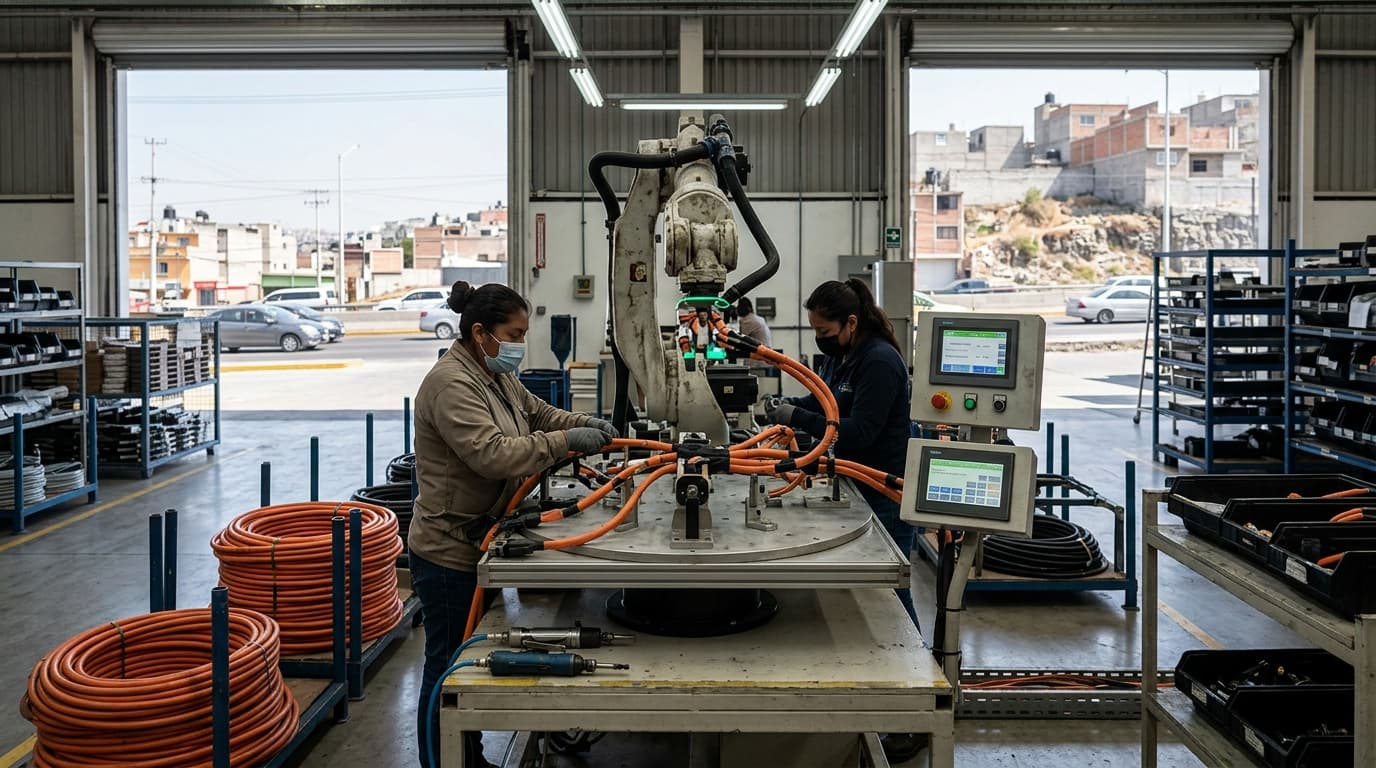
High-Voltage Automotive Wiring Systems
Geography: Americas · South America · Latin America
Mexico dominates global automotive wiring harness production — the complex nervous system of cables, connectors, and junction boxes that runs through every vehicle. This $20B+ industry is now undergoing a fundamental transformation as the shift to electric vehicles requires entirely new high-voltage (400V-800V) wiring architectures. EV harnesses use heavier gauge copper or aluminum conductors, advanced insulation materials rated for higher temperatures and voltages, and electromagnetic shielding to prevent interference with sensitive electronics.
The technical challenges are substantial: high-voltage connectors must maintain electrical integrity under vibration, thermal cycling, and crash forces; cable routing must separate high-voltage from low-voltage systems for safety; and assembly processes require new tooling and testing equipment to verify insulation integrity at production speed. Mexican manufacturers are investing in automated crimping, laser wire stripping, and in-line high-pot testing to meet these requirements.
The strategic position is reinforced by the fact that wiring harnesses are one of the few automotive components that cannot be easily automated — the complex 3D routing and manual connector insertion require human dexterity, making low-cost skilled labor essential. As every global automaker transitions to EVs, Mexico's existing harness manufacturing expertise gives it a structural advantage in capturing the higher-value EV harness segment.
Research this in Signals
Signals turns a topic into a sourced research record you can inspect and rerun. Your first scan is free, and this one starts with High-Voltage Automotive Wiring Systems already loaded, so edit it or scan as is.