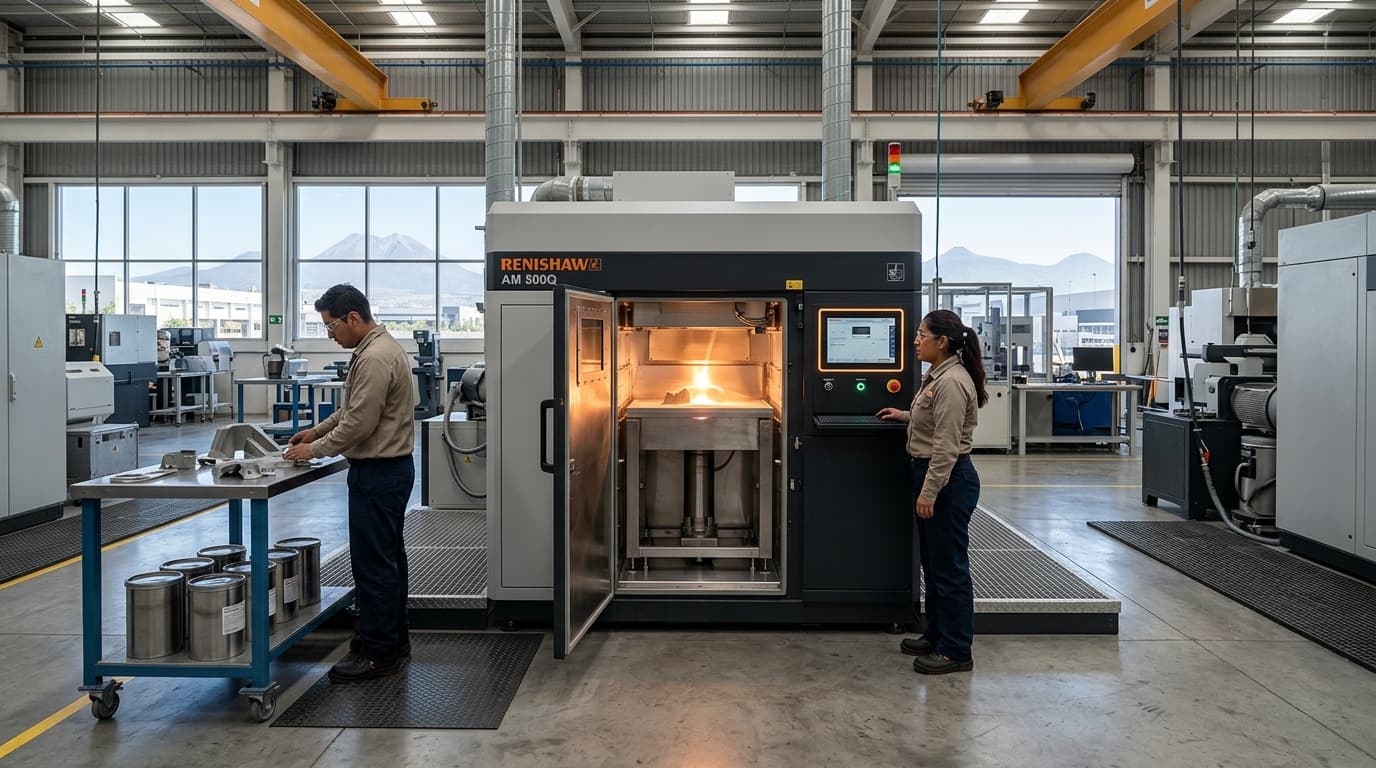
Industrial Additive Manufacturing for Auto Parts
Geography: Americas · South America · Latin America
Mexico's automotive supplier base — over 3,000 Tier 1 and Tier 2 companies — is adopting additive manufacturing (3D printing) for rapid prototyping, tooling, and increasingly for production of low-volume components. Metal powder bed fusion and directed energy deposition are used to produce complex geometries for EV-specific parts: cooling channels for battery thermal management, lightweight brackets, and custom tooling inserts that reduce injection mold lead times from weeks to days.
Research institutions including UNAM, Tec de Monterrey, and CIDESI (part of the former CONAHCYT ecosystem, now SECIHTI) are developing locally-adapted metal alloys and process parameters for aluminum, titanium, and Inconel printing. The research focus includes topology optimization algorithms that design parts for additive manufacturing from the ground up, and hybrid manufacturing processes that combine 3D printing with CNC machining for finished surfaces.
The strategic relevance is the transition from subtractive to additive manufacturing paradigms in Mexico's industrial base. As EVs require fewer but more complex components compared to ICE vehicles, additive manufacturing becomes a competitive necessity. Mexico's challenge is the capital cost of industrial metal printers ($500K-$2M per unit) and the limited domestic supply of certified metal powders, which must currently be imported.
Research this in Signals
Signals turns a topic into a sourced research record you can inspect and rerun. Your first scan is free, and this one starts with Industrial Additive Manufacturing for Auto Parts already loaded, so edit it or scan as is.