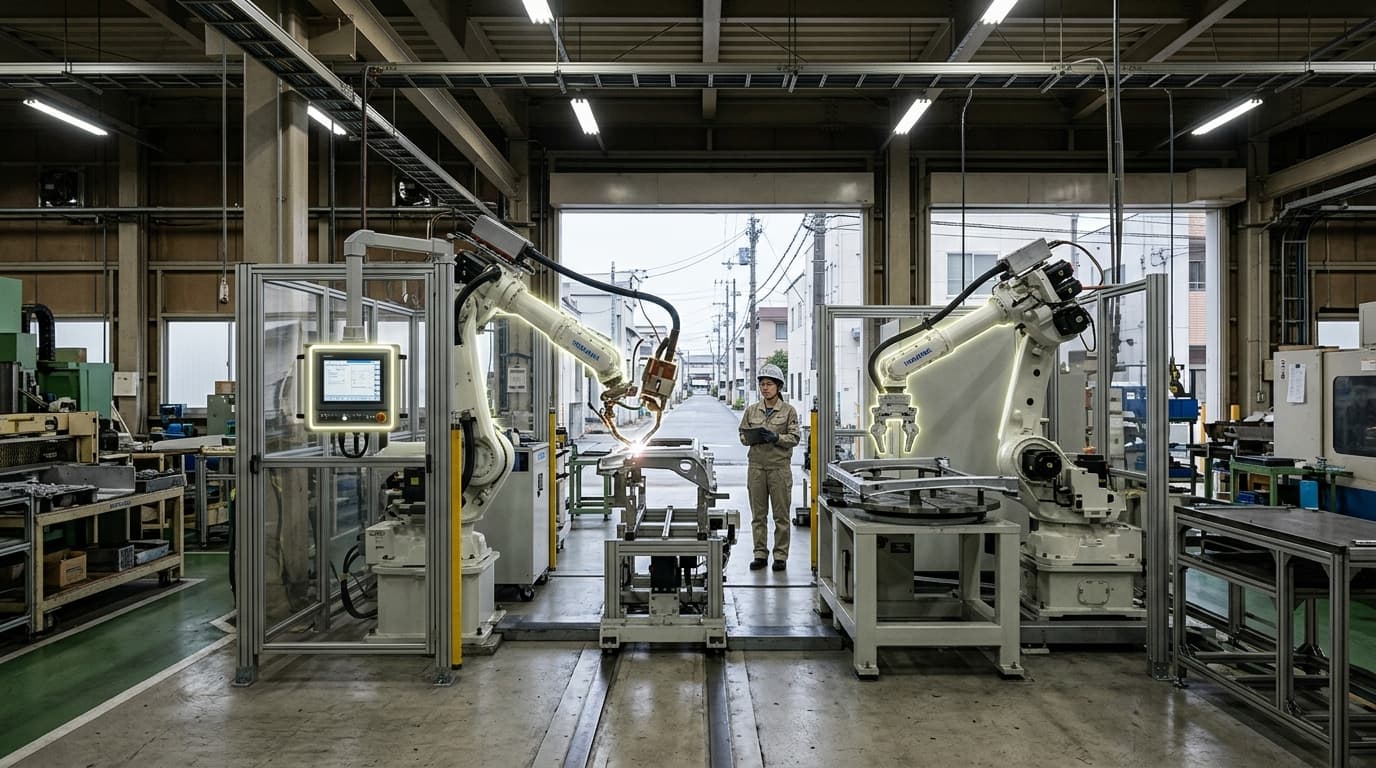
Industrial Robotics Automation
Geography: Asia Pacific · East Asia · Japan
Japan's industrial robotics ecosystem is the world's deepest, with Fanuc, Yaskawa Electric, Kawasaki Heavy Industries, and Nachi-Fujikoshi collectively controlling roughly 45% of global industrial robot production. Fanuc alone operates the world's largest robot factory in Oshino, producing 11,000 robots per month. At iREX 2025, these companies demonstrated AI-enhanced controls, with Yaskawa integrating NVIDIA Isaac AI for adaptive bin-picking and dual-arm coordination.
The significance extends beyond market share: Japanese industrial robots are the backbone of global manufacturing. Every major automotive, electronics, and aerospace factory worldwide relies on Japanese robotics for welding, painting, assembly, and materials handling. Japan's robot density is second only to South Korea, and the country's aging workforce creates sustained domestic demand that funds continued R&D.
Strategically, Japan's industrial robotics dominance is a durable competitive advantage that China is actively trying to erode through domestic champions like Siasun and JAKA. However, the precision, reliability, and decades of application knowledge embedded in Japanese systems remain difficult to replicate. The integration of AI and vision systems into existing platforms — rather than building from scratch — gives Japanese incumbents a natural upgrade path.
Research this in Signals
Signals turns a topic into a sourced research record you can inspect and rerun. Your first scan is free, and this one starts with Industrial Robotics Automation already loaded, so edit it or scan as is.