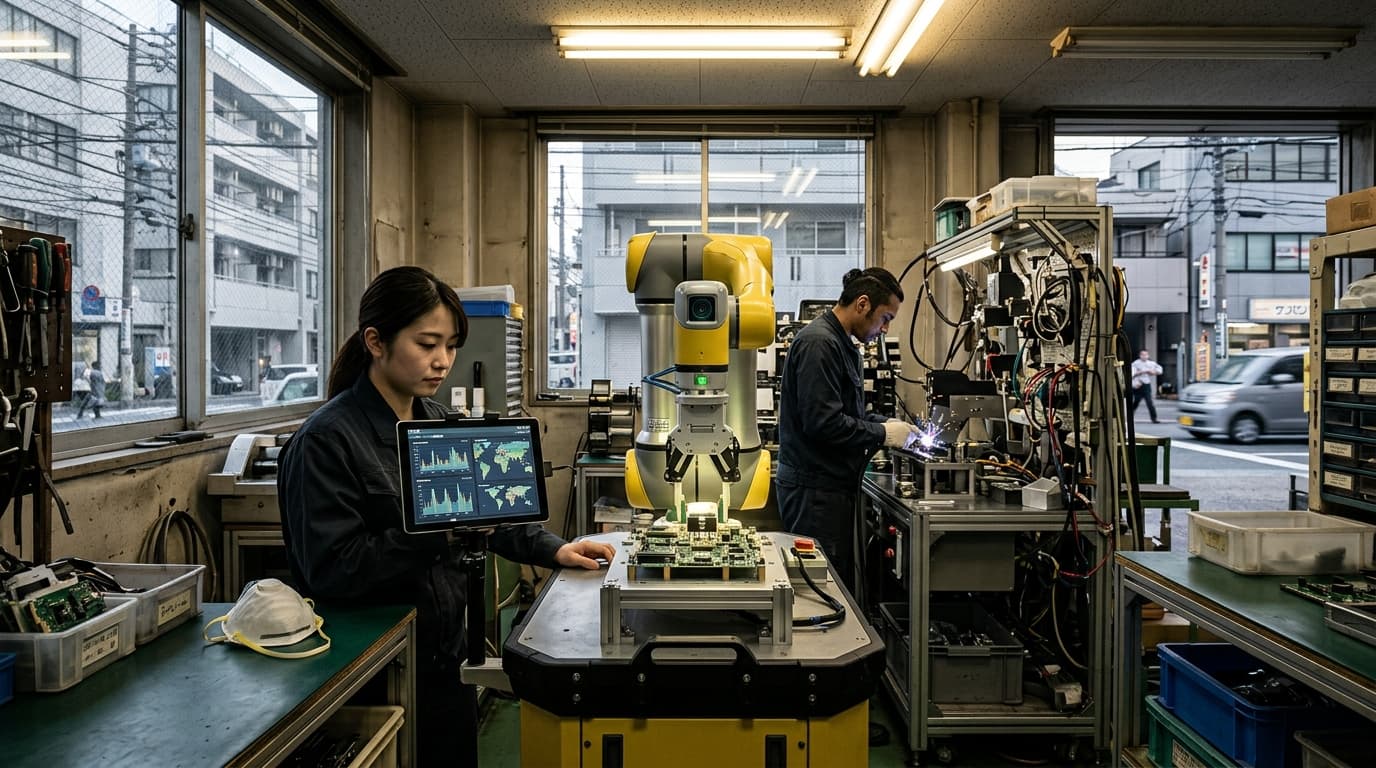
AI-Enhanced Collaborative Robots
Geography: Asia Pacific · East Asia · Japan
At iREX 2025, Yaskawa Electric and SoftBank exhibited a near-future office concept where collaborative robots work alongside humans, powered by AI perception and NVIDIA Isaac controls. Fanuc demonstrated AI-enhanced robotic guitar painting showcasing precision-adaptive collaboration. Japanese cobots are moving from pre-programmed repetition to perceptive, adaptive operation.
Japan's aging workforce and shrinking labor pool make cobots an existential technology — not a luxury but a necessity. With 29% of the population over 65 and a workforce declining by 500,000+ per year, human-robot collaboration in offices, logistics, and light manufacturing is becoming essential to maintaining economic output. METI actively funds cobot R&D through the New Energy and Industrial Technology Development Organization (NEDO).
The global cobot market is projected to reach $12 billion by 2030, and Japanese companies are well-positioned through existing relationships with automotive and electronics manufacturers. The key differentiator is safety engineering — Japanese cobots benefit from decades of industrial safety culture that makes regulators and customers more comfortable with human-robot proximity.
Research this in Signals
Signals turns a topic into a sourced research record you can inspect and rerun. Your first scan is free, and this one starts with AI-Enhanced Collaborative Robots already loaded, so edit it or scan as is.