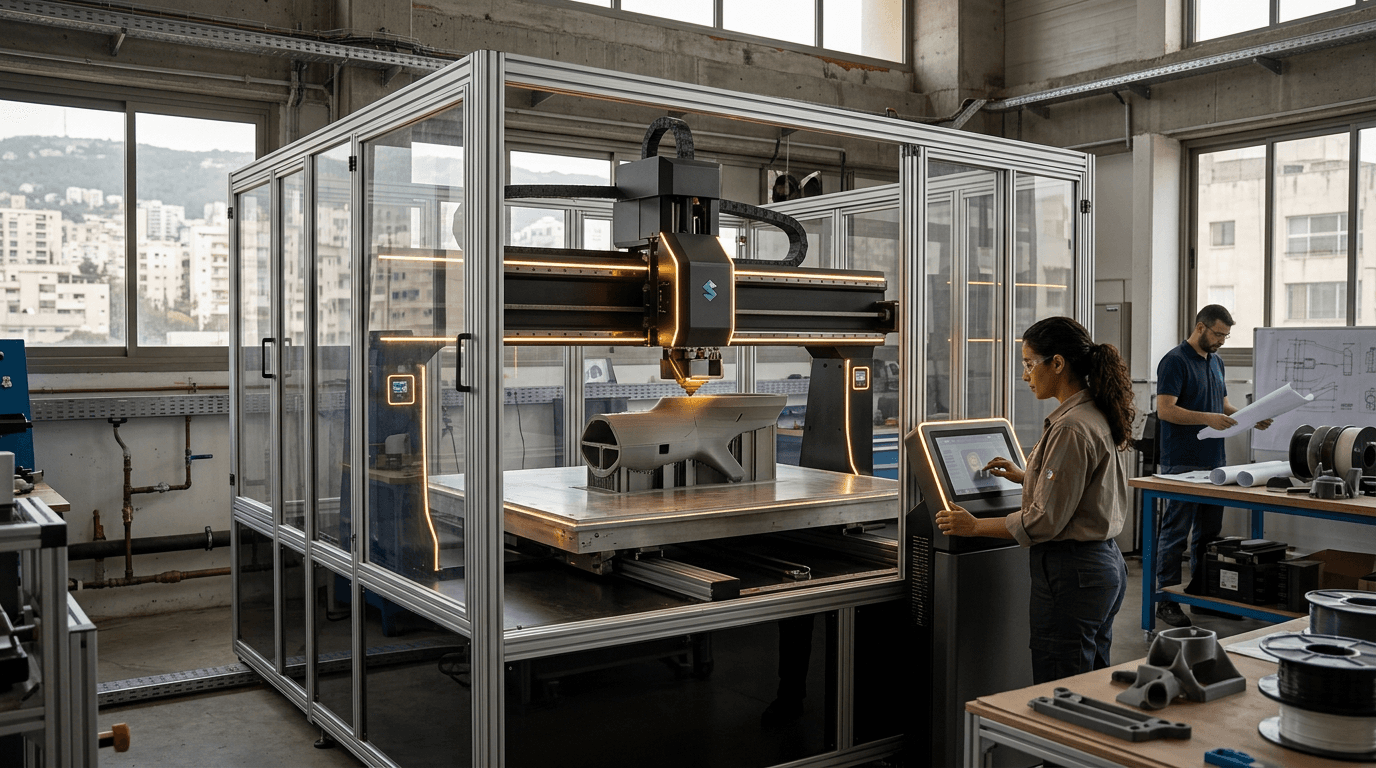
Industrial-Scale Additive Manufacturing Platforms
Geography: Emea · Middle East · Israel
Israel is home to Stratasys, one of the world's two largest additive manufacturing companies (co-headquartered in Rehovot), and Massivit 3D, which developed gel dispensing printing (GDP) technology for ultra-large parts. Stratasys invented fused deposition modeling (FDM) and PolyJet technologies, now used by defense contractors, aerospace manufacturers, and automotive OEMs for production-grade parts, rapid tooling, and certified flight components. The Israeli defense establishment uses additive manufacturing for producing drone components, missile parts, and field-expedient replacements.
The defense application is particularly significant: Israel's defense industry uses 3D printing to rapidly produce spare parts in theater, prototype new weapon system components, and manufacture geometrically complex structures (like conformal antenna housings and lightweight drone airframes) that cannot be produced through traditional subtractive methods. The ability to print replacement parts on-site reduces logistics chains — critical for a country that may face supply disruption during conflict.
Strategically, Israel's position as both a 3D printing technology originator (Stratasys) and an aggressive military adopter creates a feedback loop where defense requirements drive innovation in materials, resolution, and speed. Massivit's large-format technology addresses a different niche: printing molds, tooling, and structural components at scales up to 1.8 meters — enabling rapid production of boat hulls, vehicle panels, and architectural elements. The combination positions Israel as a full-spectrum additive manufacturing innovator.
Research this in Signals
Signals turns a topic into a sourced research record you can inspect and rerun. Your first scan is free, and this one starts with Industrial-Scale Additive Manufacturing Platforms already loaded, so edit it or scan as is.