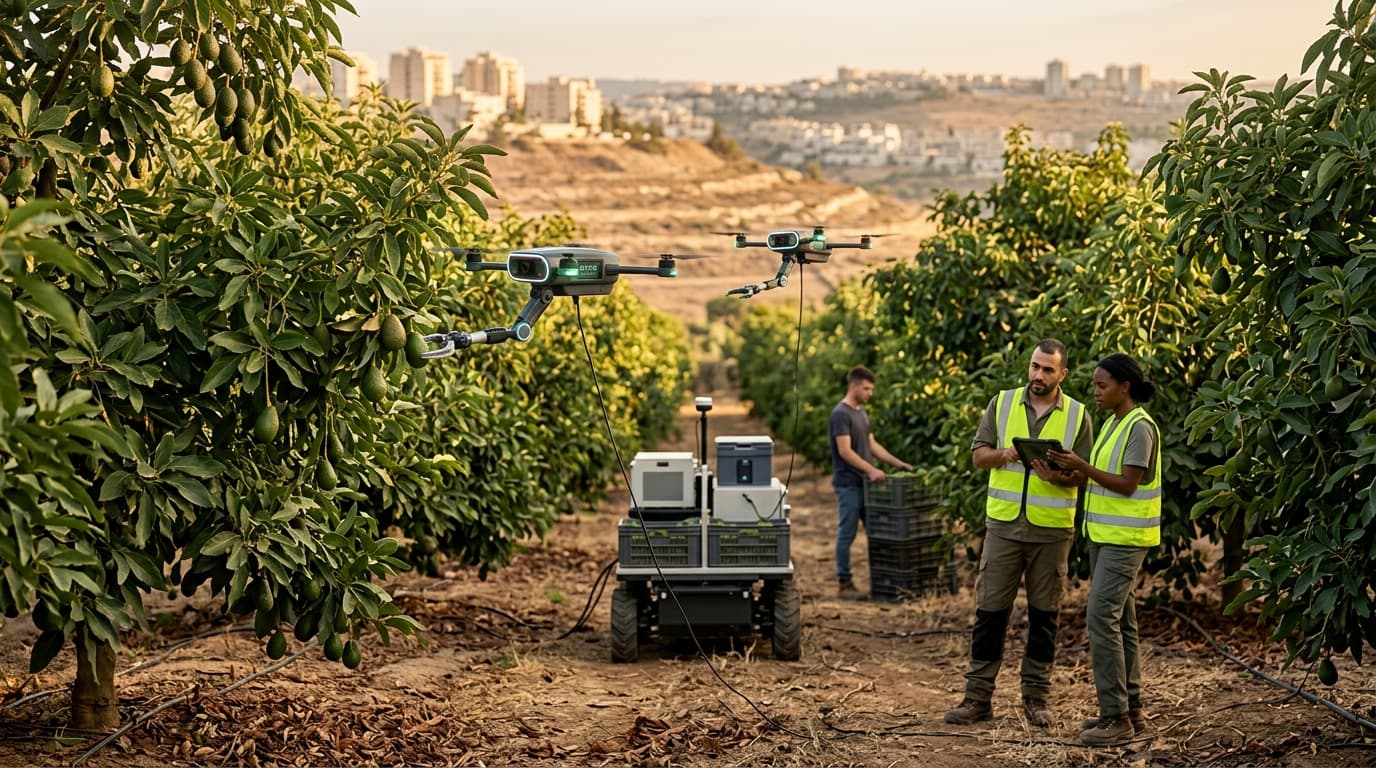
Flying Autonomous Fruit Harvesting Robots
Geography: Emea · Middle East · Israel
Tevel Aerobotics has developed a fundamentally novel approach to fruit harvesting: fleets of tethered flying autonomous robots (FARs) that navigate between trees, identify ripe fruit using computer vision, and pick it with robotic arms — all without bruising the produce. The drones are tethered for continuous power and can assess fruit ripeness, detect diseases in real-time, and perform selective harvesting that human pickers cannot match for consistency. The system is deployed commercially in Israel, Spain, and Chile across apple, stone fruit, and citrus orchards.
The technology merges three Israeli strengths: drone engineering (from the defense sector), computer vision (from the autonomous vehicle ecosystem), and agricultural innovation (from decades of constraint-driven farming). Flying robots solve a problem that ground-based harvesters cannot: they navigate the three-dimensional canopy of fruit trees without damaging branches or requiring tree architecture to be modified for machine access.
Strategically, autonomous harvesting addresses a $50 billion global fruit industry facing acute labor shortages — in many developed countries, 20-30% of fruit crops go unharvested due to insufficient seasonal labor. Tevel's pick-as-a-service model (charging per kilogram harvested) aligns grower incentives with technology adoption. The flying-robot paradigm, while initially counterintuitive, may prove more scalable than ground-based robotic arms for the irregular geometries of tree fruit production.
Research this in Signals
Signals turns a topic into a sourced research record you can inspect and rerun. Your first scan is free, and this one starts with Flying Autonomous Fruit Harvesting Robots already loaded, so edit it or scan as is.