Renewable-Powered Autonomous Robotic Manufacturing
Geography: Emea · Middle East · Gulf States
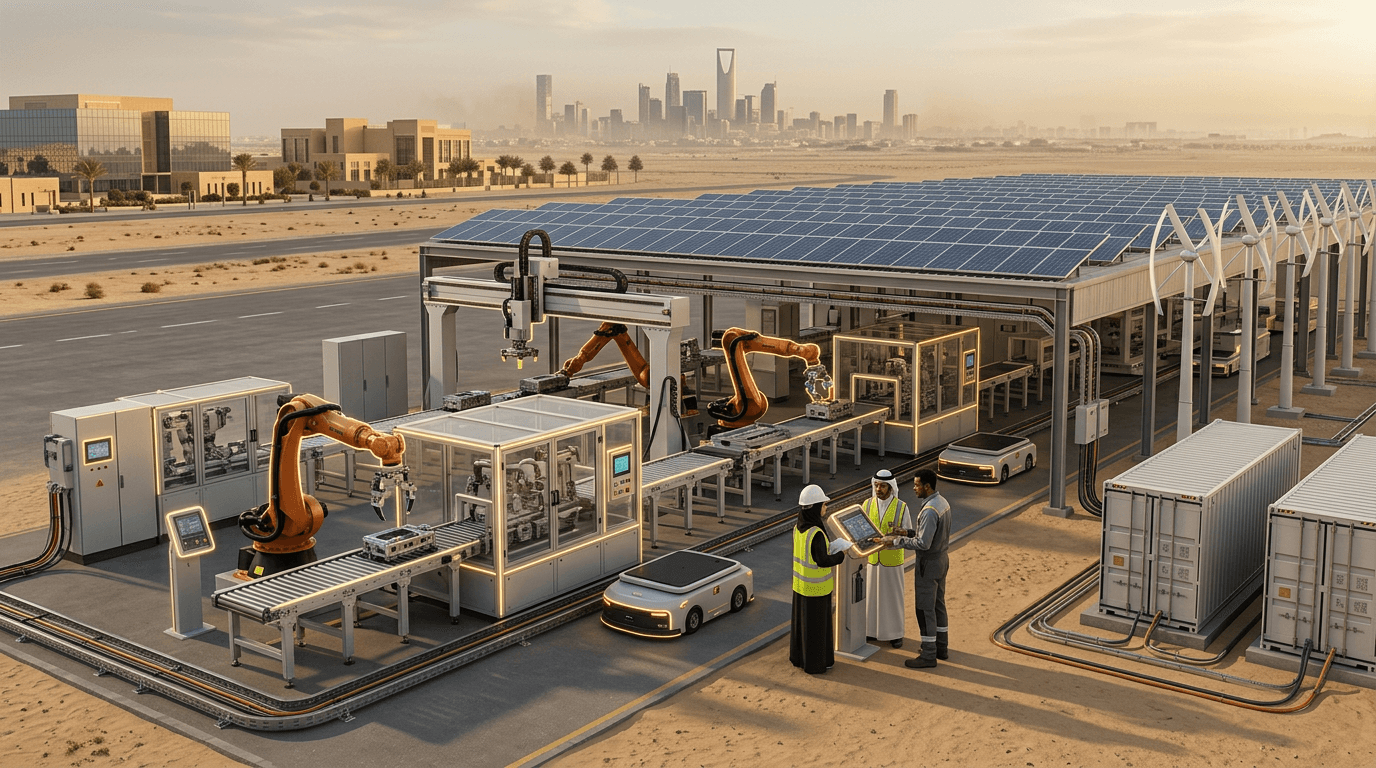
Saudi Arabia is building greenfield autonomous manufacturing facilities where the entire production chain — from raw material handling through assembly to quality inspection and packaging — is designed for robotic operation from day one rather than retrofitted onto existing human-operated lines. NEOM's industrial zone integrates collaborative robots, autonomous guided vehicles, AI-powered visual inspection systems, and digital twin monitoring into production lines powered entirely by on-site solar and wind generation. DataVolt and NEOM signed an agreement in February 2025 to develop the region's first net-zero AI factory campus, with Topian deploying autonomous robotic systems in climate-resilient greenhouse manufacturing.
Greenfield autonomous manufacturing is fundamentally different from automating existing factories. When production lines are designed for robots rather than adapted for them, the entire facility layout, material flow, quality control architecture, and energy system can be co-optimized. This eliminates the constraints that limit automation in legacy facilities — ceiling heights designed for human access, aisles sized for manual forklifts, inspection stations positioned for human eyes. The result is 30-50% higher space utilization, continuous 24/7 operation, and integrated energy management where renewable generation is matched to production scheduling.
The strategic significance is that countries building new industrial capacity can leapfrog the retrofitting costs that burden established manufacturing nations. By deploying autonomous systems from inception with renewable power, these facilities produce goods with both lower labour costs and lower carbon intensity than competitors in China, Germany, or the US who must amortize decades of legacy infrastructure. The technology stack — robotic arms, AGVs, machine vision, digital twins, renewable microgrids — exists individually but has never been integrated at factory scale on a greenfield basis.
Research this in Signals
Signals turns a topic into a sourced research record you can inspect and rerun. Your first scan is free, and this one starts with Renewable-Powered Autonomous Robotic Manufacturing already loaded, so edit it or scan as is.