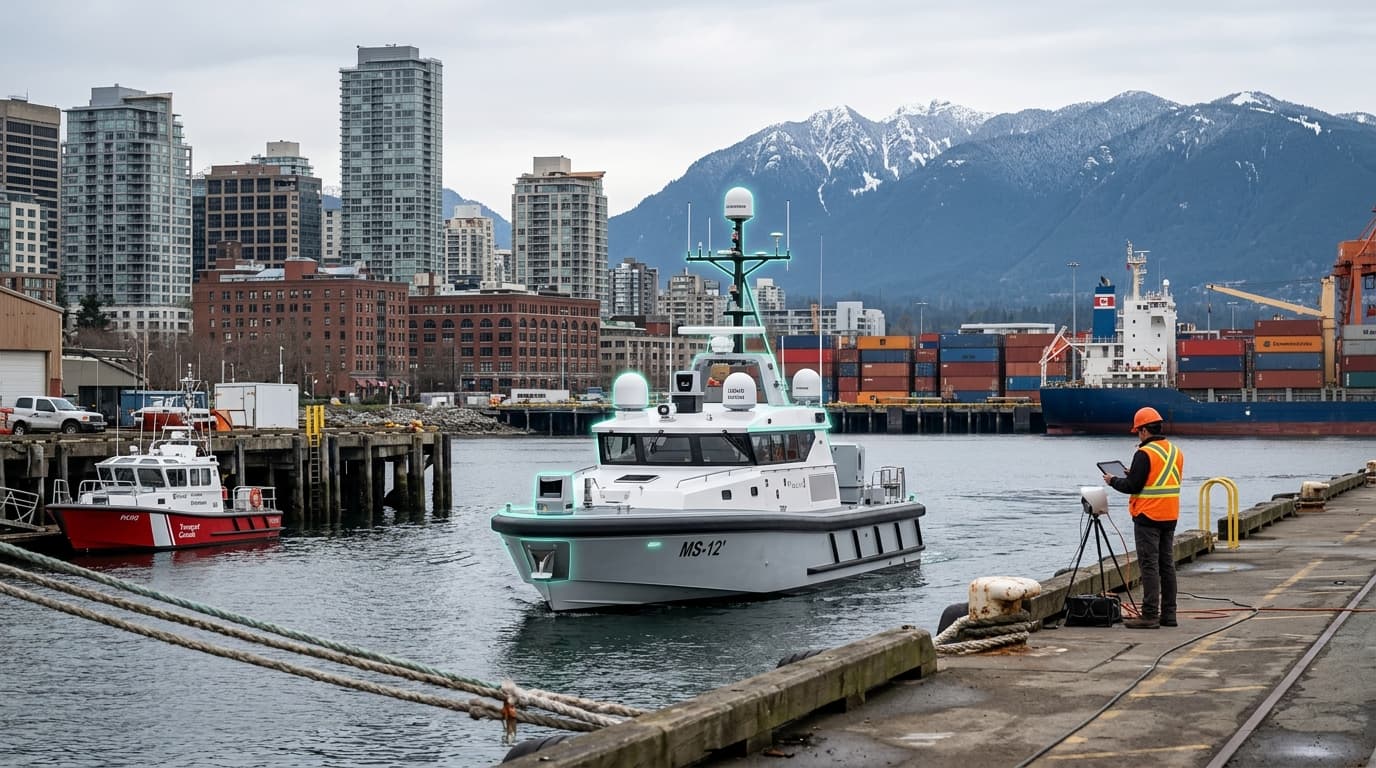
Maritime Autonomous Surface Ships (MASS)
Geography: Americas · North America · Canada
The National Research Council of Canada, working with Transport Canada's Innovation Centre, is advancing Maritime Autonomous Surface Ships (MASS) as a strategic national capability. MASS was identified as a key theme in the Government of Canada's Blue Economy Targeted Regulatory Review, resulting in a 2024 regulatory roadmap with 13 initiatives across five themes. NRC has developed sensor testbeds, a national MASS research strategy, and partnerships with facilities like The Launch (Memorial University), COVE, and COAST. Transport Canada published formal policy for small MASS operations in Canadian waters.
MASS matters because these are essentially sea-going drones capable of 24-hour surveillance, ocean mapping, hydrographic surveys, and defense applications — all without crew. Canada's expertise in AI, engineering, sensor systems, naval architecture, and machine learning, combined with the world's longest coastline and access to three oceans with diverse marine conditions, positions it uniquely for MASS development. The global MASS market is projected to reach US$12 billion by 2029.
The strategic angle is that MASS directly addresses Canada's coastline-to-navy ratio problem. With 243,042 km of coastline but a modest navy, autonomous vessels offer a force multiplier for maritime surveillance, especially in the Arctic. The regulatory framework being developed through the Blue Economy roadmap could become a reference standard internationally, as the IMO's own MASS code is expected to be ready for voluntary use by 2025. Canada's early regulatory work positions it to shape international rules rather than merely comply with them.
Research this in Signals
Signals turns a topic into a sourced research record you can inspect and rerun. Your first scan is free, and this one starts with Maritime Autonomous Surface Ships (MASS) already loaded, so edit it or scan as is.