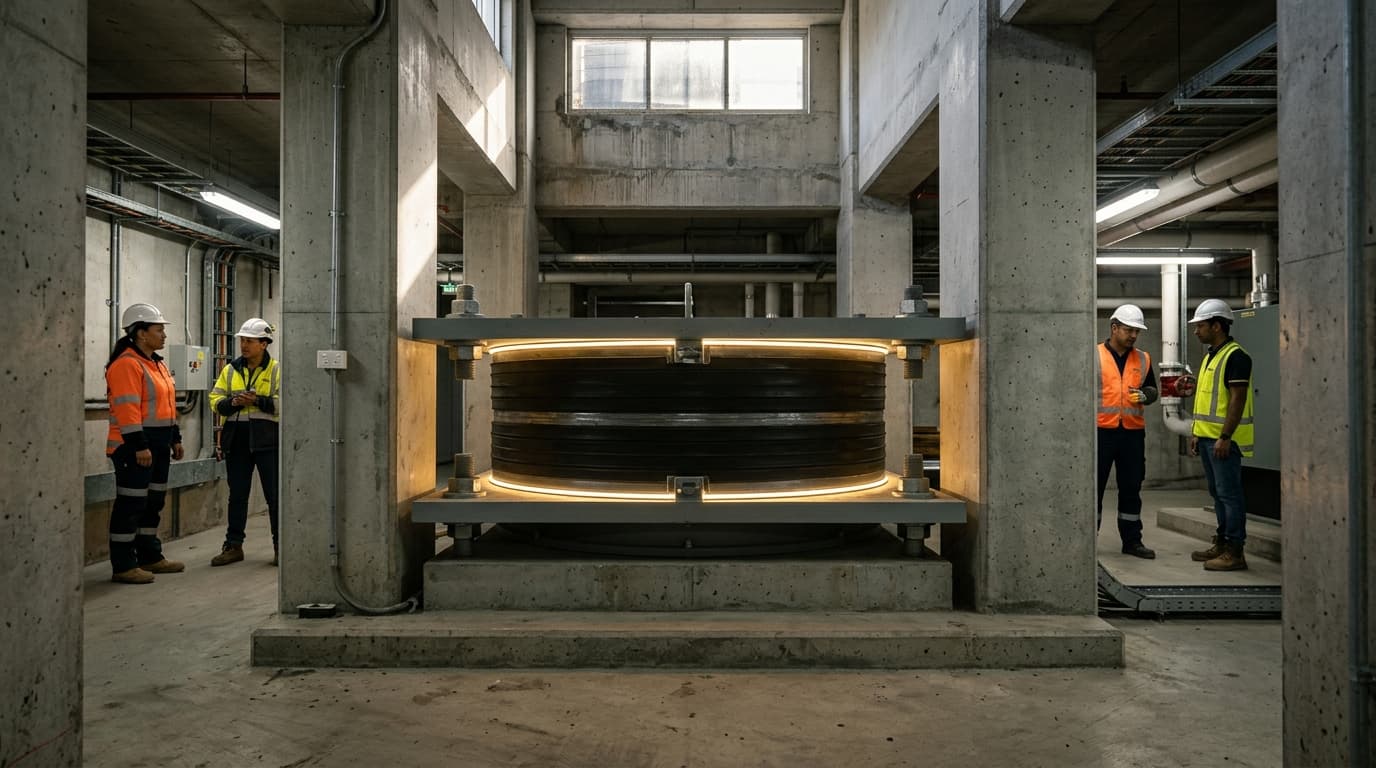
Lead-Rubber Bearing Seismic Base Isolation
Geography: Asia Pacific · Oceania · Australia New Zealand
New Zealand scientist Dr. Bill Robinson invented the lead-rubber bearing (LRB) in the 1970s — a deceptively simple device that decouples a building from the ground by sitting between the structure and its foundation. The lead core provides energy dissipation (absorbing up to 80% of earthquake energy) while the rubber layers allow lateral movement. Robinson Seismic, the NZ company that manufactures and licenses the technology, has deployed LRBs in critical infrastructure worldwide including Te Papa museum, NZ Parliament, hospitals, bridges, and nuclear facilities.
New Zealand's position on the Pacific Ring of Fire — with major earthquakes including the devastating 2010-11 Canterbury sequence — created the necessity that drove innovation. NZ's William Clayton Building (1981) was the world's first to use base isolation with LRBs, and the country has since pioneered new seismic isolation design guidelines published by NZSEE. In 2025, NZ researchers published on 3D seismic isolation for modular steel buildings, extending the technology to new construction methods. The first viaduct with base isolation was also built in New Zealand, inspiring global adoption.
The technology has been adopted in over 30 countries, with Japan alone installing base isolation in thousands of buildings after the 1995 Kobe earthquake. NZ-originated seismic engineering concepts — including capacity design, controlled rocking, and post-tensioned timber structures — represent a globally significant export of intellectual property. As climate change increases seismic risk awareness in previously low-seismicity regions, and as critical infrastructure (data centers, hospitals, chip fabs) requires guaranteed operational continuity, NZ's seismic isolation technology faces growing global demand.
Research this in Signals
Signals turns a topic into a sourced research record you can inspect and rerun. Your first scan is free, and this one starts with Lead-Rubber Bearing Seismic Base Isolation already loaded, so edit it or scan as is.