Social Service Robots
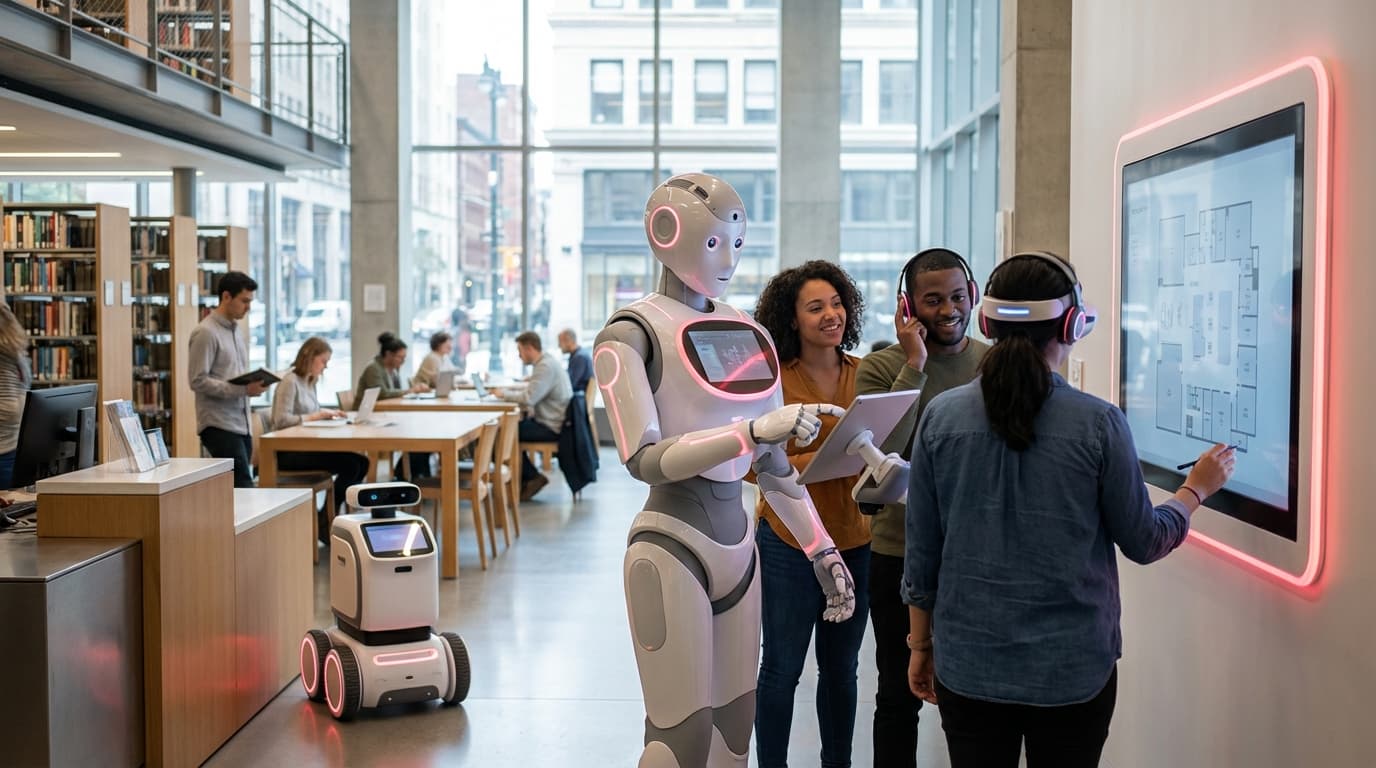
Social service robots represent a convergence of robotics, artificial intelligence, and human-centered design, creating autonomous machines capable of meaningful interaction within public spaces like libraries, museums, and community centers. These humanoid or semi-humanoid platforms integrate advanced sensor arrays—including cameras, LIDAR, and proximity detectors—with natural language processing systems and mobility frameworks that enable them to navigate complex indoor environments safely. The underlying architecture typically combines computer vision for spatial awareness, speech recognition for multilingual communication, and machine learning models that allow the robots to recognize repeat visitors, remember preferences, and adapt their interaction styles based on user demographics and needs. Unlike industrial robots designed for repetitive tasks, social service robots prioritize approachable aesthetics, expressive interfaces through screens or LED displays, and gesture-based communication that makes technology feel less intimidating to diverse user populations.
The fundamental challenge these robots address is the growing gap between public service demand and available human resources, particularly in institutions like libraries that serve increasingly diverse communities with limited staffing budgets. Traditional service models struggle to provide consistent multilingual support, extended hours assistance, and the patience required for repetitive wayfinding queries that consume significant staff time. Social service robots solve these constraints by handling high-volume, routine interactions—directing visitors to specific sections, explaining basic procedures, or providing information in dozens of languages—thereby freeing human staff to focus on complex reference work, program development, and personalized patron relationships that require empathy and expertise. This technology also creates new engagement models for populations that may face barriers to traditional services, such as children who find robot interactions less intimidating than approaching adult staff, or elderly patrons who benefit from patient, non-judgmental assistance with technology navigation.
Early deployments in libraries across North America, Europe, and Asia indicate promising adoption patterns, with institutions reporting that these robots handle thousands of basic interactions monthly while generating positive community response, particularly among younger demographics. Research suggests that social service robots prove most effective when positioned as staff augmentation rather than replacement, with successful implementations clearly communicating the robots' capabilities and limitations to manage user expectations. Current applications extend beyond simple wayfinding to include storytelling sessions for children, guided tours of special collections, and accessibility support such as escorting visually impaired patrons through facilities. As natural language processing continues to advance and costs decline, industry analysts note that these systems will likely become standard infrastructure in public institutions, evolving toward more sophisticated roles in community engagement, digital literacy instruction, and bridging language barriers in increasingly multicultural urban environments. The trajectory points toward hybrid service models where human expertise and robotic consistency create more resilient, accessible, and inclusive public knowledge spaces.
Related Organizations

Manufacturer of NAO, the standard humanoid robot platform used in the vast majority of academic research regarding autism and robotics.

Creators of a social robotics platform featuring a back-projected face capable of advanced conversational AI and social cues.

A leading integrator that deploys and programs robots (like Pepper and Nao) specifically for education and library contexts.

German research institute actively developing exoskeleton test beds and evaluating human-machine interaction.

Develops the TIAGo (Take It And Go) mobile manipulator, widely used in research and light industrial applications.

Designers of the Ameca and RoboThespian robots, used primarily for entertainment and interaction in science centers and museums.

Manufacturer of autonomous service robots for business, capable of recognizing faces and answering questions in museums and centers.

A global leader in AI and humanoid robotics, producing the JIMU Robot kits for education.

Creator of ElliQ, an AI care companion robot for older adults.

Creators of Sophia, focusing on high-fidelity facial expressions and AI for deep social engagement.
Supporting Evidence
Research this in Signals
Signals turns a topic into a sourced research record you can inspect and rerun. Your first scan is free, and this one starts with Social Service Robots already loaded, so edit it or scan as is.