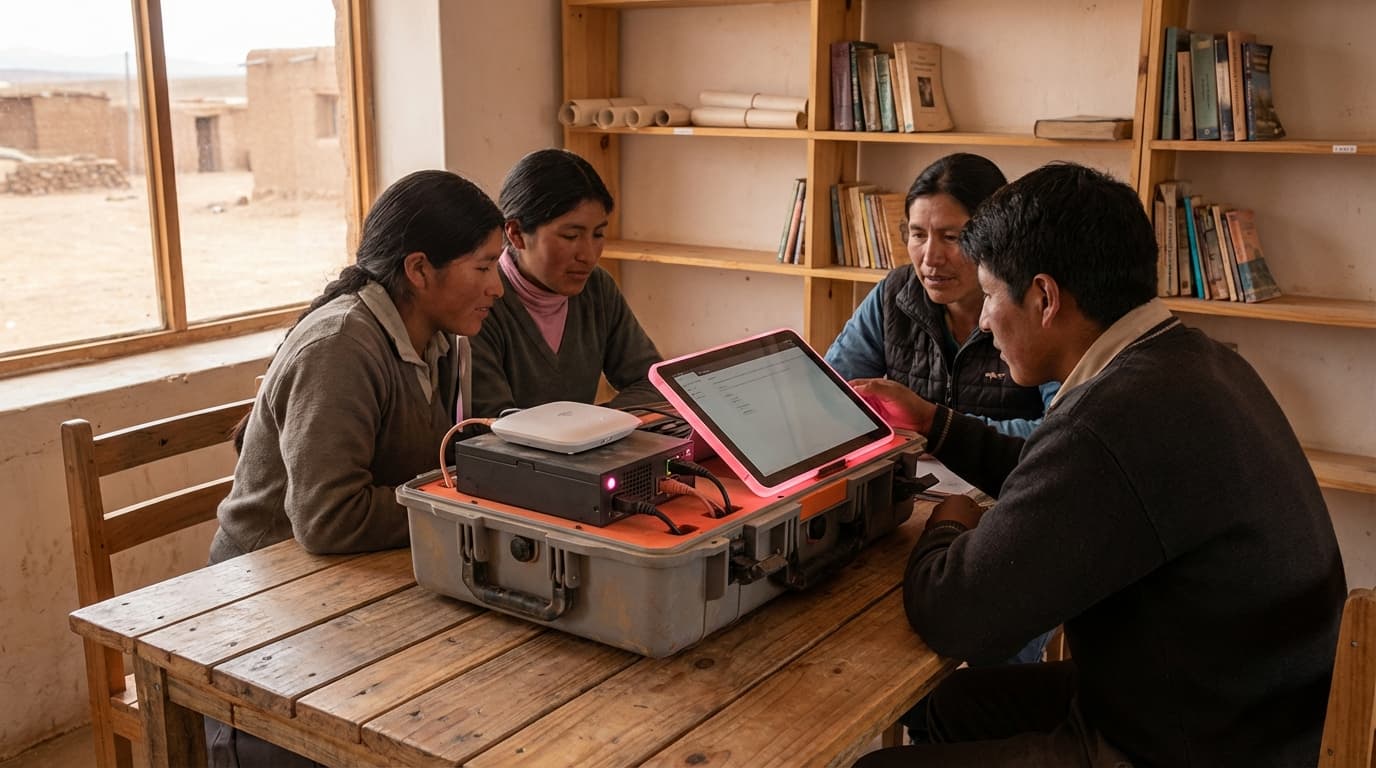
Offline-First Infrastructure Kits
Offline-First Infrastructure Kits represent a fundamental rethinking of how digital knowledge systems can function in environments where conventional assumptions about connectivity and power availability do not hold. These modular hardware bundles integrate solar power generation, local mesh networking equipment, edge computing servers, and ruggedized storage devices into cohesive systems designed to operate independently of external infrastructure. The technical architecture typically centers on low-power ARM-based servers that can run on solar energy harvested during daylight hours and stored in battery banks for continuous operation. Local mesh networks, often built using WiFi protocols adapted for longer-range, lower-bandwidth communication, create connectivity bubbles that allow devices within a community to communicate without requiring internet access. The storage components employ solid-state drives chosen for their resistance to heat, humidity, and physical shock—critical considerations in regions where climate control and stable operating environments cannot be guaranteed. This approach fundamentally decouples digital services from the assumption of always-on connectivity that characterizes most modern technology infrastructure.
The challenge these systems address is particularly acute for libraries, universities, research institutions, and community centers in the Global South, where unreliable electricity grids and prohibitively expensive or unavailable internet connectivity have historically created barriers to participating in the digital knowledge economy. Traditional cloud-based solutions and centralized digital repositories assume constant connectivity, rendering them effectively useless during the frequent power outages or network failures that characterize many developing regions. Offline-First Infrastructure Kits enable these institutions to host their own digital collections—including digitized archives, educational resources, medical information, and agricultural data—locally, where they can be accessed by community members regardless of external network conditions. This model also addresses concerns about digital sovereignty and cultural preservation, allowing communities to maintain control over their own knowledge resources rather than depending on external platforms that may be subject to censorship, service interruptions, or business model changes that could eliminate access entirely.
Pilot deployments have emerged across sub-Saharan Africa, rural India, and remote Pacific island communities, where organizations are using these systems to provide everything from offline Wikipedia access to locally-hosted digital libraries and telemedicine consultation databases. Research institutions are exploring how these kits can support field research stations that need to collect and process data in locations far from reliable infrastructure. The broader trajectory points toward a more distributed model of digital knowledge infrastructure that acknowledges the reality that billions of people live in contexts where the always-connected paradigm of mainstream technology simply does not apply. As climate change increases the frequency of infrastructure disruptions even in developed nations, the resilience principles embodied in offline-first design may offer lessons for creating more robust digital systems everywhere.
Related Organizations

A community project that consolidates the world's essential knowledge onto a cheap storage device for offline use.

Creators of RACHEL (Remote Area Community Hotspot for Education and Learning), a portable server for offline content.

A Kenyan technology company that builds rugged modems and the 'Kio Kit', a digital classroom in a box.

An offline reader that allows people to download and browse Wikipedia and other content without internet.

Develops an operating system designed for offline use, pre-loaded with educational content.

Developers of Kolibri, an ecosystem of open-source educational products designed for offline-first learning.

An open-source project providing off-grid mesh communication using LoRa radios, increasingly used for decentralized data relay.

Develops mobile mesh networking hardware and protocols that enable off-grid communication and transaction relaying.

Developers of the Commotion Wireless project, a tool for building community mesh networks.

A UK charity that works to put the power of computing and digital making into the hands of people all over the world.
Supporting Evidence
Research this in Signals
Signals turns a topic into a sourced research record you can inspect and rerun. Your first scan is free, and this one starts with Offline-First Infrastructure Kits already loaded, so edit it or scan as is.