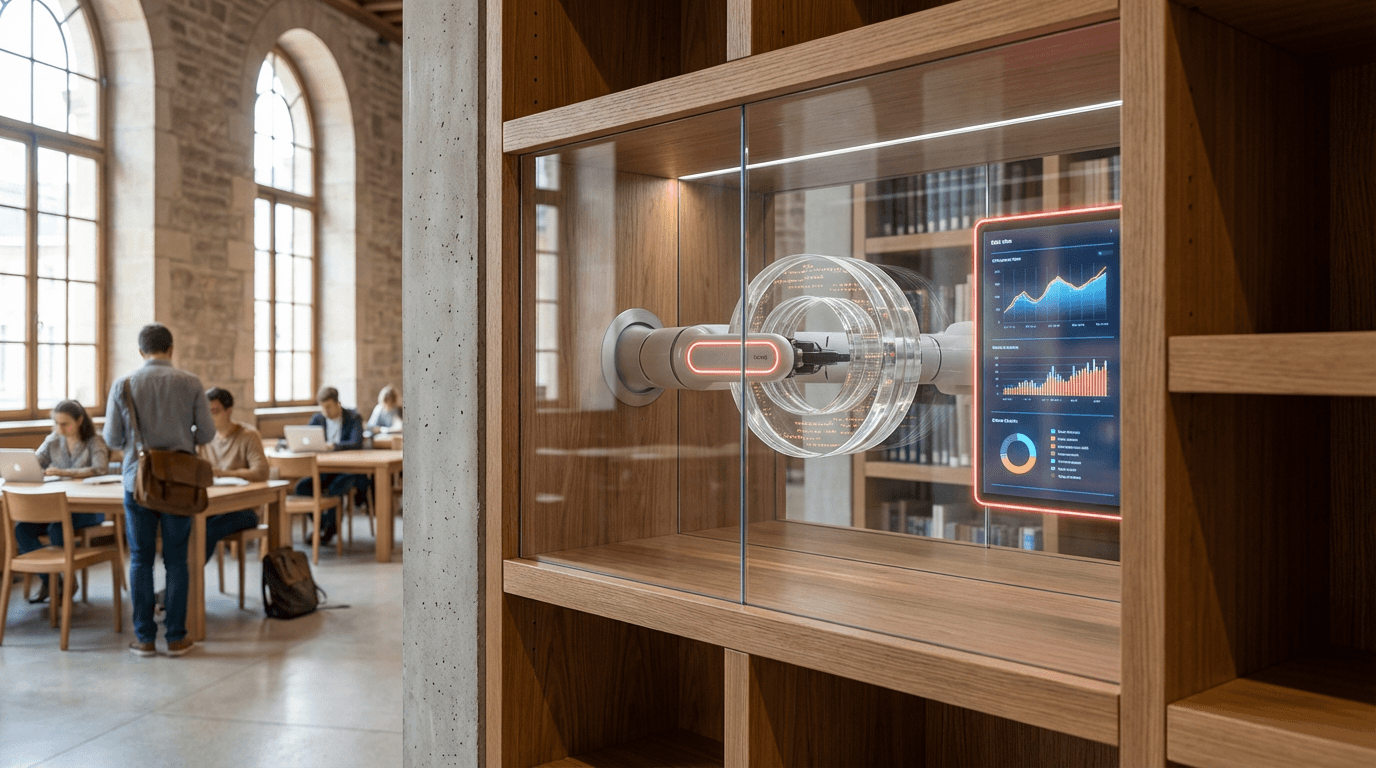
5D Optical Memory
5D optical memory represents a revolutionary approach to data storage that addresses one of the most fundamental challenges facing libraries, archives, and knowledge institutions: the preservation of information across vast timescales. Unlike conventional storage media that degrade within decades or centuries, this technology employs femtosecond laser pulses to create nanoscale structures within fused quartz glass, encoding information across five distinct dimensions: the three spatial coordinates plus two optical properties—the size and orientation of each nanostructure. These microscopic modifications to the glass matrix create stable physical changes that can theoretically persist for billions of years, far exceeding the lifespan of magnetic tapes, optical discs, or even carefully preserved paper documents. The writing process involves focusing ultra-short laser pulses into the glass substrate, creating self-assembled nanostructures through a process called nanograting formation, where the intense energy creates permanent structural alterations at the focal point without damaging surrounding material.
For cultural heritage institutions, research archives, and governmental repositories, the deterioration of storage media poses an existential threat to collective memory. Traditional digital storage requires constant migration to new formats and media as technologies evolve and physical substrates degrade, creating an endless cycle of resource-intensive preservation work. 5D optical memory fundamentally disrupts this paradigm by offering storage that can withstand temperatures up to 1,000 degrees Celsius, survive direct impact, and remain stable without any environmental controls or maintenance. This capability addresses the critical problem of ensuring that essential knowledge—from scientific discoveries to cultural records—survives not just institutional changes or technological shifts, but potentially catastrophic events that could threaten human civilization itself. The technology enables a "write once, read forever" model that eliminates the ongoing costs and risks associated with active digital preservation strategies.
Research institutions and national archives have begun exploring 5D optical memory for preserving humanity's most critical knowledge. Early implementations have successfully stored foundational texts, scientific databases, and cultural records in glass discs capable of holding hundreds of terabytes of information in a form readable by future civilizations equipped with basic optical microscopy. The technology has been demonstrated in proof-of-concept projects aimed at creating time capsules of human knowledge, with some organizations considering it for preserving genomic databases, mathematical proofs, and historical records that must remain accessible across geological timescales. As concerns about digital preservation grow alongside expanding data volumes, this approach represents a convergence of archival science and materials engineering, offering institutions a pathway to create truly permanent records that could outlast not only current storage technologies but potentially human civilization itself, ensuring that critical knowledge remains recoverable by whatever intelligent beings might seek it in the distant future.
Related Organizations


A world-leading institute for photonics research.

An initiative to preserve the world's music heritage in the Arctic.


Developing ceramic-based data storage for long-term preservation.


Nonprofit dedicated to archiving human knowledge for billions of years.



A French technology research institute focusing on micro- and nanotechnologies.
Supporting Evidence
Research this in Signals
Signals turns a topic into a sourced research record you can inspect and rerun. Your first scan is free, and this one starts with 5D Optical Memory already loaded, so edit it or scan as is.