Envisioning is an emerging technology research institute and advisory.

LinkedInInstagramGitHub

2011 — 2026

research
  • Reports
  • Newsletter
  • Methodology
  • Origins
  • Vocab
services
  • Research Sessions
  • Signals Workspace
  • Bespoke Projects
  • Use Cases
  • Signal Scanfree
  • Readinessfree
impact
  • ANBIMAFuture of Brazilian Capital Markets
  • IEEECharting the Energy Transition
  • Horizon 2045Future of Human and Planetary Security
  • WKOTechnology Scanning for Austria
audiences
  • Innovation
  • Strategy
  • Consultants
  • Foresight
  • Associations
  • Governments
resources
  • Pricing
  • Partners
  • How We Work
  • Data Visualization
  • Multi-Model Method
  • FAQ
  • Security & Privacy
about
  • Manifesto
  • Community
  • Events
  • Support
  • Contact
  • Login
ResearchServicesPricingPartnersAbout
  1. Home
  2. Research
  3. Cities
  4. Machine Vision Recycling System

Machine Vision Recycling System

AI-powered cameras that identify and sort recyclable materials in waste streams
Back to CitiesView interactive version

Traditional recycling methods often suffer from inefficiencies, contamination, and high operational costs. The introduction of Machine Vision Recycling Systems (MVRS) offers a transformative solution to these problems, heralding a new era in urban waste management.

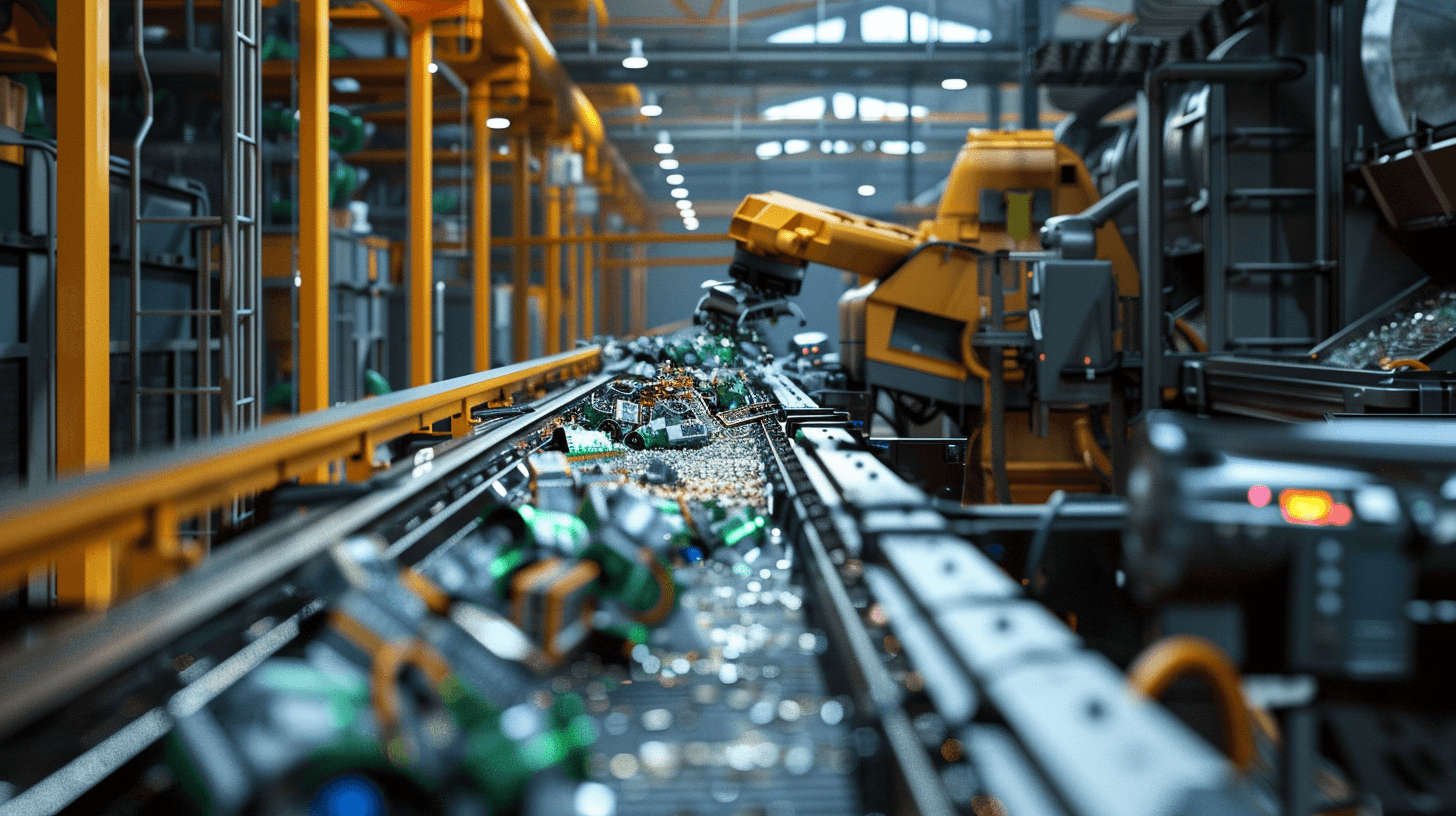
A machine vision recycling system utilises computer vision to identify and sort recyclable materials. This system operates through high-resolution cameras and sophisticated algorithms that can distinguish between different types of waste with remarkable accuracy. As waste moves along a conveyor belt, the machine vision system scans and categorises each item, directing it into the appropriate recycling stream. This process significantly reduces contamination and increases the purity of recyclable materials, enhancing the overall efficiency of recycling operations.

By automating the sorting process, MVRS reduces the reliance on manual labour, which is often prone to errors, accidents and inefficiencies. It also enables cities to handle larger volumes of waste without proportionally increasing costs or resource use. Moreover, the precision of machine vision ensures that more materials are correctly recycled, thereby reducing the environmental impact of waste and promoting sustainable urban living.

Another critical aspect of machine vision recycling systems is their adaptability. These systems can be programmed to recognise a wide variety of materials, from plastics and metals to paper and glass, making them versatile and highly effective. Additionally, continuous improvements in AI and machine learning mean that these systems can evolve and become more efficient over time, further enhancing their contribution to urban sustainability.

Technology Readiness Level
6/9Prototype Testing
Diffusion of Innovation
3/5Early Majority
Technology Life Cycle
2/4Growth
Category
Hardware

Related Organizations

AMP logo
AMP

United States · Startup

98%

Applies AI and robotics to modernize recycling infrastructure.

Developer
TOMRA logo

TOMRA

Norway · Company

95%

Provides sensor-based sorting solutions for the food, recycling, and mining industries.

Developer
ZenRobotics

Finland · Company

95%

A supplier of AI-based robotic waste sorting systems, now part of Terex.

Developer
Greyparrot logo
Greyparrot

United Kingdom · Startup

92%

Provides AI waste analytics to monitor and audit waste flows.

Developer
Recycleye

United Kingdom · Startup

92%

Brings advanced machine learning, computer vision, and robotics to the waste management industry.

Developer
EverestLabs

United States · Startup

90%

Develops RecycleOS, an AI operating system for recycling plants.

Developer
Pellenc ST

France · Company

90%

Manufacturer of intelligent optical sorting equipment for waste treatment.

Developer

CleanRobotics

United States · Startup

88%

Creator of TrashBot, a smart waste bin that uses AI and computer vision to sort waste at the point of disposal.

Developer
Bin-e

Poland · Startup

85%

An IoT smart waste bin that automatically recognizes, sorts, and compresses waste using AI-based object recognition.

Developer

Supporting Evidence

News

More efficient recycling with AI: Joint project develops automated sorting solution for bulky waste

DFKI (German Research Center for Artificial Intelligence) · Jun 15, 2025

The SmartRecycling-Up project, led by DFKI, has developed an AI-based concept that automates the sorting of bulky and construction waste using cranes and intelligent sensors, successfully tested at the ASO GmbH facility.

Support 90%Confidence 95%

Article

More efficient recycling with AI: Joint project develops automated sorting solution for bulky waste

DFKI (German Research Center for Artificial Intelligence) · Jun 15, 2025

The SmartRecycling-Up project, led by DFKI, developed an AI-based concept that automates the sorting of bulky and construction waste using cranes or excavators equipped with intelligent sensors.

Support 90%Confidence 95%

Article

Automatic Eyes of the Sorting Plant – How Computer Vision Supports Recycling

xBerry · Nov 24, 2025

Discusses the role of Computer Vision as the 'automatic eyes' of sorting plants, enabling faster and more accurate waste classification than manual labor, driven by EU circular economy regulations.

Support 80%Confidence 88%

Article

How AI Is Transforming Waste Management

Global Trash Solutions · May 1, 2025

Discusses the broader impact of AI in waste management, including robots and sensors for sorting recyclables with high accuracy and optimizing collection routes.

Support 80%Confidence 88%

Article

Top 8 Waste Management Industry Trends in 2024

startus-insights.com

How are waste management companies leveraging technology to reduce carbon emissions? Explore our in-depth research on the top 8 waste management industry trends based on our analysis of 2900+ companies. These trends include AI, robotics, chemical recycling, blockchain & more!

Support 50%Confidence 80%

Article

The Future of Recycling: Robots on the Rise

waste-management-world.com

Recycling processes need to be cost- and time-efficient. Data-driven technology is therefore becoming increasingly interesting for the recycling industry.

Support 50%Confidence 80%

Article

Optimization of an Intelligent Sorting and Recycling System for Solid Waste Based on Image Recognition Technology

onlinelibrary.wiley.com

In this paper, the technique of image recognition algorithm is used to conduct an in-depth study and analysis of the intelligent classification and recycling system of solid waste and to optimize the design of its system. The network structure and detection principle of the YOLO target detection algorithm based on convolutional neural nets are analysed, images of construction solid waste are collected as a dataset, and the image dataset is expanded using data enhancement techniques, and the target objects in the dataset are labelled and used to train their own YOLO detection models. To facilitate testing the images and to design a YOLO algorithm-based construction solid waste target detection system. Using the detection system for construction solid waste recognition, the YOLO model can accurately detect the location, class, and confidential information of the target object in the image. Image recognition is a technique to recognize images by capturing real-life images through devices and performing feature extraction, and this technique has been widely used since its inception. The deep learning-based classification algorithm for recyclable solid waste studied in this paper can classify solid waste efficiently and accurately, solving the problem that people do not know how to classify solid waste in daily life. The convolutional layer, pooling layer, and fully connected layer in a convolutional neural network are responsible for feature extraction, reducing the number of parameters, integrating features into high-level features, and finally classifying them by SoftMax classifier in turn. However, the actual situation is intricate and often the result is not obtained as envisioned, and the use of migration learning can be a good way to improve the overfitting phenomenon. In this paper, the combination of lazy optimizer and lookahead can improve the generalization ability and fitting speed as well as greatly improve the accuracy and stability. The experimental results are tested, and it is found that the solid waste classification accuracy can be as high as 95% when the VGG19 model is selected and the optimizer is combined.

Support 50%Confidence 80%

Same technology in other hubs

Horizons
Horizons
Machine Vision Recycling System

AI-powered cameras and robotics that identify and sort recyclables from waste streams

Connections

Software
Software
Autonomous Sustainability Monitoring

Real-time sensor networks and AI tracking air quality, energy use, and waste across cities

Technology Readiness Level
6/9
Diffusion of Innovation
2/5
Technology Life Cycle
1/4

Book a research session

Bring this signal into a focused decision sprint with analyst-led framing and synthesis.
Research Sessions