Envisioning is an emerging technology research institute and advisory.

LinkedInInstagramGitHub

2011 — 2026

research
  • Reports
  • Newsletter
  • Methodology
  • Origins
  • Vocab
services
  • Research Sessions
  • Signals Workspace
  • Bespoke Projects
  • Use Cases
  • Signal Scanfree
  • Readinessfree
impact
  • ANBIMAFuture of Brazilian Capital Markets
  • IEEECharting the Energy Transition
  • Horizon 2045Future of Human and Planetary Security
  • WKOTechnology Scanning for Austria
audiences
  • Innovation
  • Strategy
  • Consultants
  • Foresight
  • Associations
  • Governments
resources
  • Pricing
  • Partners
  • How We Work
  • Data Visualization
  • Multi-Model Method
  • FAQ
  • Security & Privacy
about
  • Manifesto
  • Community
  • Events
  • Support
  • Contact
  • Login
ResearchServicesPricingPartnersAbout
  1. Home
  2. Research
  3. Cities
  4. LiDAR (Light Detection and Ranging)

LiDAR (Light Detection and Ranging)

Laser-based mapping that creates precise 3D models of urban environments and infrastructure
Back to CitiesView interactive version

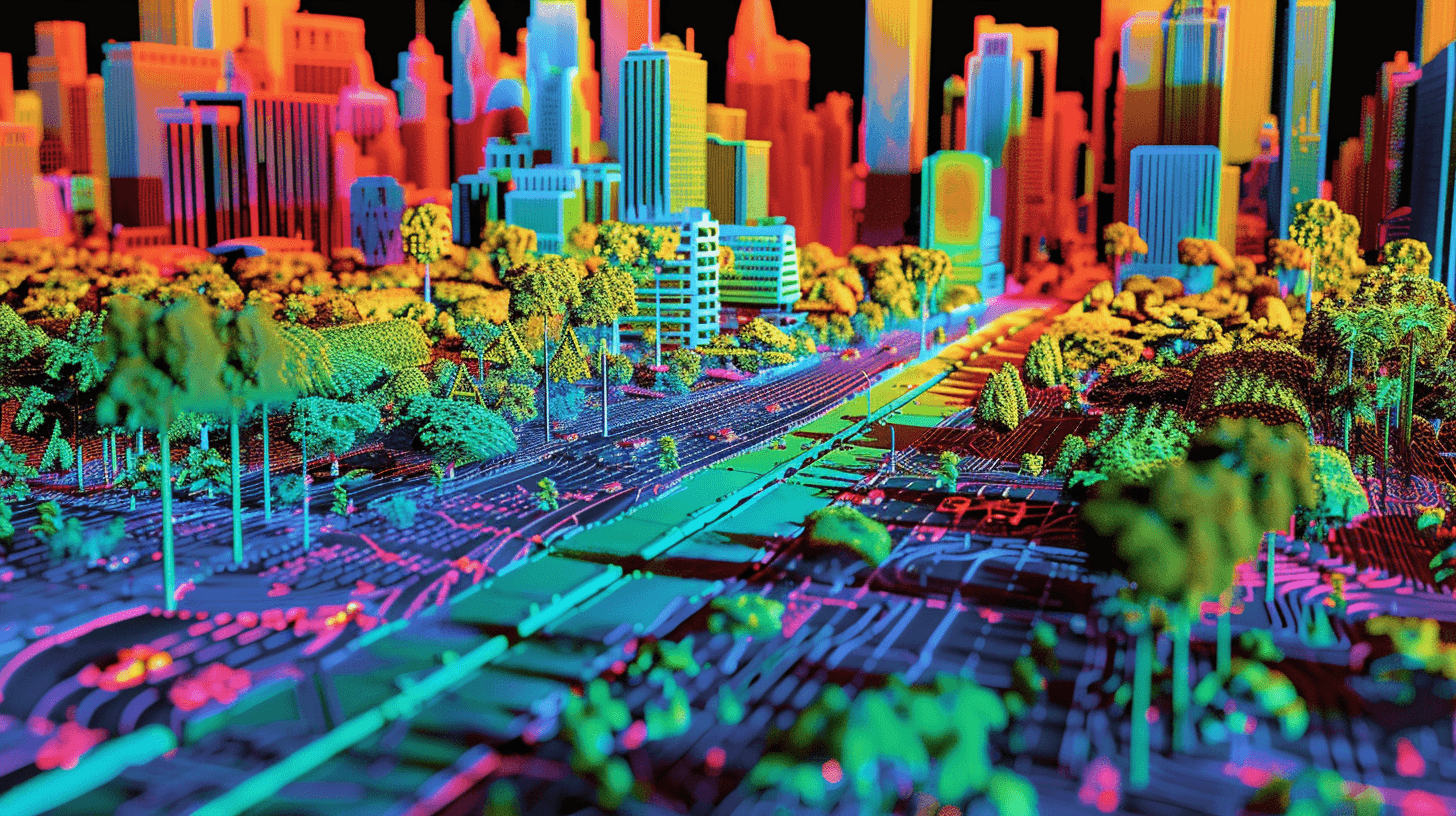
Light Detection and Ranging (LiDAR) technology provides precise, real-time data that can enhance city planning, transportation systems, and environmental monitoring. Often referred to as laser scanning, this remote sensing technology measures distances by illuminating a target with laser light and analysing the reflected light.

LiDAR systems consist of a laser, a scanner, and a GPS receiver, and they can be mounted on vehicles, drones, satellites, stationary platforms or even smartphones. They work by emitting rapid laser pulses and capturing the time it takes for these pulses to bounce back from surfaces, allowing for precise measurements and high-resolution 3D modelling. This data is used to monitor traffic flow, assess the structural integrity of infrastructure, map green spaces, and manage utility networks.

The primary function of LiDAR is to produce detailed, high-resolution spatial data, which is invaluable for urban planning and management. For instance, in transportation, LiDAR can monitor traffic flow and density in real-time, helping to reduce congestion and optimise traffic light timings, making it an essential feature of self-driving vehicles. In environmental management, it can map green spaces, monitor tree canopies, and assess air quality, contributing to more sustainable urban development. Additionally, LiDAR is instrumental in infrastructure maintenance, detecting structural issues in buildings, bridges, and roads before they become critical problems.

Moreover, by integrating this solution into urban systems, cities can enhance their resilience to climate change challenges. For example, LiDAR can model flood risks by mapping terrain elevations and water flow patterns, empowering cities to implement effective flood mitigation strategies. In disaster response, LiDAR's quick, detailed assessments of affected areas significantly improve emergency services' response times and effectiveness.
Technology Readiness Level
9/9Fully Operative
Diffusion of Innovation
4/5Late Majority
Technology Life Cycle
3/4Maturity
Category
Hardware

Related Organizations

Leica Geosystems logo

Leica Geosystems

Switzerland · Company

98%

A premium manufacturer of measurement and survey equipment, including airborne and terrestrial LiDAR.

Developer
Riegl

Austria · Company

95%

Performance leader in airborne, mobile, terrestrial, and unmanned laser scanning solutions.

Developer
Velodyne Lidar

United States · Company

95%

A pioneer in real-time 3D LiDAR sensors, recently merged with Ouster.

Developer
Teledyne Optech

Canada · Company

92%

A leader in high-accuracy lidar 3D survey systems and integrated cameras.

Developer
Hesai Technology logo
Hesai Technology

China · Company

90%

A global leader in LiDAR solutions for ADAS, autonomous driving, and robotics.

Developer
Trimble logo
Trimble

United States · Company

90%

Develops Tekla Structures, a leading BIM software for structural engineering and steel detailing, along with hardware for connecting BIM to the field.

Developer
YellowScan

France · Company

89%

Designs and develops lightweight LiDAR solutions for drones (UAVs).

Developer
Luminar Technologies logo
Luminar Technologies

United States · Company

88%

An autonomous vehicle sensor and software company with a focus on long-range LiDAR.

Developer
Innoviz Technologies logo
Innoviz Technologies

Israel · Company

87%

A leading provider of high-performance, solid-state LiDAR sensors and perception software.

Developer
Esri logo
Esri

United States · Company

85%

Global leader in GIS software (ArcGIS), providing the spatial analytics layer used by thousands of local governments for urban planning and policy.

Deployer

Supporting Evidence

Article

Digital Scotland’s LiDAR revolution: First data release to reveal Scotland’s landscape in unprecedented detail

Digital Scotland · Jan 29, 2026

Scotland has released the first data from its national land LiDAR programme, aiming to map the environment in unprecedented detail to support the economy and well-being. The programme covers 15% of Scotland as of January 2026, with data available for public access.

Support 95%Confidence 100%

Article

What is LiDAR? How lasers are driving a revolution in archaeology

National Geographic · Oct 9, 2025

Explains how LiDAR has revolutionized archaeology by allowing researchers to map unsurveyed land and spot surface anomalies like sunken cities or graves that are hidden by vegetation.

Support 90%Confidence 100%

Paper

The use of LiDAR for the documentation and modelling of cultural heritage sites hidden by the forest canopy

Journal of Forest Science · Oct 30, 2025

This study details the use of airborne laser scanning (ALS) to detect and document charcoal kiln sites, optimizing data processing workflows to create models of cultural heritage hidden under forest canopies.

Support 88%Confidence 100%

Paper

Expanding forest research with terrestrial LiDAR technology

Nature Communications · Oct 6, 2025

Review article discussing the expansion of forest research capabilities through terrestrial LiDAR technology, enabling precise structural measurements of vegetation that were previously difficult to obtain.

Support 85%Confidence 100%

Article

Multispectral LiDAR Data for Land Cover Classification of Urban Areas

mdpi.com

Airborne Light Detection And Ranging (LiDAR) systems usually operate at a monochromatic wavelength measuring the range and the strength of the reflected energy (intensity) from objects. Recently, multispectral LiDAR sensors, which acquire data at different wavelengths, have emerged. This allows for recording of a diversity of spectral reflectance from objects. In this context, we aim to investigate the use of multispectral LiDAR data in land cover classification using two different techniques. The first is image-based classification, where intensity and height images are created from LiDAR points and then a maximum likelihood classifier is applied. The second is point-based classification, where ground filtering and Normalized Difference Vegetation Indices (NDVIs) computation are conducted. A dataset of an urban area located in Oshawa, Ontario, Canada, is classified into four classes: buildings, trees, roads and grass. An overall accuracy of up to 89.9% and 92.7% is achieved from image classification and 3D point classification, respectively. A radiometric correction model is also applied to the intensity data in order to remove the attenuation due to the system distortion and terrain height variation. The classification process is then repeated, and the results demonstrate that there are no significant improvements achieved in the overall accuracy.

Support 50%Confidence 80%

Article

Hyperspectral and Lidar Data Applied to the Urban Land Cover Machine Learning and Neural-Network-Based Classification: A Review

mdpi.com

Rapid technological advances in airborne hyperspectral and lidar systems paved the way for using machine learning algorithms to map urban environments. Both hyperspectral and lidar systems can discriminate among many significant urban structures and materials properties, which are not recognizable by applying conventional RGB cameras. In most recent years, the fusion of hyperspectral and lidar sensors has overcome challenges related to the limits of active and passive remote sensing systems, providing promising results in urban land cover classification. This paper presents principles and key features for airborne hyperspectral imaging, lidar, and the fusion of those, as well as applications of these for urban land cover classification. In addition, machine learning and deep learning classification algorithms suitable for classifying individual urban classes such as buildings, vegetation, and roads have been reviewed, focusing on extracted features critical for classification of urban surfaces, transferability, dimensionality, and computational expense.

Support 50%Confidence 80%

Article

Explore the 10 Top LiDAR Applications in 2023 & 2024

startus-insights.com

How are industries using LiDAR to improve navigation and operational safety? Explore the top LiDAR use cases across industries based on our analysis of 882 global lidar startups & scaleups. Their solutions include advanced navigation, environment mapping, remote sensing and more!

Support 50%Confidence 80%

Article

Arqueologia do Futuro

radionovelo.com.br

Aos poucos, eles estão sendo descortinados. São desenhos grandes, cavados em valas profundas e feitos com uma matemática sofisticada: círculos, quadrados, hexágonos, grandes rodas com estradas irradiando de todos os lados. Esses são geoglifos, marcas na terra feitas por povos indígenas de séculos passados, que estão sendo revelados aos olhos dos satélites pelo pior motivo possível: o desmatamento desenfreado da Amazônia. Agora, no entanto, uma nova tecnologia a laser, o LiDAR, está varrendo a floresta para descobrir geoglifos antes que a floresta seja removida. E a esperança é que a identificação de novos sítios arqueológicos possa ajudar a preservar o passado e o futuro da Amazônia de uma tacada só.

Support 50%Confidence 80%

Article

32 times lasers revealed hidden forts and settlements from centuries ago Countdowns

livescience.com

Support 50%Confidence 80%

Article

The Changing Face of Urban Planning: LiDAR and Future Cityscapes

flyguys.com

Urban planning and sustainable city development are paramount in our rapidly expanding world. As cities expand and evolve, innovative technologies such as LiDAR (Light Detection and Ranging) are being deployed to address complex challenges. LiDAR is a game-changer in urban planning, offering invaluable insights and data for shaping future cities. This technology is being used to create 3D models of cities and to gather real-time data that allows city planners to make informed decisions about urban development and to create smart cities that are resilient to future challenges.

Support 50%Confidence 80%

Connections

Hardware
Hardware
Remote Earth Sensing

Satellite and drone monitoring of urban land use, air quality, and infrastructure for planning

Technology Readiness Level
9/9
Diffusion of Innovation
4/5
Technology Life Cycle
3/4
Hardware
Hardware
Hyperspectral Imaging

Captures light across hundreds of wavelengths to identify materials and monitor urban environments

Technology Readiness Level
9/9
Diffusion of Innovation
3/5
Technology Life Cycle
2/4
Hardware
Hardware
Active Monitoring Drone

Autonomous drones that collect real-time data on urban infrastructure, traffic, and environmental conditions

Technology Readiness Level
8/9
Diffusion of Innovation
3/5
Technology Life Cycle
2/4

Book a research session

Bring this signal into a focused decision sprint with analyst-led framing and synthesis.
Research Sessions