Envisioning is an emerging technology research institute and advisory.

LinkedInInstagramGitHub

2011 — 2026

research
  • Reports
  • Newsletter
  • Methodology
  • Origins
  • Vocab
services
  • Research Sessions
  • Signals Workspace
  • Bespoke Projects
  • Use Cases
  • Signal Scanfree
  • Readinessfree
impact
  • ANBIMAFuture of Brazilian Capital Markets
  • IEEECharting the Energy Transition
  • Horizon 2045Future of Human and Planetary Security
  • WKOTechnology Scanning for Austria
audiences
  • Innovation
  • Strategy
  • Consultants
  • Foresight
  • Associations
  • Governments
resources
  • Pricing
  • Partners
  • How We Work
  • Data Visualization
  • Multi-Model Method
  • FAQ
  • Security & Privacy
about
  • Manifesto
  • Community
  • Events
  • Support
  • Contact
  • Login
ResearchServicesPricingPartnersAbout
  1. Home
  2. Research
  3. Cities
  4. AR Workforce Assistance

AR Workforce Assistance

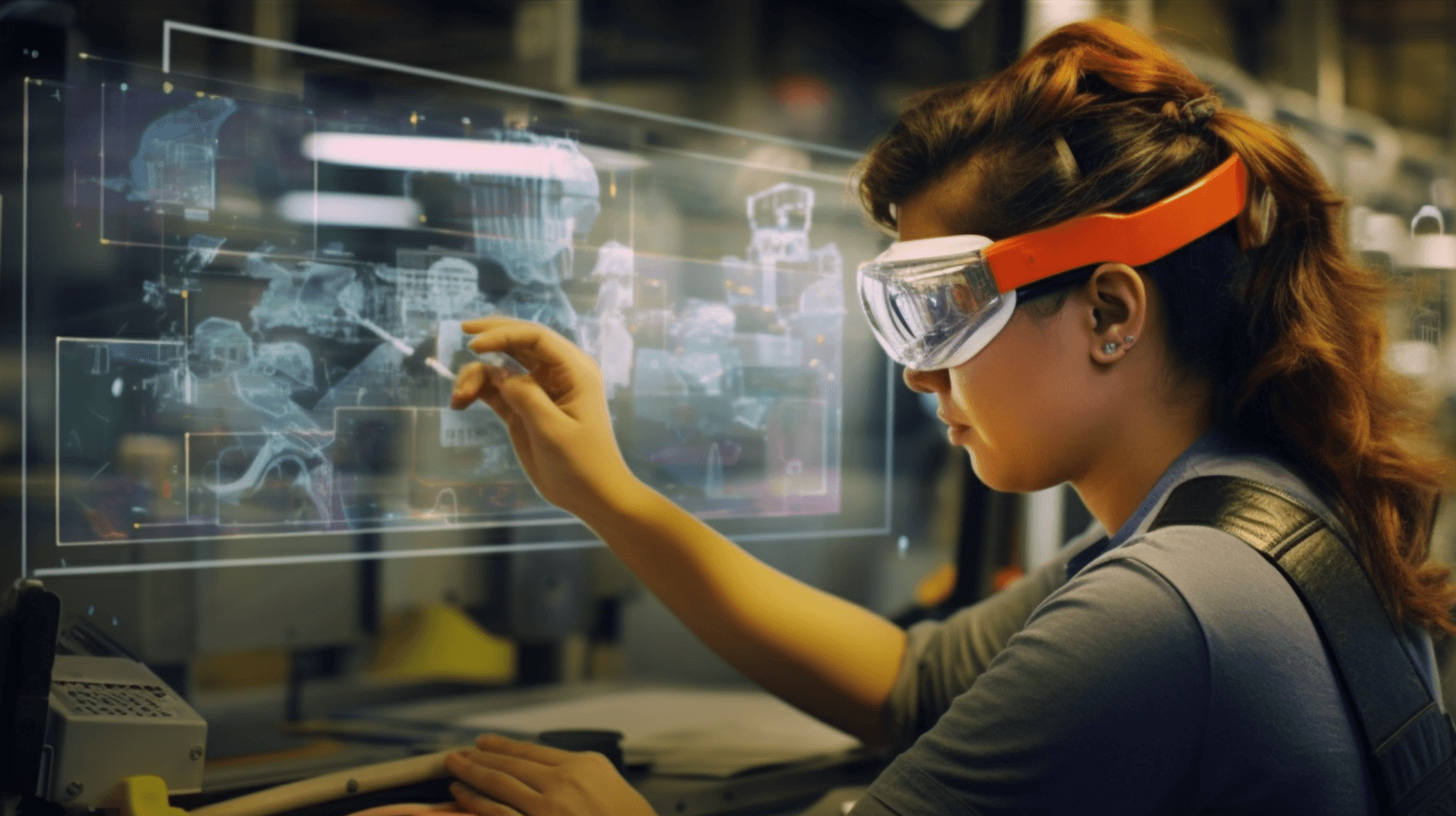
Overlays digital instructions and data onto workers' field of view via smart glasses or mobile devices
Back to CitiesView interactive version

Augmented Reality (AR) Workforce Assistance is revolutionising the way urban environments function by addressing several critical challenges faced by contemporary cities. This technology aims to enhance productivity, reduce operational errors, and provide real-time solutions to complex problems that arise in various urban sectors, such as construction, maintenance, and emergency response.

AR Workforce Assistance overlays digital information onto the physical world through devices like smart glasses or mobile devices. It provides workers with interactive, 3D visuals and real-time data directly in their field of vision. For example, a technician repairing electrical systems can see step-by-step instructions, diagnostic data, and safety warnings superimposed on the equipment they are working on, thereby reducing the likelihood of errors and significantly speeding up the repair process.

The functionality of AR Workforce Assistance relies on advanced sensors, computer vision, and artificial intelligence (AI) to analyse the environment and provide contextual information. These systems can recognise objects and their conditions, predict potential issues, and offer guidance on the best course of action. In a construction setting, AR can project the digital plans onto the actual site, allowing workers to visualise the final structure and ensure that every component is in its correct place – which streamlines the construction process and minimises costly mistakes.

As urban areas continue to grow and infrastructure becomes more complex, the demand for efficient, accurate, and safe operational methods increases. AR technology not only meets these demands but also enhances the capabilities of the urban workforce. It empowers workers by providing them with the tools and information they need to perform their tasks more effectively, which leads to improved productivity and job satisfaction.

Moreover, AR Workforce Assistance plays a pivotal role in urban resilience. In emergency situations, first responders equipped with AR can access critical information such as building layouts, hazard locations, and real-time updates, which enhances their ability to make informed decisions quickly and effectively. This can lead to faster response times and better outcomes in crisis scenarios, ultimately making cities safer and more resilient.

Technology Readiness Level
7/9Prototype Demonstration
Diffusion of Innovation
2/5Early Adopters
Technology Life Cycle
2/4Growth
Category
Applications

Related Organizations

RealWear logo
RealWear

United States · Company

95%

Develops ruggedized head-mounted tablet devices for industrial frontline workers to access data hands-free.

Developer
Trimble logo
Trimble

United States · Company

95%

Develops Tekla Structures, a leading BIM software for structural engineering and steel detailing, along with hardware for connecting BIM to the field.

Developer
TeamViewer logo
TeamViewer

Germany · Company

90%

Offers 'TeamViewer Frontline', an enterprise AR productivity platform (acquired from Ubimax) for logistics and manufacturing.

Developer
XYZ Reality logo
XYZ Reality

United Kingdom · Startup

90%

Creators of 'The Atom', an engineering-grade AR headset designed specifically for construction accuracy.

Developer
Librestream logo
Librestream

Canada · Company

85%

Provides the Onsight augmented reality platform for remote expert guidance in field service and maintenance.

Developer
Magic Leap logo
Magic Leap

United States · Company

85%

AR headset manufacturer utilizing dynamic dimming and eye-tracking for optimized rendering.

Developer
Scope AR logo
Scope AR

United States · Company

85%

Develops the WorkLink platform for creating AR work instructions and remote assistance without coding.

Developer
Vuzix logo
Vuzix

United States · Company

85%

Supplier of smart glasses and Augmented Reality (AR) technologies.

Developer
Bentley Systems logo
Bentley Systems

United States · Company

80%

Infrastructure engineering software company.

Developer

Supporting Evidence

Paper

Development of an AI-powered AR glasses system for real-time first aid guidance in emergency situations

BioData Mining · Aug 26, 2025

This paper introduces an AI-powered augmented reality (AIAR) platform designed to assist untrained bystanders in delivering effective emergency response using real-time object detection and AR overlays.

Support 95%Confidence 98%

Paper

Digital Twins and Augmented Reality for Humanitarian Logistics in Urban Disasters: Framework Development

Logistics · Oct 10, 2025

Develops a framework integrating Digital Twins and Augmented Reality to support humanitarian logistics in urban disaster scenarios.

Support 92%Confidence 95%

Paper

5G-Enabled Mobile AR System for Location-aware Assistance in Buildings – System Overview and Preliminary Evaluation

FIG Working Week 2025 Proceedings · Jun 10, 2025

Describes a 5G-enabled mobile AR assistance system for technicians in technical building equipment maintenance. The system uses sensor fusion for indoor positioning and overlays BIM-based visualizations to guide maintenance tasks.

Support 92%Confidence 95%

Article

Augmented Reality in Construction: A Practical Guide to ROI and Safety

AIDAR Solutions · Dec 18, 2025

Discusses how AR overlays digital plans onto jobsites to guide crews, boost safety by flagging hazards, and streamline communication.

Support 85%Confidence 88%

Article

AR Smart Glasses Case Studies: How AR Enhances Field Work

UC Today · Jan 3, 2026

Reviews case studies showing how AR smart glasses improve productivity, training, and collaboration for field workers across various industries.

Support 80%Confidence 85%

Article

Using augmented reality in urban planning processes: Sustainable urban transitions through innovative participation

ingentaconnect.com

The use of augmented reality applications in urban planning improves the quality of participation processes and contributes to sustainable city development. However, as our case studies also show, these potentials are not fully exploited yet as augmented reality is not yet used in all planning phases. Sustainable urban development requires innovative approaches and concepts that involve people not only in planning processes but also in influencing the design of urban space. Modern formats, such as augmented reality (AR), can help to increase the motivation for participation and present different planning concepts more realistically through different forms of visualization. Based on case studies in Vienna, Austria, and Lucerne, Switzerland, we examine AR applications in planning participation and discuss the innovative nature of these applications. We show that the use of AR not only increases the motivation of the population to participate in planning processes but also increases the quality of participation processes and can, thus, trigger a sustainable transformation of cities.

Support 50%Confidence 80%

Article

Making urban planning experienceable with AR

pelicad.com

In the dynamic landscape of urban development, stakeholder engagement and effective communication are key to success. Augmented Reality (AR) emerges as a transformative tool, offering innovative solutions for enhancing citizen understanding and participation in Smart City projects.

Support 50%Confidence 80%

Article

Google's AI smart glasses are the most exciting thing I saw at I/O — here's what you need to know

tomsguide.com

Ray-Ban Meta Smart Glasses will have walked so that Google AI glasses can run

Support 50%Confidence 80%

Article

Augmented reality for industrial services provision: the factors influencing a successful adoption in manufacturing companies

emerald.com

The authors identify four categories (task, workforce, context and technology) that combine 18 factors that manufacturing companies should consider when introducing AR technology to support industrial services.

Support 50%Confidence 80%

Article

Artificial Intelligence and Urban Planning: Technology as a Tool for City Design

archdaily.com

The convergence of artificial intelligence (AI) and urban planning holds significant promise for creating more intelligent, efficient, and sustainable cities. This fusion entails the integration of cutting-edge technologies that can guide decision-making, enhance resource allocation, predict trends, engage citizens, and more. In this framework, where AI is seen as a tool for advancing various urban aspects, there has been a surge in the development of applications, software, and other technological systems tailored to support urban planning. Below, we have highlighted some global studies and technologies applied from urban morphology to community involvement.

Support 50%Confidence 80%

Article

UrbanAR

urbanar.app

We want to make the urban design and planning process of our cities more fun and engaging: to make our cities more of a collaborative effort and better for everyone. Currently, municipalities are using old methods to get input from citizens, but we can change that!

Support 50%Confidence 80%

Article

Enhancing Urban Planning with Augmented Reality and Cloud Technology

pelicad.com

Urban planning is a complex process that involves envisioning, designing, and implementing sustainable and functional communities. It's crucial for urban planners to effectively communicate their ideas to citizens, city authorities, and decision-makers to ensure the success of their projects. Thanks to advancements in technology, particularly in the realms of Augmented Reality (AR) and cloud computing, urban planners now have powerful tools at their disposal to streamline their workflows and improve stakeholder engagement. One such innovation is the ability to visualize 3D CAD data in immersive Augmented Reality environments. By uploading their 3D CAD planning data to the cloud, urban planners can automatically generate AR visualizations that bring their designs to life. These visualizations not only help citizens, city authorities, and decision-makers better understand complex planning data but also evoke positive emotions that can aid in convincing critical stakeholder groups.

Support 50%Confidence 80%

Connections

Software
Software
Spatial Computing

Blends digital content with physical spaces using sensors and computer vision for interactive 3D environments

Technology Readiness Level
8/9
Diffusion of Innovation
3/5
Technology Life Cycle
2/4
Software
Software
Autonomous Sustainability Monitoring

Real-time sensor networks and AI tracking air quality, energy use, and waste across cities

Technology Readiness Level
6/9
Diffusion of Innovation
2/5
Technology Life Cycle
1/4
Hardware
Hardware
Active Monitoring Drone

Autonomous drones that collect real-time data on urban infrastructure, traffic, and environmental conditions

Technology Readiness Level
8/9
Diffusion of Innovation
3/5
Technology Life Cycle
2/4
Software
Software
Autonomous Maintenance Software

AI-driven software that monitors, diagnoses, and repairs urban infrastructure autonomously

Technology Readiness Level
7/9
Diffusion of Innovation
2/5
Technology Life Cycle
2/4

Book a research session

Bring this signal into a focused decision sprint with analyst-led framing and synthesis.
Research Sessions