Envisioning is an emerging technology research institute and advisory.

LinkedInInstagramGitHub

2011 — 2026

research
  • Reports
  • Newsletter
  • Methodology
  • Origins
  • Vocab
services
  • Research Sessions
  • Signals Workspace
  • Bespoke Projects
  • Use Cases
  • Signal Scanfree
  • Readinessfree
impact
  • ANBIMAFuture of Brazilian Capital Markets
  • IEEECharting the Energy Transition
  • Horizon 2045Future of Human and Planetary Security
  • WKOTechnology Scanning for Austria
audiences
  • Innovation
  • Strategy
  • Consultants
  • Foresight
  • Associations
  • Governments
resources
  • Pricing
  • Partners
  • How We Work
  • Data Visualization
  • Multi-Model Method
  • FAQ
  • Security & Privacy
about
  • Manifesto
  • Community
  • Events
  • Support
  • Contact
  • Login
ResearchServicesPricingPartnersAbout
  1. Home
  2. Research
  3. Cities
  4. Adaptable Floating Station

Adaptable Floating Station

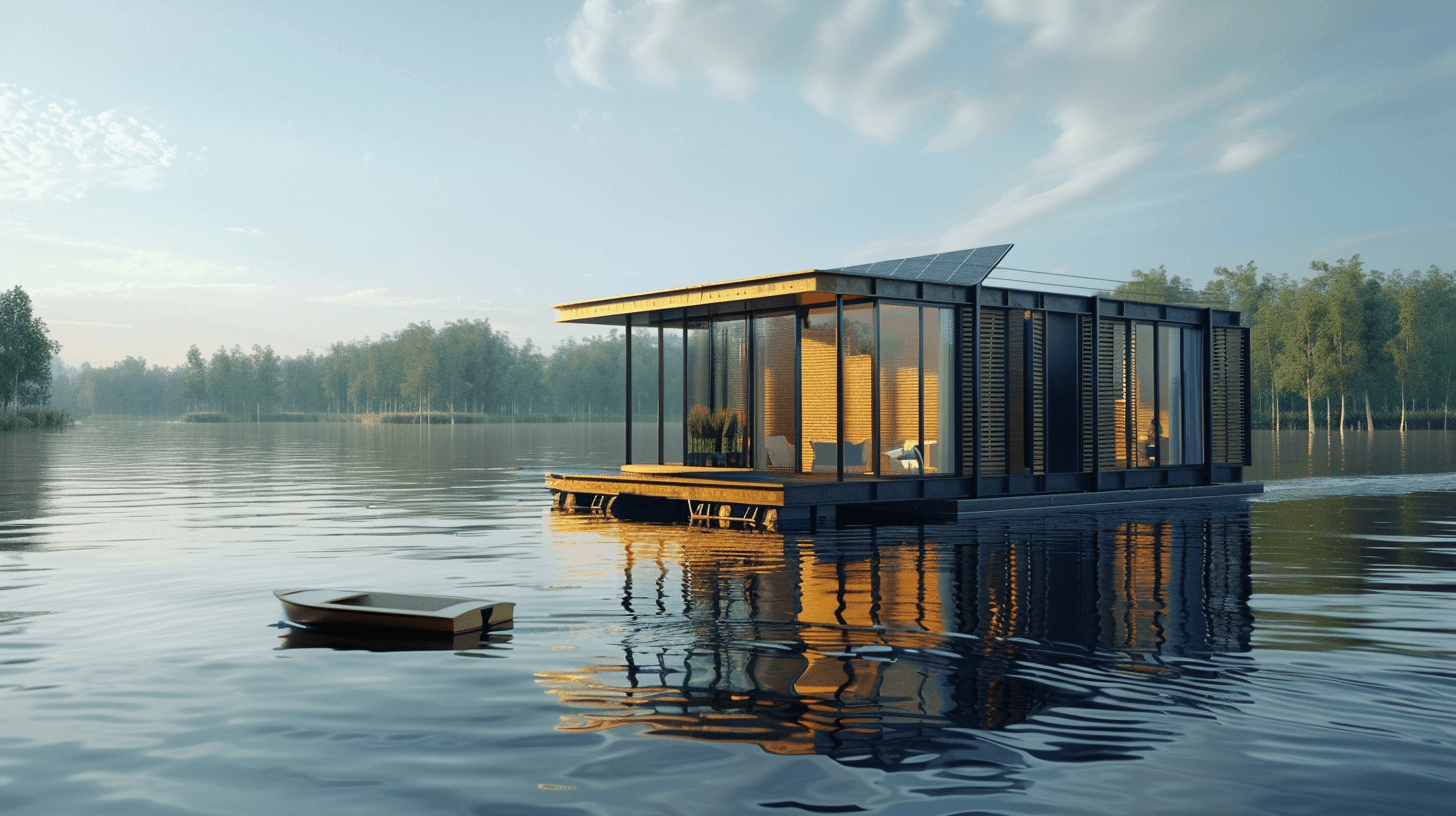
Repurposed shipping containers that float and deliver housing, healthcare, or education during floods
Back to CitiesView interactive version

In the face of increasing climate volatility, urban areas worldwide are grappling with the devastating impacts of floods. Traditional infrastructure often fails to meet the demands of these natural disasters, leaving communities vulnerable and without essential services. Adaptable Floating Stations, an innovative technological solution, address this pressing issue by providing flexible and resilient infrastructure capable of delivering vital services such as housing, healthcare, and education during flood events.

An Adaptable Floating Station repurposes standard shipping containers, transforming them into multifunctional units that can float and adapt to rising water levels. These stations are designed with modular layouts that allow for rapid deployment and reconfiguration based on the immediate needs of the affected population. Each container is fitted with necessary utilities and amenities, ensuring they are self-sufficient and capable of operating independently or as part of a larger network.

The technology behind these floating stations leverages advanced materials and engineering techniques to ensure buoyancy, durability, and stability in turbulent waters. Solar panels and rainwater harvesting and filtering systems provide sustainable energy and water sources, while integrated communication networks enable coordination with emergency services and local authorities. The adaptability of these stations means they can be deployed pre-emptively in flood-prone areas or transported quickly to disaster sites, offering immediate relief and support.

As climate change continues to exacerbate the frequency and intensity of flooding, urban resilience must evolve. These floating stations not only provide a practical solution to the logistical challenges posed by floods but also promote sustainable and forward-thinking urban planning. By incorporating adaptable and mobile infrastructure, cities can ensure the continuity of essential services, safeguarding the well-being of their inhabitants even in times of crisis.

Technology Readiness Level
6/9Prototype Testing
Diffusion of Innovation
2/5Early Adopters
Technology Life Cycle
1/4Emergence
Category
Hardware

Related Organizations

NLÉ

Netherlands · Company

95%

Architecture and design practice led by Kunlé Adeyemi, famous for the 'Makoko Floating School', a prototype floating structure built for flood-prone regions using local materials and modular techniques.

Developer
Waterstudio.NL logo
Waterstudio.NL

Netherlands · Company

95%

An architectural firm exclusively dedicated to floating urbanization, designing floating foundations and modular structures for housing and public services.

Developer
Buoyant Foundation Project logo
Buoyant Foundation Project

Canada · Nonprofit

90%

A research initiative at the University of Waterloo designing amphibious foundations that allow existing structures to float during floods.

Researcher
Oceanix logo
Oceanix

United States · Company

90%

A blue tech company building floating cities, including a prototype in Busan, South Korea, designed to withstand floods and sea-level rise.

Developer
FlexBase logo
FlexBase

Netherlands · Company

88%

Specializes in designing and constructing large floating foundations using EPS (Expanded Polystyrene) and concrete.

Developer
BACA Architects logo
BACA Architects

United Kingdom · Company

85%

Specialists in 'aquatecture', designing amphibious and floating buildings for flood zones.

Developer
Blue21 logo
Blue21

Netherlands · Company

85%

A social enterprise and design firm focused on floating urban development and maritime technology to address climate change.

Researcher
Space&Matter logo
Space&Matter

Netherlands · Company

85%

Architects behind 'Schoonschip', a circular floating community in Amsterdam.

Developer
Seasteading Institute

United States · Nonprofit

80%

A nonprofit think tank promoting the creation of floating ocean cities.

Researcher
Mecanoo

Netherlands · Company

75%

A renowned architecture firm that designs water-resilient infrastructure and floating concepts.

Developer

Supporting Evidence

Article

Floating Schools

CONTEXT · Nov 15, 2025

The Floating Schools initiative in Bangladesh utilizes a fleet of solar-powered floating structures to provide education, healthcare, and training to flood-prone riverine communities, operationalizing a mature system by 2021.

Support 98%Confidence 95%

News

Let the city float: A hybrid floating structure solution for resilient, adaptable and sustainable urban development

The Hong Kong Polytechnic University · Oct 14, 2025

Researchers propose sustainable and smart floating structure solutions for urban development to combat rising sea levels, offering adaptable platforms for housing and recreation.

Support 88%Confidence 90%

News

Sea Tech Floating Terminal (STFT): Adapting Maritime Infrastructure for the Era of Ultra-Large Container Vessels

Sea Technology · Oct 15, 2025

Sea Technology's floating terminal concept achieved DNV Approval in Principle in late 2025, offering a modular solution to expand capacity and resilience in maritime infrastructure.

Support 80%Confidence 85%

Article

Sea Tech Floating Terminal (STFT): Adapting Maritime Infrastructure

Sea Tech · Oct 15, 2025

The Sea Tech Floating Terminal is a modular floating solution designed to expand port capacity and absorb extreme loads. It achieved DNV Approval in Principle, demonstrating the viability of large-scale floating infrastructure.

Support 75%Confidence 85%

Article

MAST develops adaptable flat-pack system for building floating homes

dezeen.com

Danish maritime architecture studio MAST has developed Land on Water, a system for constructing floating buildings that aims to be more flexible and sustainable than traditional methods.

Support 50%Confidence 80%

Article

Waterstudio

waterstudio.nl

Waterstudio.NL is an architectural firm located in the Netherlands that is confronting the challenge of developing solutions to the problems posed by urbanization and climate change. The prognosis is that by 2050 approximately 70% of the world’s population will live in urbanized areas. Given the fact that about 90% of the world’s largest cities are situated on the waterfront, we have arrived at a situation where we are forced to rethink the way we live with water in the built environment. Considering the unpredictability of future developments and unanticipated needs, we should come up with flexible strategies – planning for change. Our vision is that large-scale floating projects in an urban environment provide a tangible solution to these problems that are both flexible and sustainable.

Support 50%Confidence 80%

Article

Floating City Apps for Wetslums

waterstudio.nl

Comparable to adjusting your smart phone with apps according to your changing needs you can also adjust the functionality in a slum by adding functions with Floating City Apps.

Support 50%Confidence 80%

Article

What would an entirely flood-proof city look like?

theguardian.com

The wetter the better. From sponge cities in China to ‘berms with benefits’ in New Jersey and floating container classrooms in the slums of Dhaka, we look at a range of projects that treat storm water as a resource rather than a hazard

Support 50%Confidence 80%

Article

Make it Right’s New Orleans FLOAT House by Morphosis to Gain LEED Platinum Certification

inhabitat.com

Morphosis respected the cultural vernacular of the common New Orleansshotgun house by first raising the structure off the ground level to protect the building from flooding. The outstanding part of this alteration of the indigenous typology is the forethought that all mechanical, plumbing, and sustainable systems will float during floods in a prefabricated “chassis”. The design of the house’s base is based closely on the GM skateboard chassis, which supports several body styles. The chassis is integrated into the design and supports a variety of future home customizations. Currently, the FLOAT House and its prefabricated components sit on a combination of piers and concrete pads assembled on-site.

Support 50%Confidence 80%

Article

These floating buildings could help save us from flooding - and they're made from recycled plastic bottles

weforum.org

Bangladesh is one of the most vulnerable countries in the world when it comes to flooding, storms, and rising sea levels. In 2016, Bangladesh experienced four cyclones — a record number in the country's recent history. And by 2050, sea level rise could inundate 17% of its land, displacing up to 18 million people in Bangladesh, according to Atiq Rahman, the nation's leading climate scientist.

Support 50%Confidence 80%

Article

The Eco-Friendly Floating Cities of the Future

archdaily.com

Support 50%Confidence 80%

Article

Dynamic Floating Stations Model for Emergency Medical Services with a Consideration of Traffic Data

mdpi.com

To equally distribute the workload and minimize the travel distance for fire departments, we developed a new dynamic floating stations model (DFSM) to target traffic-related emergency medical services (EMS) during peak hours. This study revealed that traffic-related EMS incidents have different characteristics to other EMS incidents. The number of floating stations was determined by the number of available ambulances at a given time. The optimum floating station location was identified by using the given capacity to establish the smallest service radius. In DFSM simulations using floating stations with a capacity of 100 and 150 EMS incidents, the result shows significant improvements in comparison to the current situation.

Support 50%Confidence 80%

Article

Rising Above: Exploring the potential of floating city concepts

parametric-architecture.com

Recently, floating city concepts became popular with the global climate crisis leading to the sea-level rise. A city on water may sound utopian, but floating cities are not new. Humanity has a long history of communities living on the water. Water-based communities or canal cities like Amsterdam or Venice come to mind when discussing floating cities. But the latest developments and conditions of the globe led people to think of more futuristic and sustainable ocean-based communities.

Support 50%Confidence 80%

Connections

Applications
Applications
Sponge City

Urban design using permeable surfaces and green infrastructure to absorb, filter, and store rainwater naturally

Technology Readiness Level
6/9
Diffusion of Innovation
3/5
Technology Life Cycle
2/4
Hardware
Hardware
Volumetric Modular Housing

Factory-built housing modules assembled on-site to reduce construction time and costs

Technology Readiness Level
9/9
Diffusion of Innovation
3/5
Technology Life Cycle
2/4

Book a research session

Bring this signal into a focused decision sprint with analyst-led framing and synthesis.
Research Sessions