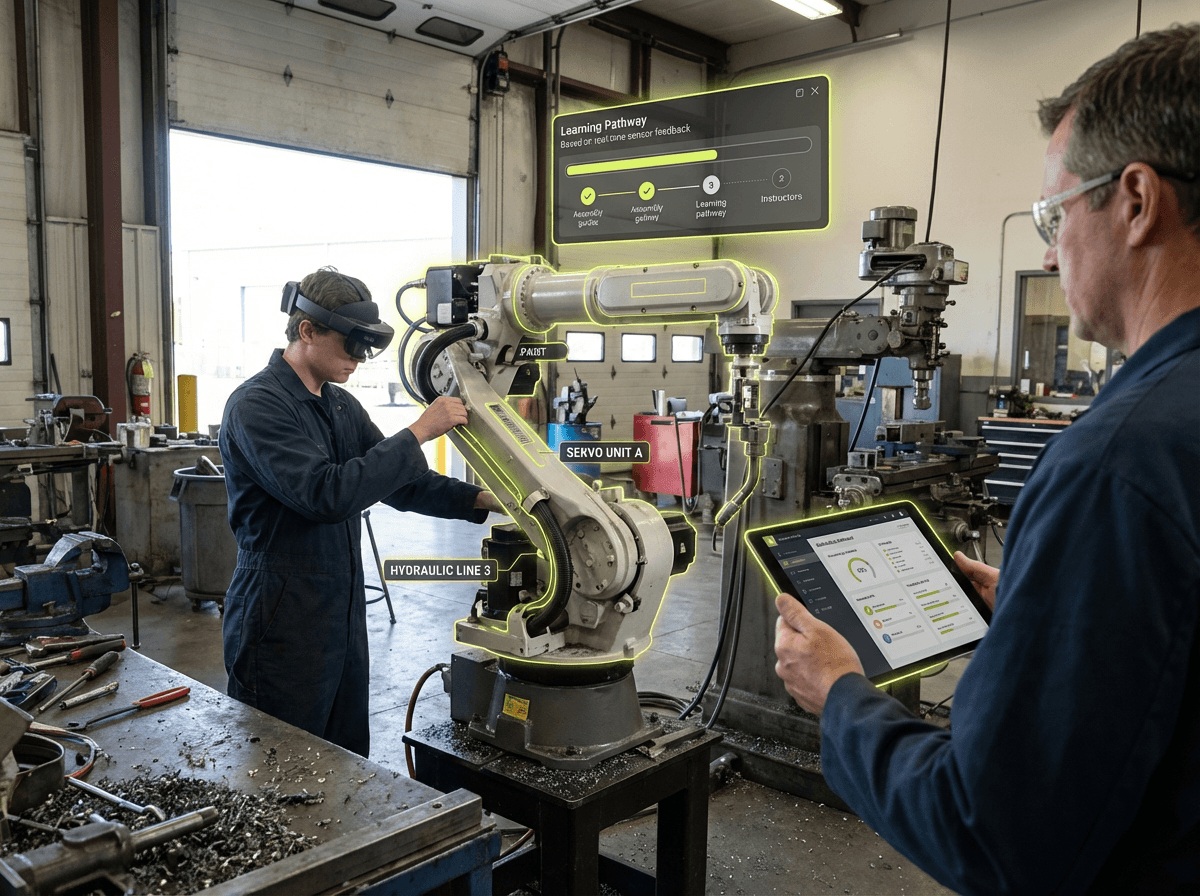
Workplace Upskilling Ecosystems
Workplace upskilling ecosystems integrate AI-driven learning pathways directly into work environments, connecting learning content with actual job tasks, real-time feedback loops, and organizational knowledge bases to create seamless learning-on-the-job experiences. These systems analyze job requirements, identify skill gaps, and deliver just-in-time learning that's immediately applicable to current work. Advanced ecosystems feature apprenticeship simulations that provide hands-on procedural learning for trades and technical roles, using virtual or augmented reality to practice complex procedures safely before performing them in real work contexts. By embedding learning into work processes and providing contextual, applicable training, these ecosystems enable continuous skill development that's directly relevant to job performance and career advancement.
This innovation addresses the challenge of keeping workforce skills current in rapidly changing industries, where traditional training approaches may be disconnected from actual work and where finding time for separate training can be difficult. By integrating learning into work processes, these ecosystems enable continuous upskilling that's immediately applicable. Companies developing these capabilities include corporate learning platforms, workforce development organizations, and technology companies focused on skills-based learning, with some systems already providing integrated learning and work experiences.
The technology is particularly significant for workforce development and lifelong learning, where integrated learning ecosystems can support continuous skill development throughout careers. As these systems improve and become more sophisticated, they could transform how organizations develop their workforce. However, ensuring learning quality, managing integration complexity, maintaining learner engagement, and demonstrating clear impact on job performance remain challenges. The technology represents an important evolution in workplace learning, but requires continued development to achieve seamless integration and measurable impact.
Related Organizations

A learning experience platform that uses data analytics to suggest personalized learning pathways and skill development for employees.

A talent intelligence platform that uses AI to match individuals with career paths, identifying skills gaps and suggesting upskilling opportunities.

An internal talent marketplace that uses AI to mentor employees on potential career moves and projects within their organization.

Platform managing education benefits for companies, connecting employees to degree programs and bootcamps.

Tech startup building a professional apprenticeship alternative to university and corporate training.

A workforce intelligence platform acquired by Cornerstone that uses AI to map skills and labor market data.

Collaborative learning platform that enables internal experts to create courses and upskill peers.

An AI technology company that infers employee skills from digital footprints (emails, commits, tickets).

A major cloud-based people development software provider (LMS/LXP/HR).

Through Copilot and the 'Recall' feature in Windows, Microsoft is integrating persistent memory and agentic capabilities directly into the operating system.
Supporting Evidence
Research this in Signals
Signals turns a topic into a sourced research record you can inspect and rerun. Your first scan is free, and this one starts with Workplace Upskilling Ecosystems already loaded, so edit it or scan as is.