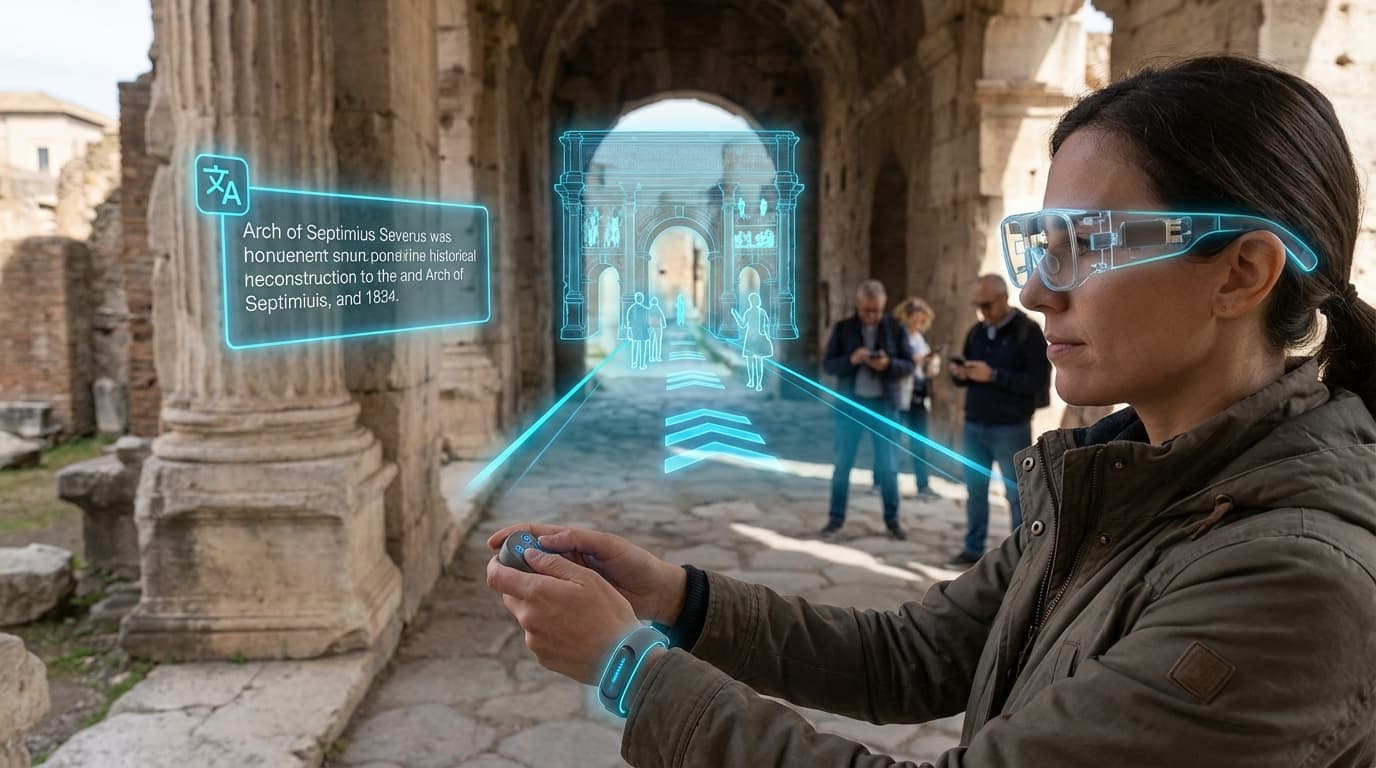
Mixed Reality Cultural Guides
Mixed Reality Cultural Guides represent a convergence of augmented reality (AR) and mixed reality (MR) technologies designed to bridge language barriers and cultural gaps for travelers exploring unfamiliar destinations. These systems utilize advanced computer vision, natural language processing, and spatial mapping to overlay contextual digital information onto the physical world in real time. Through wearable devices such as smart glasses or smartphone applications, the technology captures the user's field of view and identifies objects, landmarks, signage, and even spoken language within the environment. Sophisticated algorithms then process this visual and auditory input, matching it against extensive databases of cultural, historical, and linguistic information to generate relevant overlays that appear seamlessly integrated with the real-world scene.
The tourism industry has long grappled with the challenge of making destinations accessible and meaningful to international visitors who may not speak local languages or understand cultural nuances. Traditional solutions like printed guidebooks, audio tours, and human guides have limitations in scalability, personalization, and real-time adaptability. Mixed Reality Cultural Guides address these constraints by providing instant, contextual information tailored to each traveler's interests and language preferences. When a visitor points their device at a historical building, the system can display architectural details, historical events that occurred there, and even visual reconstructions showing how the structure appeared in different eras. Similarly, restaurant menus, street signs, and museum exhibits become instantly comprehensible through real-time translation overlays, while navigation assistance guides travelers along optimal routes with directional arrows and points of interest highlighted in their visual field.
Early deployments of these technologies have appeared in major tourist destinations and cultural heritage sites, with museums and tourism boards partnering with technology providers to enhance visitor experiences. Research suggests that these immersive guides significantly increase engagement and comprehension compared to traditional interpretive methods, particularly among younger, tech-savvy travelers. The technology also enables more independent exploration, reducing reliance on scheduled tours while still providing rich educational content. As 5G networks expand and AR hardware becomes more lightweight and affordable, industry analysts note a trajectory toward widespread adoption across diverse tourism contexts—from urban walking tours to archaeological sites. This evolution aligns with broader trends toward experiential travel and the digitization of cultural heritage, positioning Mixed Reality Cultural Guides as essential infrastructure for the future of global tourism, where physical and digital experiences merge to create deeper cross-cultural understanding and more meaningful travel encounters.
Related Organizations

Creator of the HistoPad, an augmented reality tablet solution used in major heritage sites to provide immersive historical reconstructions.

A platform enabling creators and institutions to build location-based AR tours, often used for historical 'time travel' experiences.

Creators of CausalImpact, a package for causal inference using Bayesian structural time-series.

AR platform company that develops the Lightship ARDK and owns Scaniverse, a 3D scanning app leveraging LiDAR.

Provides a publishing platform for creating guided tours and AR treasure hunts for museums and cultural sites.

Social media and camera company developing AR spectacles.

Manufacturer of consumer AR glasses (Air, Light) that tether to phones or computing pucks.

Develops a 3D streaming CODEC for the metaverse, enabling high-quality AR content delivery to mobile devices.

Specializes in AR for sports and live events, providing real-time data overlays for spectators.
Scan the World
United Kingdom · Open Source
A community-built open source museum hosting thousands of 3D printable scans of art and sculpture.
Supporting Evidence
Research this in Signals
Signals turns a topic into a sourced research record you can inspect and rerun. Your first scan is free, and this one starts with Mixed Reality Cultural Guides already loaded, so edit it or scan as is.