









Biomanufacturing in Space
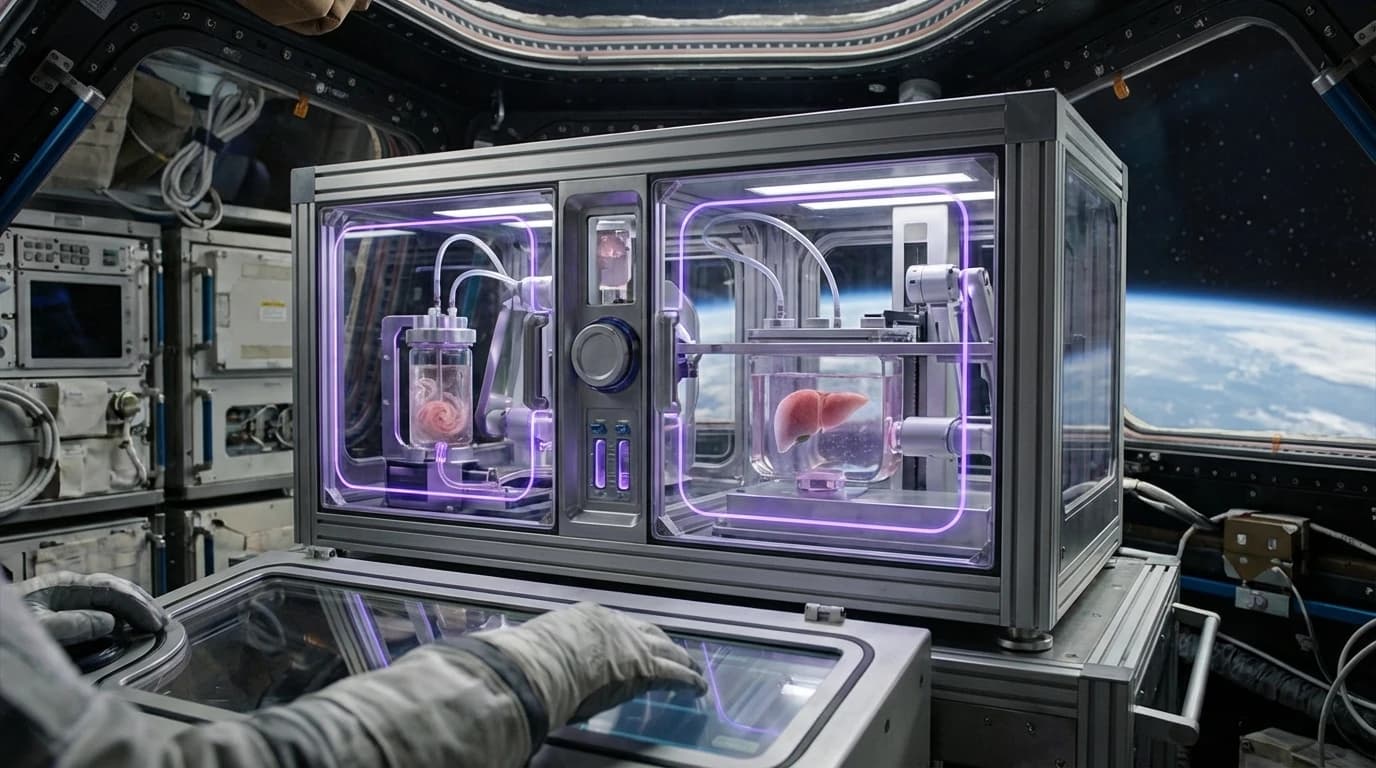
Microgravity Biomanufacturing
Manufacturing pharmaceuticals and bioprinted tissues in orbit using microgravity conditions
Microgravity biomanufacturing leverages the unique environment of space—where there is no sedimentation, convection, or gravity-driven separation—to produce materials that are difficult or impossible to manufacture on Earth. This includes growing perfect protein crystals for drug development, manufacturing high-purity pharmaceuticals with better properties, and bio-printing complex 3D vascularized tissues and organs. The microgravity environment enables processes and structures that gravity prevents on Earth, potentially transforming space stations into high-value manufacturing facilities for medical and pharmaceutical products.
This innovation addresses limitations in pharmaceutical manufacturing and tissue engineering on Earth, where gravity causes sedimentation, convection, and structural collapse that prevent optimal production. By manufacturing in microgravity, these processes can achieve better results, potentially leading to more effective drugs and the ability to create complex tissues and organs. Companies and research institutions are developing these capabilities, with some products already being manufactured on the ISS.
The technology could enable new medical treatments and pharmaceutical products that aren't possible on Earth, potentially transforming healthcare. As commercial space stations are developed, biomanufacturing could become a major economic driver, justifying the cost of space infrastructure. However, the technology faces challenges including the high cost of space manufacturing, scaling production, and ensuring product quality and consistency. The technology represents an interesting application of space capabilities to Earth problems, but its economic viability depends on the value of the products created and the cost of space manufacturing. Success could create new markets for space-based production and enable medical advances that benefit people on Earth.
TRL
6/9Demonstrated
Impact
5/5
Investment
4/5
Category
applications
Related Organizations
Manages the US National Lab on the ISS, facilitating biomanufacturing experiments.
Investor
Operates the BioFabrication Facility (BFF) on the ISS for printing human tissue.
Developer
Develops orbital manufacturing capsules designed to produce pharmaceuticals in microgravity and return them to Earth.
Developer
Developing protein-based artificial retinas manufactured in microgravity to improve layering quality.
Developer
Provides miniaturized microgravity labs for pharmaceutical research and manufacturing.
Developer
Conducted extensive research on Keytruda (pembrolizumab) crystallization on the ISS.
Researcher
Developing the Dream Chaser spaceplane and LIFE habitats to support commercial space activities including manufacturing.
Deployer
Provides modular bioreactors and services for microgravity research and manufacturing.
Developer
Conducting stem cell research in space to improve mass production capabilities.
Researcher
Investigating protein crystallization in microgravity to improve drug stability and manufacturing.
Researcher
What was expected
Published forecasts about this technology, graded against what happened in Hindsight.
Biopharma in Space
Zero G Bioprinting
This page is broader than it.
Supporting Evidence
Evidence data is not available for this technology yet.
Research this in Signals
Scan Microgravity Biomanufacturing for yourself.
Signals turns a topic into a sourced research record you can inspect and rerun. Your first scan is free, and this one starts with Microgravity Biomanufacturing already loaded, so edit it or scan as is.