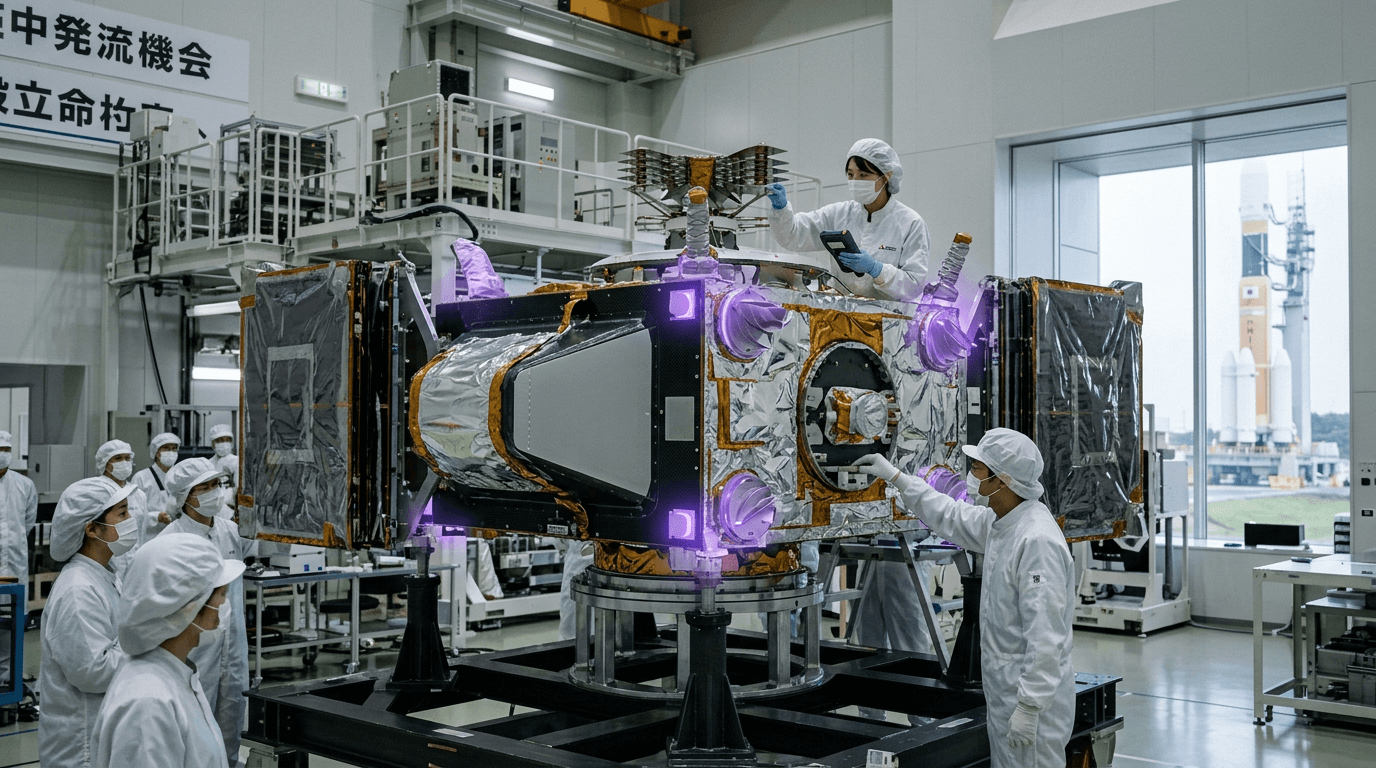
Quasi-Zenith Satellite System (QZSS)
Geography: Asia Pacific · East Asia · Japan
The Quasi-Zenith Satellite System (QZSS), branded 'Michibiki,' is Japan's regional satellite navigation system designed to augment GPS signals and eventually provide standalone positioning capability over Japan and the Asia-Oceania region. The system uses satellites in highly elliptical quasi-zenith orbits that ensure at least one satellite is always near-directly overhead Japan, solving the urban canyon and mountainous terrain problems that degrade GPS accuracy. Currently operating with 4 satellites, QZSS is expanding to a 7-satellite constellation by 2026, with an 11-satellite configuration under consideration.
QZSS provides centimeter-level accuracy through its CLAS (Centimeter Level Augmentation Service) — far beyond standard GPS precision — enabling applications like autonomous driving, precision agriculture, drone delivery, and infrastructure monitoring that require exact positioning. The system also includes a disaster messaging service (DC Report) that can broadcast evacuation and safety information directly to receivers during earthquakes and tsunamis, independent of cellular networks. This dual-use capability — precision positioning plus disaster resilience — makes QZSS uniquely valuable for Japan's geography and seismic risk profile.
Strategically, QZSS represents Japan's path to GNSS sovereignty without building a full global constellation like GPS, BeiDou, or Galileo. The 7-satellite configuration will enable standalone positioning if GPS becomes unavailable — a critical capability given GPS's vulnerability to jamming and spoofing, demonstrated in conflicts from Ukraine to the Middle East. QZSS also extends Japan's soft-power influence across the Asia-Pacific, as the system freely provides enhanced positioning to Australia, Southeast Asia, and Pacific Island nations — regions where China's BeiDou is actively competing for adoption.
Research this in Signals
Signals turns a topic into a sourced research record you can inspect and rerun. Your first scan is free, and this one starts with Quasi-Zenith Satellite System (QZSS) already loaded, so edit it or scan as is.