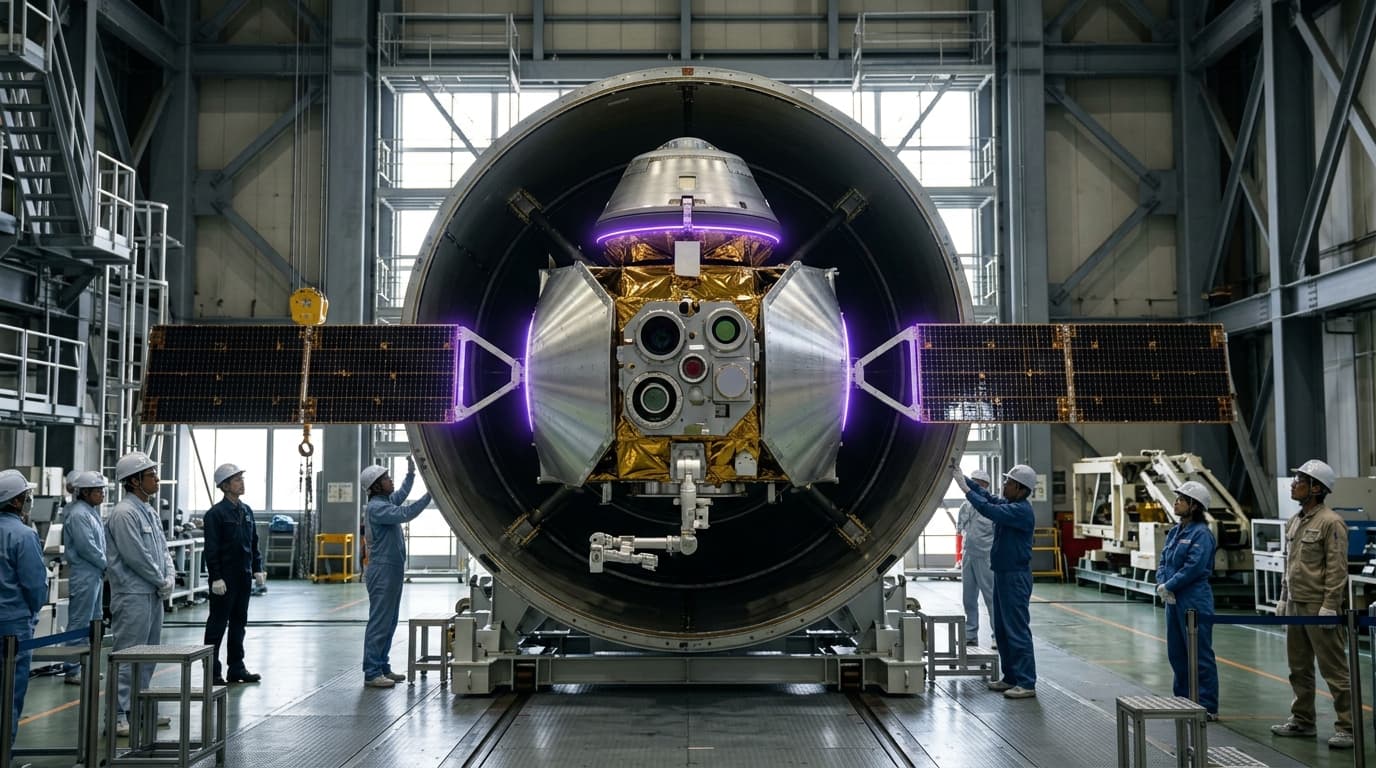
Martian Moons eXploration (MMX)
Geography: Asia Pacific · East Asia · Japan
The Martian Moons eXploration (MMX) mission is JAXA's next flagship planetary science mission, planned for launch in FY2026 aboard an H3 rocket. MMX will explore Mars's two moons — Phobos and Deimos — with the primary objective of landing on Phobos and returning surface samples to Earth by 2031. The mission will also carry instruments from NASA, ESA, DLR, and CNES, making it a major international collaboration.
MMX combines multiple Japan space technology strengths: the precision landing capability demonstrated by SLIM, the sample return expertise proven by Hayabusa2, and the H3 rocket's improved payload capacity. Phobos samples could resolve a longstanding scientific debate about whether Mars's moons are captured asteroids or formed from Martian impact debris — with implications for understanding Mars's geological history.
The mission positions Japan at the forefront of sample return science — a rare capability shared only with NASA (Mars Sample Return) and China (Chang'e). Sample return missions are far more scientifically valuable than remote sensing, providing ground truth for decades of laboratory analysis. MMX continues Japan's strategy of achieving outsized scientific impact through clever mission design rather than massive budgets.
Research this in Signals
Signals turns a topic into a sourced research record you can inspect and rerun. Your first scan is free, and this one starts with Martian Moons eXploration (MMX) already loaded, so edit it or scan as is.