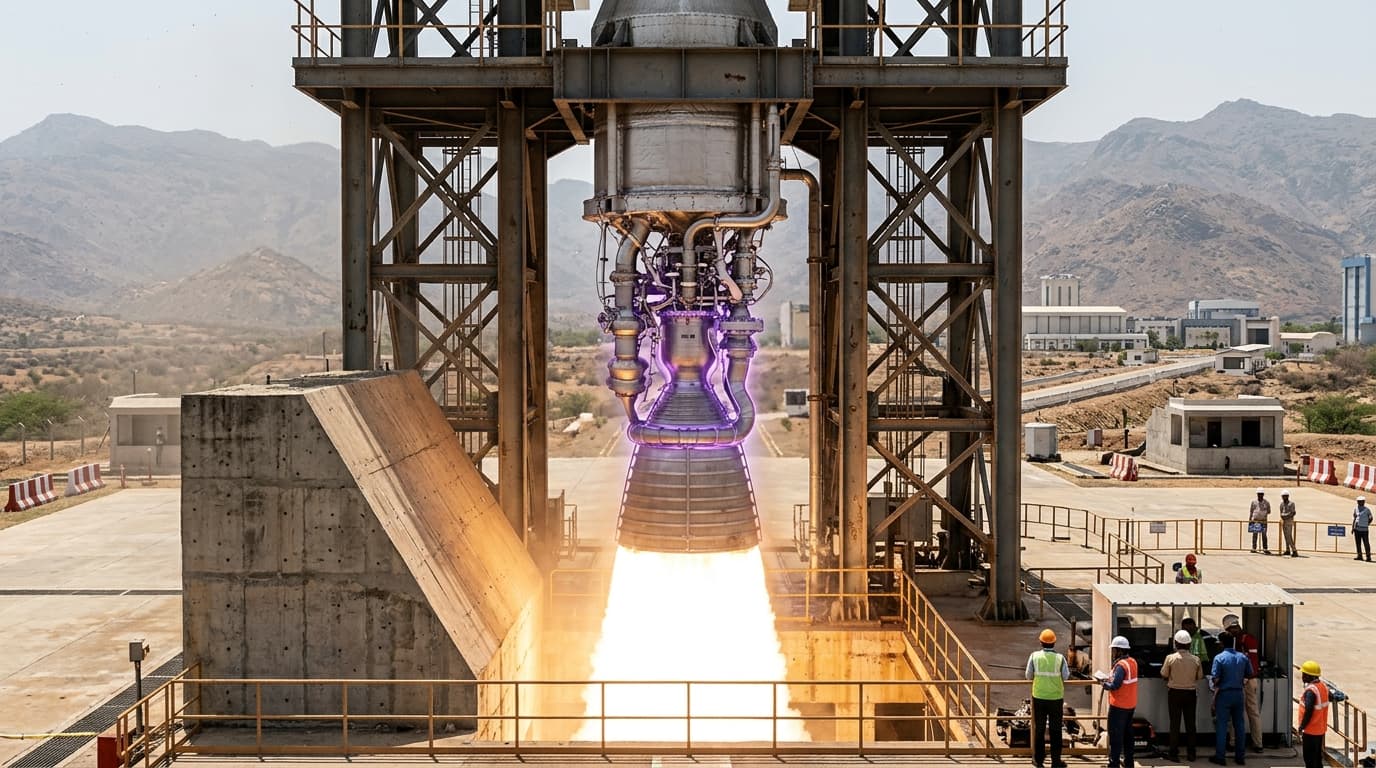
Indigenous Semicryogenic Rocket Engine (SCE-200)
Geography: Asia Pacific · South Asia · India
ISRO achieved a major milestone in March 2025 with the first successful hot test of the Power Head Test Article (PHTA) of the SCE-200 semicryogenic engine at the ISRO Propulsion Complex in Mahendragiri, Tamil Nadu. The SCE-200 is a LOX (liquid oxygen) / kerosene engine delivering 2,000 kN (approximately 200 tonnes) of thrust — significantly more powerful than any engine ISRO has previously developed. The test validated the propellant feed system design including low- and high-pressure turbopumps, pre-burner, starter system, and control components.
The SCE-200 will power the semicryogenic booster stage of an upgraded LVM3 (Launch Vehicle Mark 3), dramatically increasing India's payload capacity to orbit. This is critical for India's plans to launch heavier satellites, build its space station (BAS), and compete in the commercial heavy-lift launch market. The engine uses a gas-generator cycle and features innovations including a novel triethylaluminium/triethylboron ignition system developed by Vikram Sarabhai Space Centre — the first time this technology has been used in an ISRO engine.
Semicryogenic engines (LOX/kerosene) are the workhorses of space launch globally — SpaceX's Merlin and Raptor, Russia's RD-180, and ULA's Vulcan engines all use similar propellant combinations. India mastering this technology closes a critical gap in its launch vehicle capabilities. Combined with ISRO's demonstrated cryogenic engine expertise (CE-20, which had a successful ignition trial in February 2025) and the ongoing work on reusable launch vehicles, the SCE-200 positions India to offer competitive heavy-lift launch services in the 2030s.
Research this in Signals
Signals turns a topic into a sourced research record you can inspect and rerun. Your first scan is free, and this one starts with Indigenous Semicryogenic Rocket Engine (SCE-200) already loaded, so edit it or scan as is.