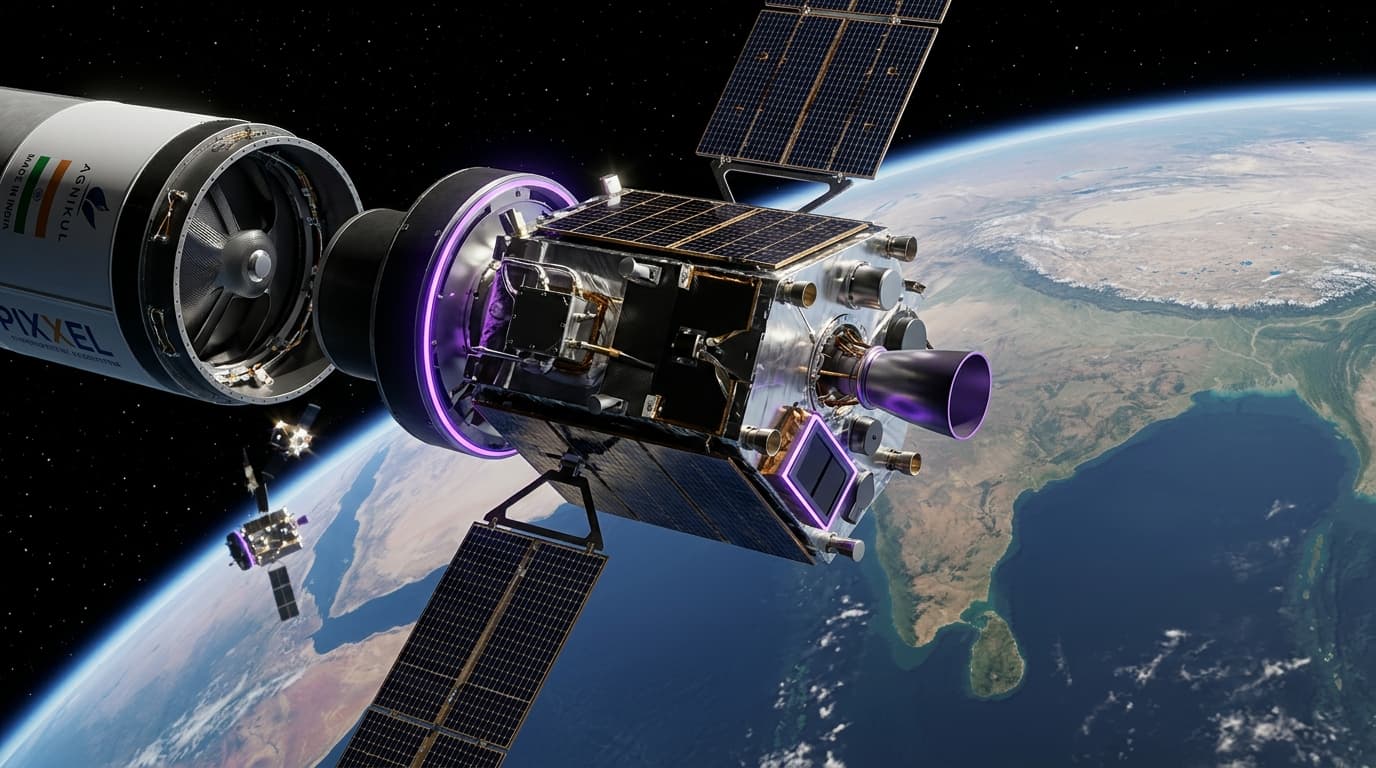
Indian Private Space Ecosystem
Geography: Asia Pacific · South Asia · India
India's space sector was liberalized in 2020 when the government allowed private companies to build and launch rockets, operate satellites, and offer space services. The result has been explosive growth: over 1,200 space-sector companies were registered by early 2025, supported by the Indian National Space Promotion and Authorization Centre (IN-SPACe). Key players include Skyroot Aerospace (launched Vikram-S, India's first private rocket, in 2022), Agnikul Cosmos (developing 3D-printed rocket engines), and Pixxel (launched India's first private satellite constellation).
Pixxel's Firefly series — six hyperspectral imaging satellites launched on SpaceX Falcon 9 rockets in 2025 — represents a new category of Indian space capability. These satellites capture data across hundreds of spectral bands, enabling applications in agriculture monitoring, environmental assessment, and mineral exploration at resolutions impossible with conventional satellites.
The private space sector benefits from India's deep engineering talent pool (many Indian engineers designed chips and software for global space companies before returning home) and ISRO's willingness to share facilities and expertise. The combination of low-cost engineering, government support, and a 2020s startup culture is creating a space ecosystem that could position India as a major player in the commercial space economy alongside the US, Europe, and China.
Research this in Signals
Signals turns a topic into a sourced research record you can inspect and rerun. Your first scan is free, and this one starts with Indian Private Space Ecosystem already loaded, so edit it or scan as is.