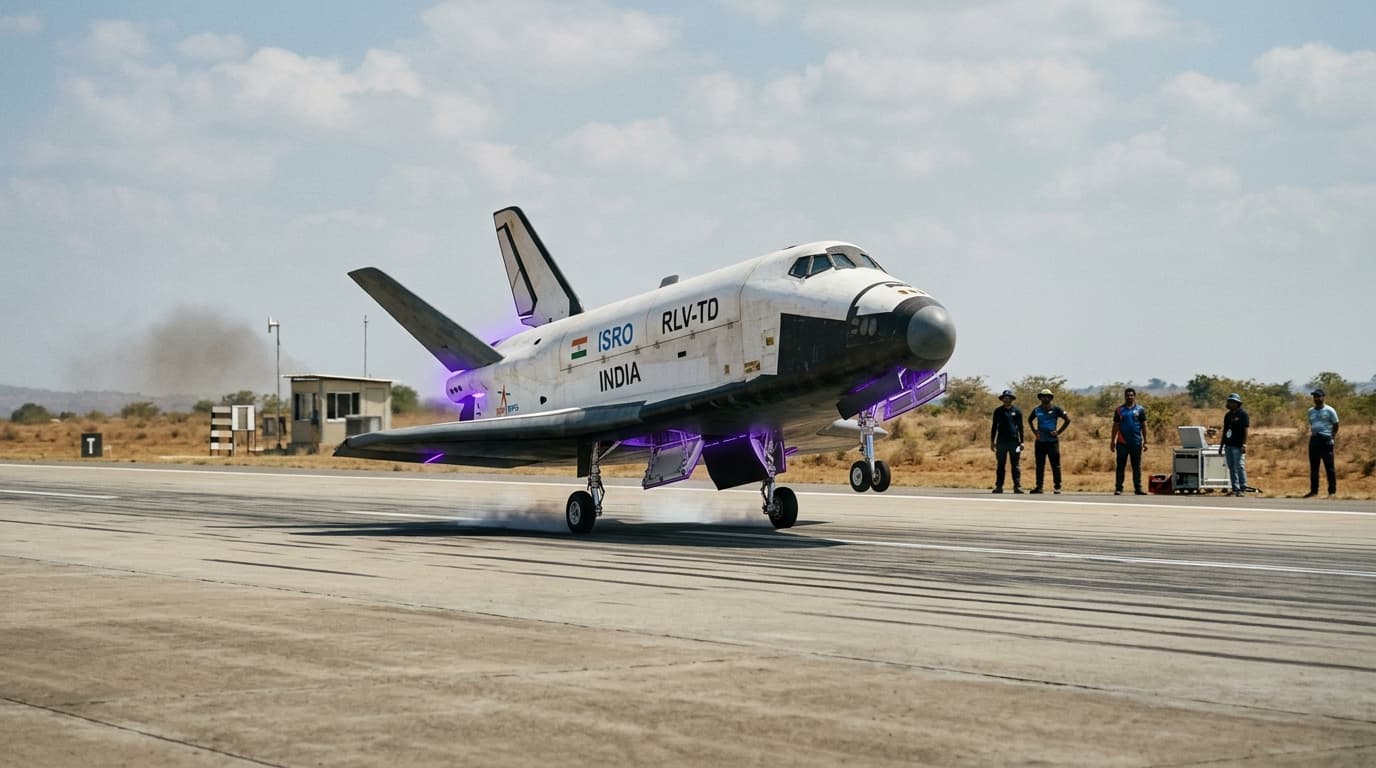
ISRO Reusable Launch Vehicle Technology
Geography: Asia Pacific · South Asia · India
ISRO is developing a Reusable Launch Vehicle-Technology Demonstrator (RLV-TD), a winged vehicle that can launch vertically like a rocket and land horizontally on a runway like an aircraft. The RLV-LEX (Landing Experiment) was successfully conducted in April 2023, demonstrating autonomous approach and runway landing — a critical milestone in reusable launch technology development.
The RLV program aims to reduce launch costs by an order of magnitude. While SpaceX has demonstrated booster reusability with Falcon 9, ISRO's approach is different — a fully reusable, winged vehicle (similar in concept to a space shuttle but single-stage). The vehicle would carry payloads to orbit and return to land on a runway, ready for refurbishment and relaunch.
Developing a fully reusable orbital vehicle is among the most difficult engineering challenges in aerospace. ISRO's step-by-step approach — first demonstrating hypersonic flight (2016), then autonomous landing (2023), with orbital tests planned next — reflects the agency's characteristic caution and cost-consciousness. If successful, an Indian reusable launch vehicle, combined with India's already low labor and manufacturing costs, could make Indian launch services the most cost-effective in the world by a significant margin.
Research this in Signals
Signals turns a topic into a sourced research record you can inspect and rerun. Your first scan is free, and this one starts with ISRO Reusable Launch Vehicle Technology already loaded, so edit it or scan as is.