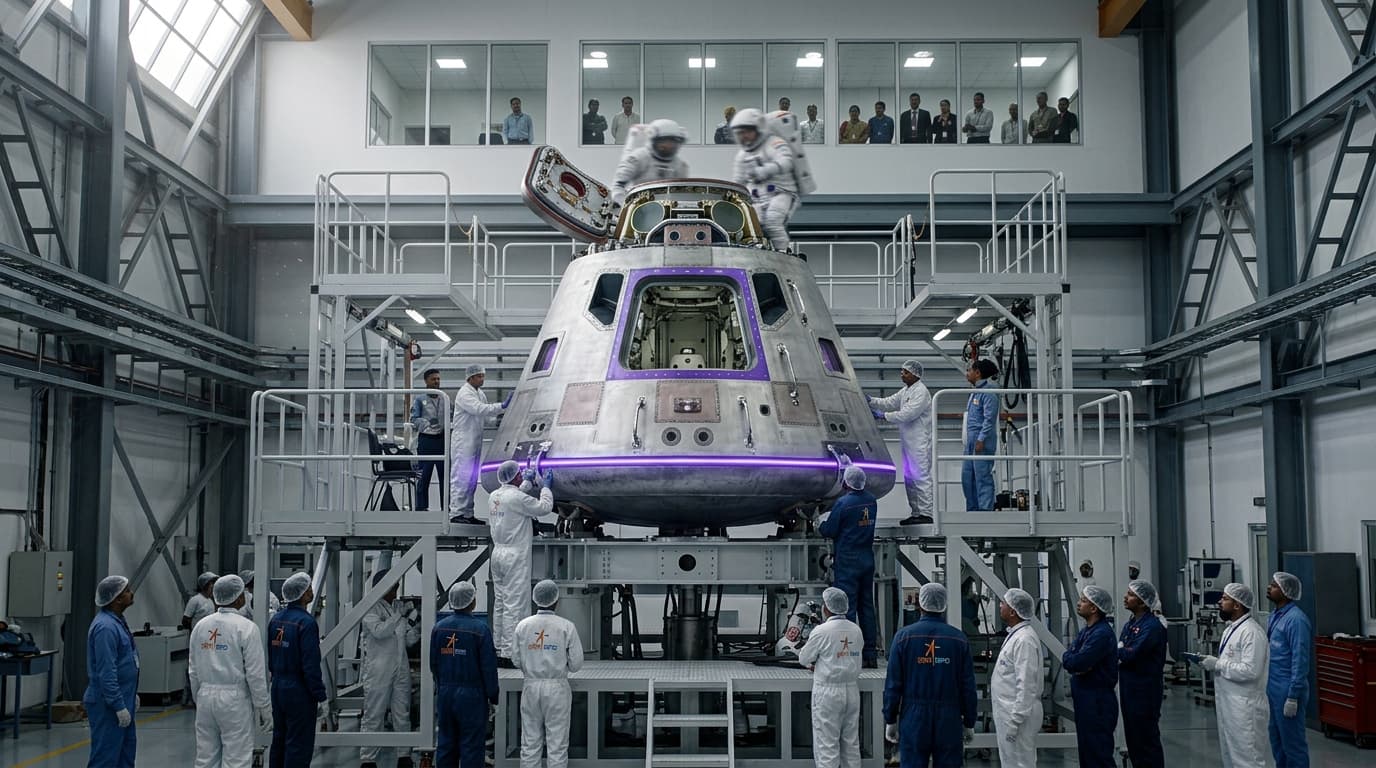
Gaganyaan Human Spaceflight Program
Geography: Asia Pacific · South Asia · India
Gaganyaan is India's ambitious program to develop indigenous human spaceflight capability. The mission aims to send a three-member crew to low Earth orbit (400 km) for a three-day mission using an upgraded GSLV Mk III launch vehicle and a domestically designed crew module. Four Indian Air Force pilots have been selected and trained as astronaut candidates (called Vyomanauts).
The program has been progressing through a series of test vehicle missions. The TV-D1 test in October 2023 demonstrated the crew escape system. The TV-D2 mission is scheduled for Q3 2025, with the first unmanned orbital flight targeted for Q4 2025. Parachute drop tests for the crew module were successfully completed in November 2025 at the Babina Field Firing Range.
Gaganyaan would make India the fourth nation (after Russia, USA, and China) to independently send humans to space. Beyond the prestige, the program is developing critical technologies — life support systems, crew capsule design, re-entry thermal protection — that will be foundational for India's planned Bharatiya Antariksh Station (BAS), an indigenous space station. The program also drives India's broader space industrial ecosystem, with hundreds of private companies supplying components.
Research this in Signals
Signals turns a topic into a sourced research record you can inspect and rerun. Your first scan is free, and this one starts with Gaganyaan Human Spaceflight Program already loaded, so edit it or scan as is.