Ultra-High Payload Ratio Cargo Drones (DARPA Lift Challenge)
Geography: Americas · North America · United States
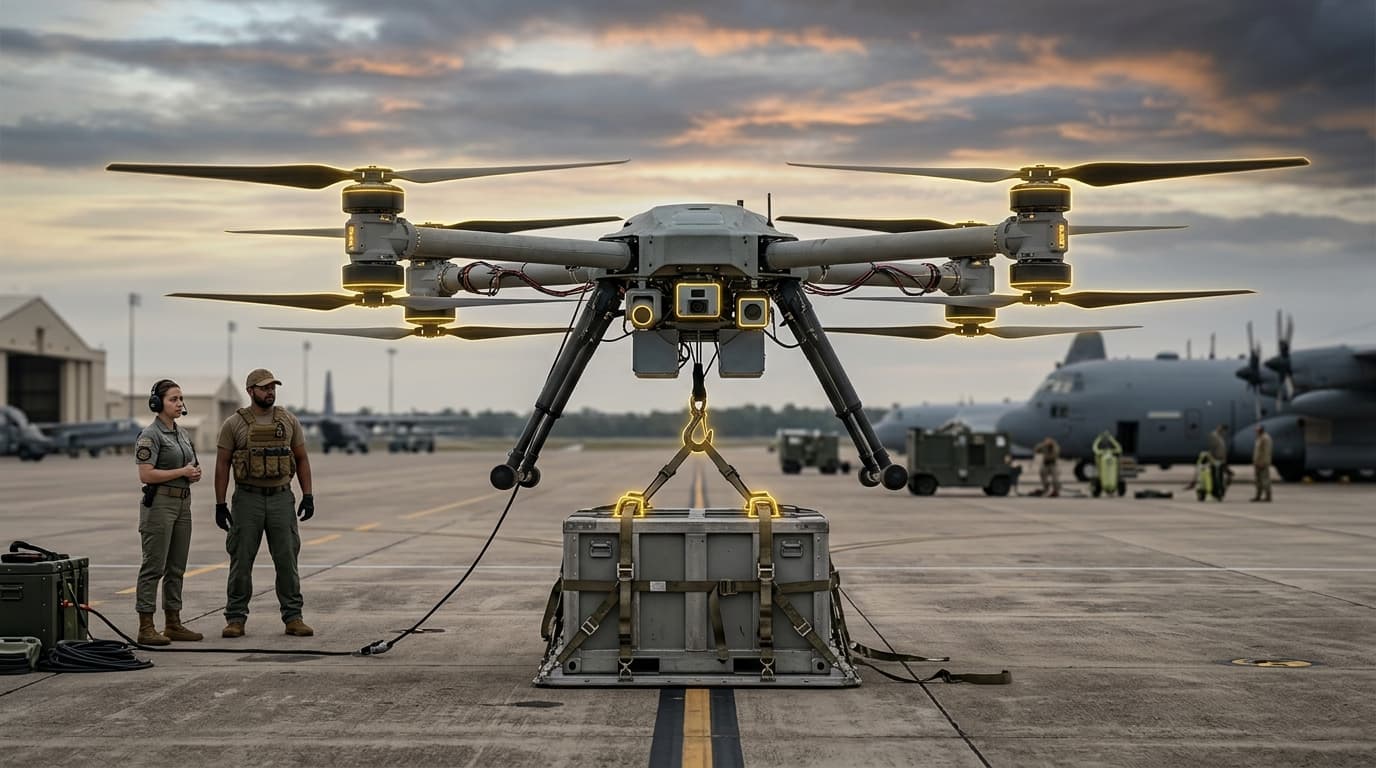
DARPA announced the Lift Challenge in November 2025, a $6.5 million prize competition seeking novel designs for small uncrewed aircraft systems capable of carrying payloads exceeding four times their own airframe weight. Registration opened January 2026, with live head-to-head performance trials scheduled for Summer 2026. The challenge requires strict FAA compliance and prioritizes designs that could scale from small demonstrators to operationally relevant cargo delivery systems.
Current drones are fundamentally limited by the payload-to-weight ratio problem: most can carry roughly their own weight or less. This makes drone logistics impractical for anything heavier than small packages. A 4:1 payload ratio would be transformative — a 50-pound drone could carry 200 pounds of supplies, medical equipment, or ammunition. For military forward operating bases, this could reduce dependence on vulnerable ground convoys and manned helicopters for resupply. For disaster response, it could enable rapid delivery of heavy equipment to cut-off areas.
The Lift Challenge represents DARPA's bet that unconventional aerodynamic configurations, novel materials, or hybrid propulsion systems can break through the current payload ceiling. This echoes DARPA's historical pattern of using prize competitions to catalyze innovation from non-traditional participants — the Grand Challenge that launched the autonomous vehicle industry, the Robotics Challenge that advanced humanoid robotics. If any team achieves the 4:1 target, it could spawn an entirely new category of cargo drones for both military and civilian logistics.
Research this in Signals
Signals turns a topic into a sourced research record you can inspect and rerun. Your first scan is free, and this one starts with Ultra-High Payload Ratio Cargo Drones (DARPA Lift Challenge) already loaded, so edit it or scan as is.