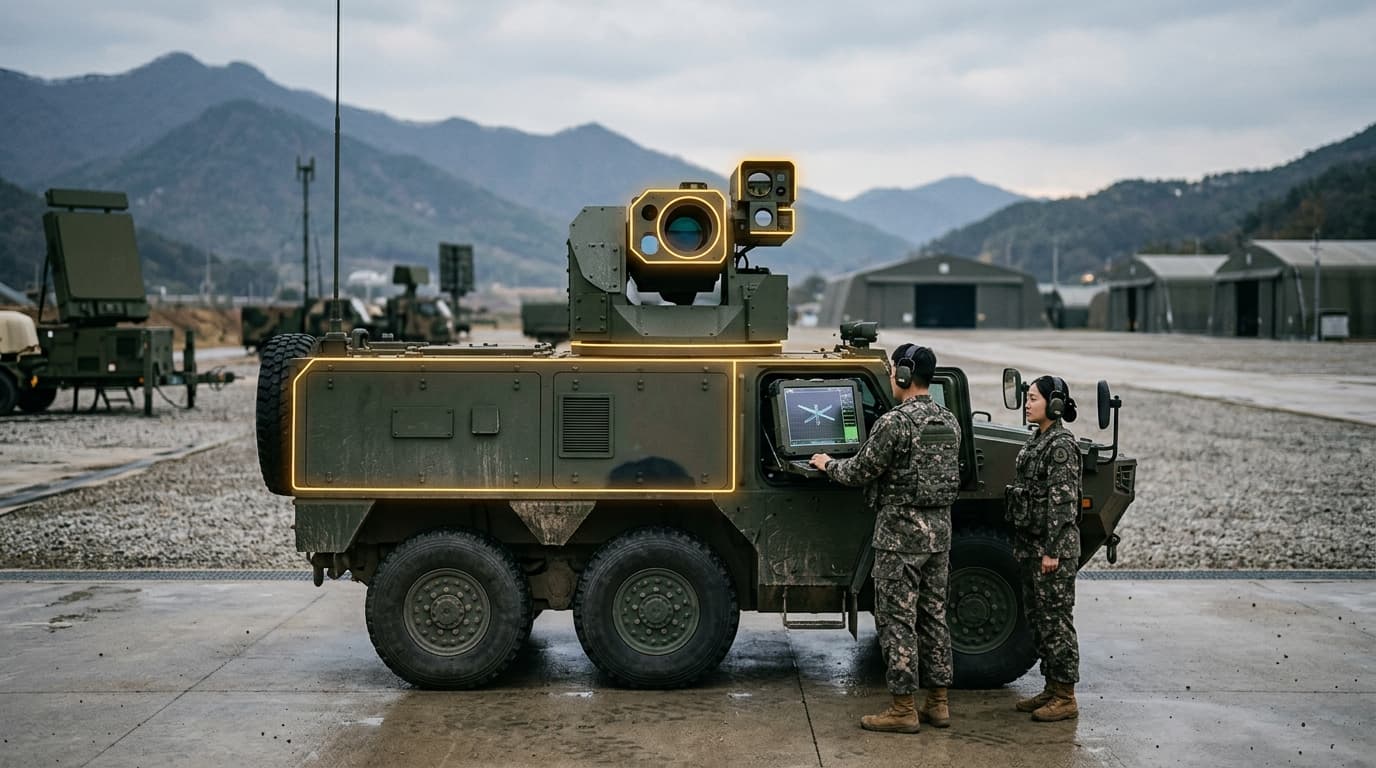
Laser Anti-Drone Weapon System (Cheongwang)
Geography: Asia Pacific · East Asia · South Korea
South Korea's Defense Acquisition Program Administration (DAPA) deployed the Block-I laser anti-aircraft weapon system — dubbed 'Cheongwang' (Sky Light) — in late 2024, making Korea the first country in the world to operationally field directed energy weapons for air defense. The 20kW fiber laser system, manufactured by Hanwha Aerospace, can track and destroy small drones and multicopters at ranges of 2-3 kilometers by emitting a concentrated beam for up to 20 seconds. The cost per shot is approximately $1.50, compared to tens of thousands of dollars for a conventional missile interceptor.
The technology was developed in direct response to North Korean drone incursions — in December 2022, five North Korean drones crossed the DMZ and flew over Seoul for hours, exposing critical gaps in conventional air defense. Traditional anti-aircraft missiles are ineffective and wildly uneconomical against small, cheap drones. Laser weapons solve both problems: they engage at the speed of light, have effectively unlimited ammunition (as long as power is supplied), and cost nearly nothing per shot. Cheongwang is deployed around Seoul and along the DMZ frontline.
Korea is now scaling to 100kW-class systems — in December 2025, DAPA contracted with Australia's Electro Optic Systems (EOS) for a higher-power laser weapon capable of engaging larger threats at greater distances. Korea's urgency in directed energy weapons is driven by the same lesson Ukraine taught the world: cheap drones change warfare economics, and only cheap countermeasures (like lasers) can restore the defender's advantage. Korea's operational deployment gives it real-world data and iteration cycles that no other country's laser weapon program currently has.
Research this in Signals
Signals turns a topic into a sourced research record you can inspect and rerun. Your first scan is free, and this one starts with Laser Anti-Drone Weapon System (Cheongwang) already loaded, so edit it or scan as is.