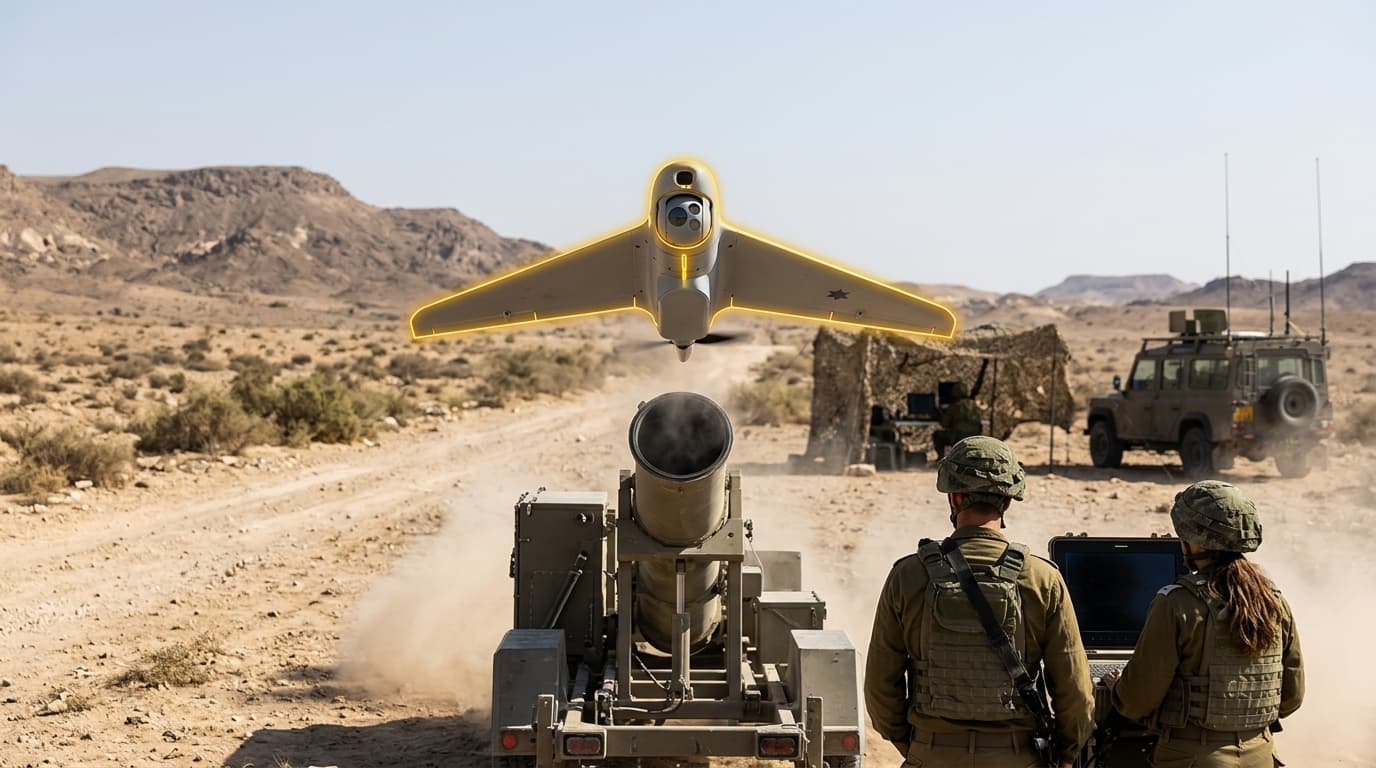
Loitering Munition Autonomous Strike Systems
Geography: Emea · Middle East · Israel
Israel pioneered the loitering munition concept with IAI's Harpy (anti-radiation) and Harop (multi-target) systems — autonomous air platforms that loiter over battlefields for hours before diving into targets on operator command or autonomously. The Harop carries a 23 kg warhead, can loiter for 6+ hours at 1,000 km range, and uses day/night electro-optical sensors. The Mini Harpy combines anti-radiation and EO attack modes in a smaller package for tactical units.
Loitering munitions have become arguably the most significant new weapons category of the 2020s, and Israel created the template. Azerbaijan's decisive use of Israeli-supplied Harop systems against Armenian air defenses in the 2020 Nagorno-Karabakh war demonstrated how these weapons could neutralize entire integrated air defense networks. The technology occupies a unique niche between traditional missiles (fire-and-forget) and drones (recoverable), offering persistence, precision, and low cost.
Israel's loitering munition ecosystem spans multiple manufacturers (IAI, Elbit, UVision) with systems ranging from man-portable tactical variants to long-range strategic platforms. Export contracts exceed $1 billion, with customers across Asia, Europe, and the Middle East. The category Israel invented is now being copied worldwide, but Israeli systems retain the advantage of extensive combat validation — a moat no testing range can replicate.
Research this in Signals
Signals turns a topic into a sourced research record you can inspect and rerun. Your first scan is free, and this one starts with Loitering Munition Autonomous Strike Systems already loaded, so edit it or scan as is.