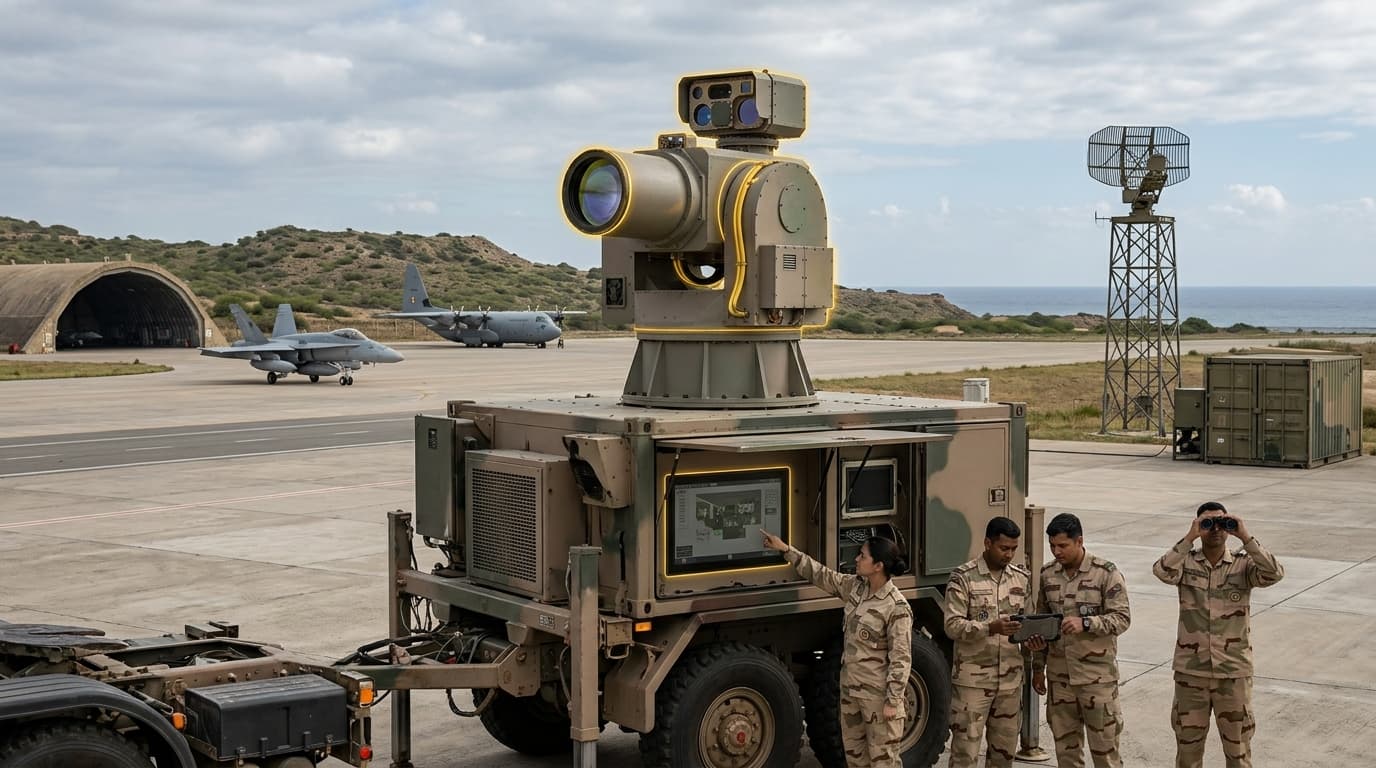
Laser Directed Energy Weapon Systems
Geography: Asia Pacific · South Asia · India
In April 2025, DRDO announced the successful full-scale trial of the Mk-II(A) laser-directed energy weapon system, nicknamed 'Shahastra Shakti.' The system demonstrated the capability to disable drones, missiles, and smaller projectiles using concentrated laser beams. This success builds on decades of Indian DEW research dating back to the KALI (Kilo Ampere Linear Injector) program and the Aditya experimental test bed, which seeded critical technologies for laser weapon programs.
India's DEW ambitions extend further. DRDO has sought $100 million from the Ministry of Defence to develop DURGA II (Directionally Unrestricted Ray-Gun Array), a high-power laser weapon designed for broader battlefield applications. The technology roadmap includes vehicle-mounted, ship-mounted, and eventually aircraft-mounted laser systems. The Mk-II(A) success demonstrated key subsystems: high-energy laser generation, beam delivery and focusing over distance, target tracking and engagement, and thermal management of the weapon system itself.
Directed energy weapons represent a paradigm shift in air defense economics. A conventional missile interceptor costs $100,000-$3 million per shot; a laser engagement costs roughly the price of a diesel generator's fuel — perhaps $10-50 per shot. Against the proliferating threat of cheap drones (as demonstrated in the Ukraine-Russia and Middle East conflicts), this cost asymmetry strongly favors laser defenses. India demonstrating this capability positions it both for domestic force protection and as a potential DEW exporter — a market expected to grow to $20+ billion by 2030.
Research this in Signals
Signals turns a topic into a sourced research record you can inspect and rerun. Your first scan is free, and this one starts with Laser Directed Energy Weapon Systems already loaded, so edit it or scan as is.