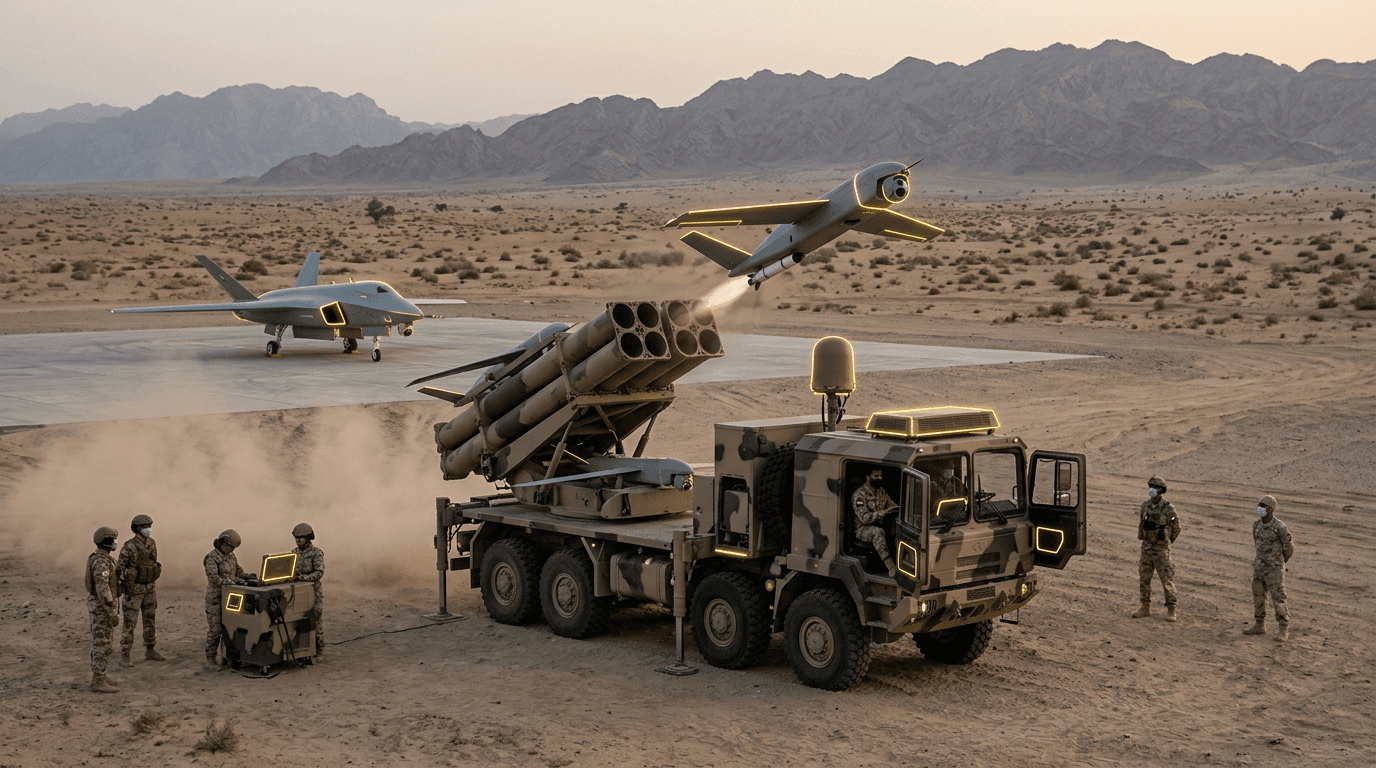
Indigenous Loitering Munition Systems
Geography: Emea · Middle East · Gulf States
The UAE's ADASI subsidiary (under EDGE Group) has developed multiple families of loitering munitions and strike UAVs: the QX-1, QX-2, and QX-3 with varying payload capacities for frontline forces, and the Shadow family of jet-engine-powered UAVs (Shadow 25, Shadow 50-TJ, Shadow 50-P) with GNSS satellite-linked navigation for extended-range operations. The Reach-S provides heavier loitering strike capability.
Loitering munitions have become the defining weapons of 21st-century conflict — as demonstrated in Nagorno-Karabakh, Ukraine, and Yemen. Nations that cannot produce them domestically face a critical capability gap. The Gulf states' transition from pure consumers to producers of these systems represents a fundamental shift in regional military-industrial power, moving beyond the traditional model of purchasing Western or Israeli systems.
The indigenous loitering munition capability is strategically significant because these weapons are often subject to the tightest export controls. Israel's Harop and US Switchblade are restricted to approved buyers; Turkey's Bayraktar has shown how domestic drone production transforms geopolitical leverage. The UAE's ability to produce, use, and export these systems independently — without US or Israeli permission — makes it the first Gulf nation with genuine autonomous strike sovereignty.
Research this in Signals
Signals turns a topic into a sourced research record you can inspect and rerun. Your first scan is free, and this one starts with Indigenous Loitering Munition Systems already loaded, so edit it or scan as is.