At SXSW 2026, Amy Webb (Future Today Strategy Group) declared the death of the trend report, especially the static PDF. The statement landed because it named something many people working with trends, futures, and innovation already feel: the format is struggling to keep up with the speed of change.
The format is also saturated, stagnant, and biased. Cultural Strategist Amy Daroukakis noticed how “90% of annual trend reports come from only 10 cities: London, New York, Tokyo, Paris, Shanghai, Los Angeles, Amsterdam, Berlin, São Paulo & Seoul.” Matt Klein, Digital Anthropologist, noted that over the past five years, the number of trend reports has more than doubled, and many of them have become repetitive pieces of corporate advertising.
The problem is not research itself. Organizations still need to understand emerging technologies, cultural shifts, market signals, and strategic uncertainty. They still need synthesis, interpretation, and direction. The problem is what happens when that work ends as a fixed output.
A report captures a moment. But change does not stop at publication. New signals appear, assumptions shift, technologies converge, and what once seemed peripheral can quickly become relevant. In that context, a static report can lose value not because it was poorly made, but because it was not designed to keep learning.
This is where research systems become more useful.
Instead of treating signals as examples inside a final document, a research system treats them as reusable intelligence. Signals can be collected, tagged, assessed, compared, updated, and revisited over time. They can support different scans, questions, and strategic conversations without starting from scratch each time. That continuity changes the role of foresight.
It allows teams to see not only what is emerging, but how developments connect, accelerate, fade, or converge across domains. It makes research easier to navigate, question, and apply. Most importantly, it allows intelligence to compound.
This is the logic behind Envisioning’s Signals Workspace. The platform supports different AI-powered scans, from vision and horizon scans to technology scans, using customized metrics and bespoke assessments. Rather than producing a single finished view of the future, it helps organizations build a living base of signals they can continue to explore.
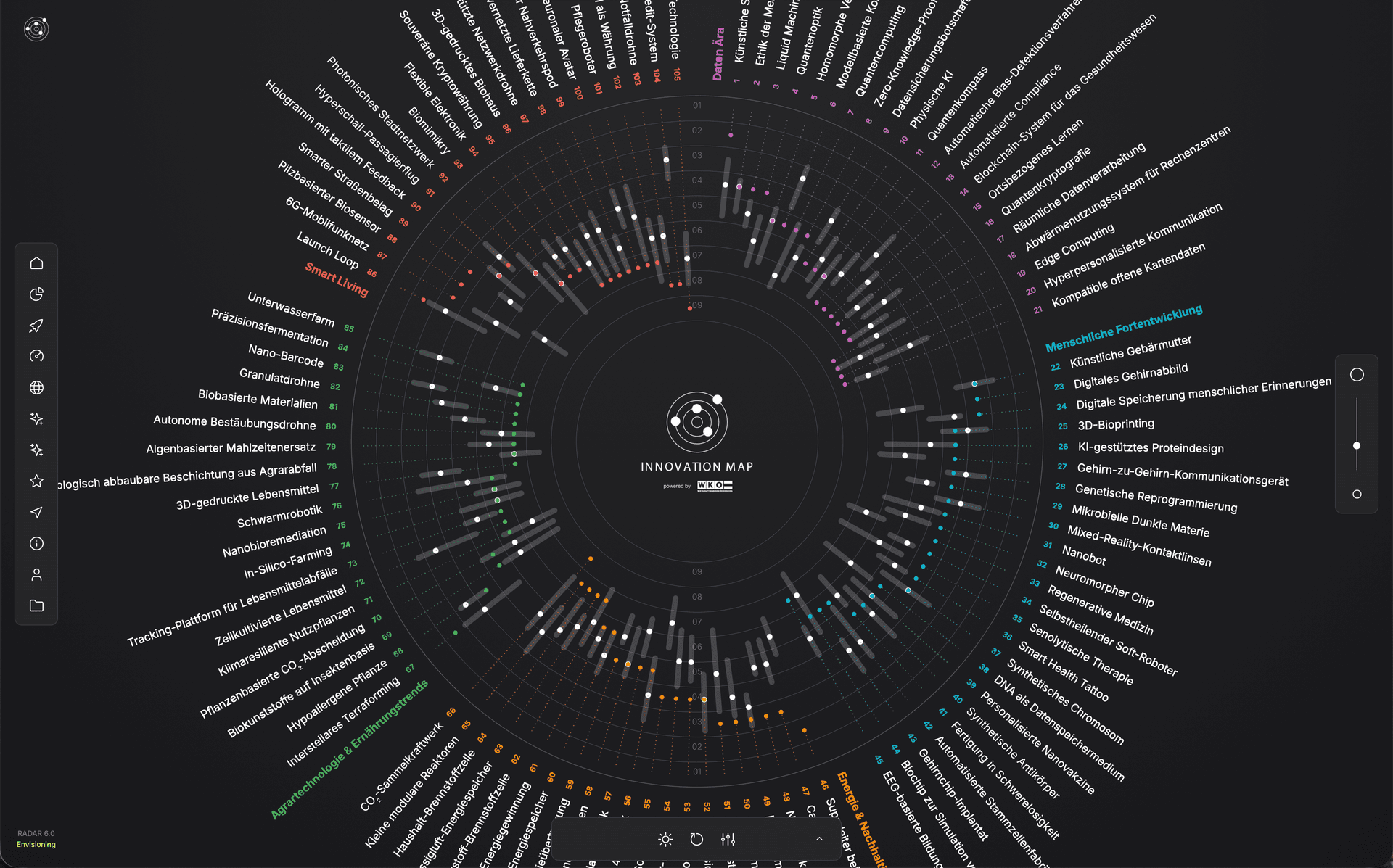
Our work with WKO, Austria’s Chamber of Commerce, reflects this approach. For years, we have mapped emerging technologies together through a dynamic radar that helps Austrian businesses explore developments relevant to their future. The value lies not only in the research output but also in the continuity of the system behind it.
This does not mean reports have no place.
Reports can still synthesize, communicate, and create alignment. They are useful when a team needs a clear narrative at a specific moment. But they should not carry the full weight of strategic intelligence.
The future of foresight is not simply more reports. It is research that remains active after publication. A static output can tell people what was seen. A continuous intelligence system helps them keep seeing.
Explore Signals Workspace to see how Envisioning turns signal scanning into structured, reusable foresight intelligence.