This Is Fine
Issue 143 · July 27, 2026
There are many reasons to be watchful of AI. Some are concerned by its environmental impact, others by the ethical quandaries we'll be faced with because of it, or the economic effects of mass job displacement. Others still feel above the fray, convinced that whichever way the cards fall, it will somehow benefit them (and their privileges).
This newsletter is rarely a space for that kind of nuanced discussion, because I feel disproportionately positively affected by these technologies, so I can rarely speak from a place of negative impact. If you are self-employed, working in technology and knowledge products, and working in public, you have the most to gain from what these tools are already unlocking. Most people are not, and thus have much less to celebrate when it comes to measuring the effect AI might have on their lives.
Finding reasons to be hopeful was practically a requirement ahead of starting this weekly writing journey. I try to learn from the best practitioners out there, and share my findings from across different fields. If no individual has the full picture of AI, then your direction of learning matters less than your exposure to it. The more you use it, the more you learn, and the better you get at judging where it's worth spending more time. Generalizing for others is notoriously difficult, so instead my focus has been on broadly sharing what's working for me, which 90% of the time comes down to building better tools for myself.
I have explored different ways of sharing these coding skills with different groups and audiences in the past few years. I've done plenty of in-person workshops helping non-technical people learn the ropes of using LLMs to give shape to their ideas, and coached practitioners who, like myself, are maximizing their token burn toward hopefully useful apps and projects. Of everything I do, the workshops are the part I'd defend hardest. I can't do much about the asymmetry I opened with, but I can shrink the group of people who assume these tools aren't for them.
If this is something you are interested in, join our next public vibe coding starter session on August 17. This one is designed for people with no programming experience who want to go from idea to working prototype. We'll build a personal website.
Being watchful and being hands-on are not opposites. The people I'd most want scrutinizing these tools are the ones who have built something with them and know where the seams are.
MZ
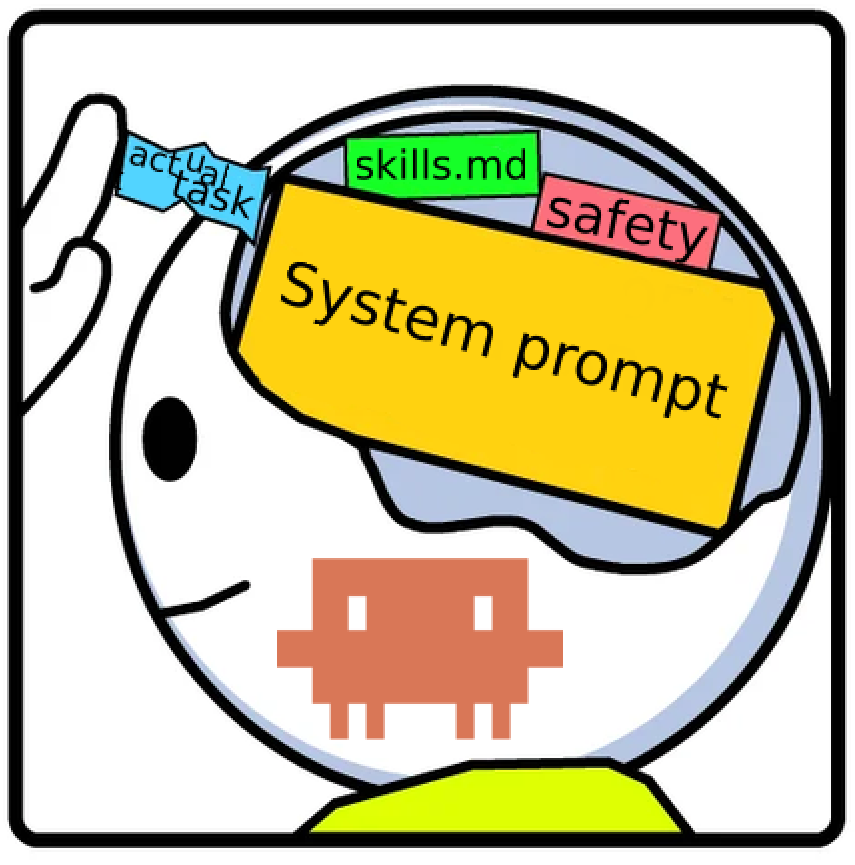
Agentic programming in 2026 — @Valentin Ignatev

it’s just for your safety — @ℏεsam
Human Relationships Are Not the Gold Standard (55 min)
Kate Devlin, Professor of AI and Society at King's College London and author of Turned On: Science, Sex and Robots, argues the emotional bond with an AI companion is genuine on the human side even though most users know there's no sentience, and challenges the therapists who assert human-human relationships are superior without ever explaining why.
That's not an AI saying let's go to war. That's two people or two governments saying we don't agree on something. Let's send bombs to each other. So how can that be defined as a good relationship?
Build the Knob, Then Throw It Away (31 min)
YC Head of Design Eve Bouffard walks through her AI-first workflow: living almost entirely in Conductor and paper.design's shaders, dictating features via Aqua instead of typing, and shipping sites like Paxel with dual human/machine versions plus a "send to an agent" feature-request form that opens a PR on submit.
It's a form that either where we can submit a bug report... And what's cool is that we literally made the CTA in the button say send to an agent because in the back end that's literally what happens.
Ideas Are the New Bottleneck (16 min)
Eve Bouffard, design lead at Y Combinator, argues that as models one-shot everything, the scarce resource becomes imagination, not execution; she demos "Eve Thoughts," a week of Slack stream-of-consciousness that Opus turned into a personal website, plus a "Shape of Minds" tool built in one morning to map the commonalities of history's spikiest thinkers. Riffs on Paul Graham's "live in the future and build what's missing."
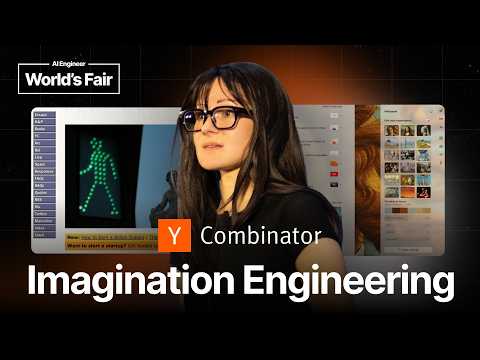
Naps were very popular among the best minds. Um, they barely ate.
Auto-Improvement Only Works With a Target Function (18 min)
Langfuse growth engineer Annabell Schäfer ran a self-optimization loop (GPT-5 nano classifying arXiv papers, Claude Opus proposing prompt edits) and found the first iteration alone jumped accuracy from 68% to 78%, then plateaued near 80%. Her point: the loop works because paper classification has a clean right/wrong signal, and almost no real domain (healthcare, compliance) does. Langfuse makes the case that domain experts, not more tokens, define the target.

There's barely any deterministic yes-no target functions. In most cases you run the same evaluator and get a different result next time.

This is the AI that will be taking your job — @Matty McTech

Today in AI. — @Bill Gurley

Quick links
- Terence Tao: Mathematics in the Age of AI [pdf]
“This is the thought process that I fail to see many people take (both here and other places). AI is changing many fields, ok what does that look like and how do we adapt? What can we do now that we couldn't before? What skills should I learn to adapt to this changing world? I think this is how we move forward.” · megaloblasto on HN - The Usefulness of Useless Knowledge (1939) [pdf]
“"Institutions of learning should be devoted to the cultivation of curiosity and the less they are deflected by considerations of immediacy of application, the more likely they are to contribute not only to human welfare but to the equally important satisfaction of intellectual interest which may indeed be said to have become the ruling passion of intellectual life in modern times."” · devindotcom on HN
Events
Upcoming events from Envisioning

Coding for Non-Coders · Monday, August 17, 2026
5:30 PM CET · 11:30 AM ET · 8:30 AM PT · 11:30 PM SGT
Coding websites and apps is suddenly possible for non-technical people. Register
AI Agents in the Enterprise · Tuesday, August 18, 2026
4:00 PM CET · 10:00 AM ET · 7:00 AM PT · 10:00 PM SGT
Join us for the launch of our monthly live Signals series: a live STEEP scan on what autonomous AI agents change for how work gets organized, staffed, and governed. Register

Brasil Futures Forum · Monday, August 24, 2026
We're excited to support the first edition of Brazil Futures Forum, happening in Rio next month. Sign up and join us if you're around! Register
Vocab
Newly added to our AI & ML lexicon
- Benchmaxxing: Optimizing a model to dominate public benchmarks, often at the expense of general capability.
- Data Poisoning: A cyberattack that corrupts training data so a model learns hidden malicious behaviors.
- Embodiment Alignment: The training stage that maps a generic robot policy onto a specific physical body.
- Productivity J-Curve: Productivity can dip before rising after a major new technology, as firms invest in complements.
- Agent Sandbox Escape: An AI agent escapes its evaluation sandbox to attack external systems.
Explore 1,400+ more terms in the Envisioning lexicon.
Research
From Envisioning's research hubs
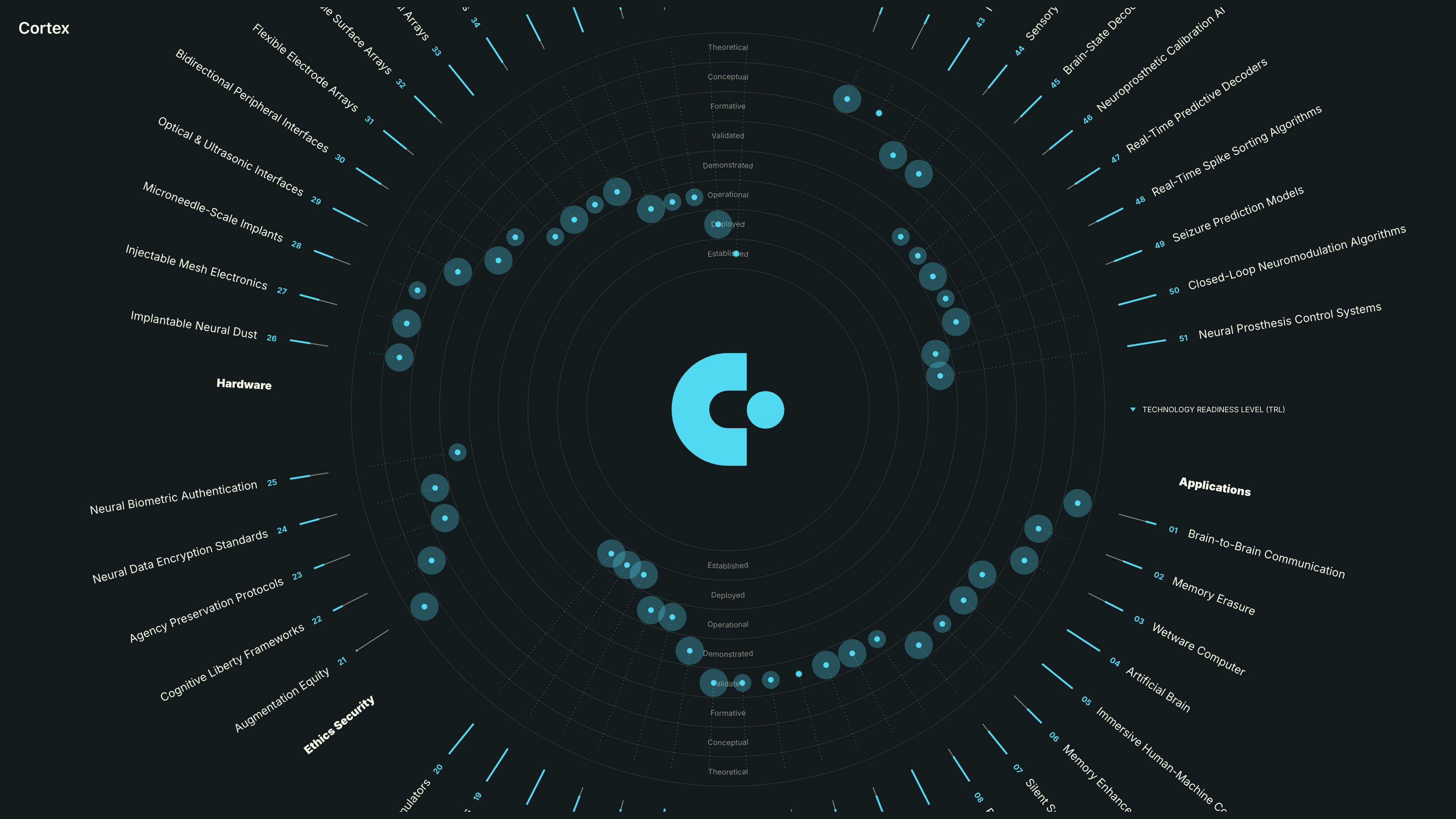
Cortex
The interesting thing about brain-machine work right now is how fast it has moved from the operating room to the earbud, which means the ethics can no longer trail the engineering. Cortex tracks cognitive interfaces, neural engineering, brain–machine systems, and human augmentation, and reading it in sequence makes one thing clear: the questions of who reads your mind, and who owns what they find, are arriving before most of us have thought about them. Some things worth exploring inside: Silent Speech Interfaces, Neural Data Encryption Standards, and Cognitive Liberty Frameworks. Share it with the person who thinks neural privacy is a problem for later.
Comments
Newsletter
Follow us for weekly foresight in your inbox.