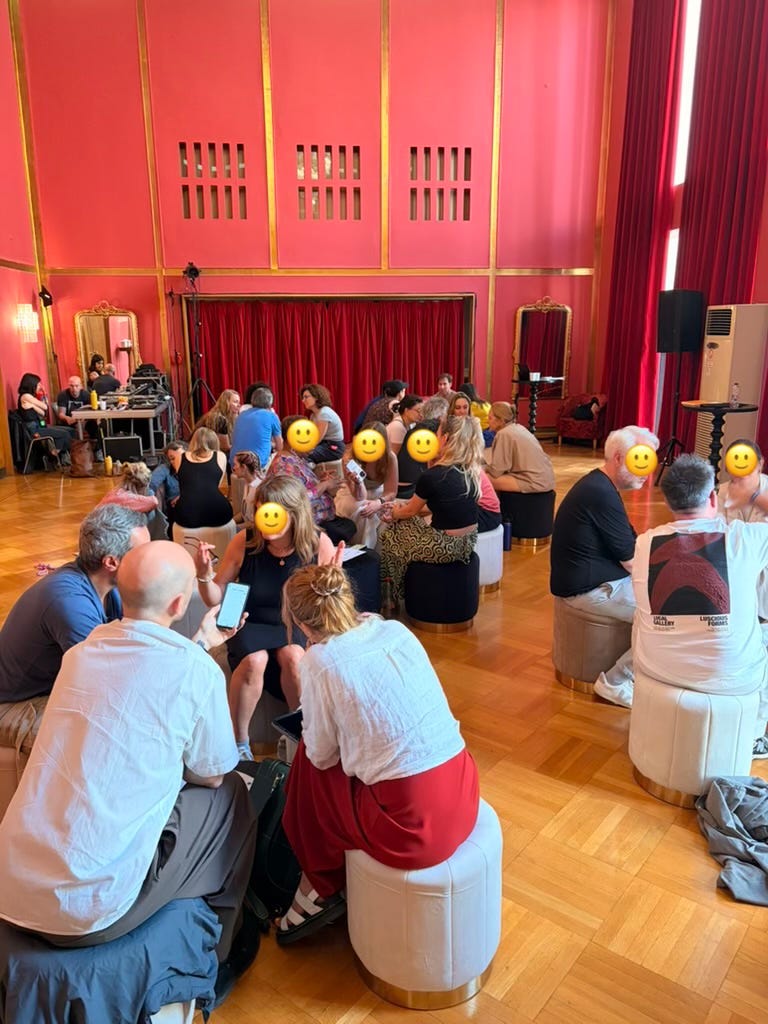
At the World Beautiful Business Forum in Athens, Envisioning’s co-founder, Michell Zappa, co-facilitated an experimental workshop on collective agency, hosted by C3 Labs, the UN-founded Collaboration for Complex Challenges initiative.
The session, titled Reclaiming Collective Agency in the World, posed a practical question: What could a 12-month global learning lab look like if prototyped by the people in the room?
Throughout the workshop, participants engaged in embodied dialogue, group discussion, voting, AI-assisted transcription, and signal mapping. This process served as a live experiment in human-AI sensemaking, transforming collective energy into structured, comparable intelligence.
Why this matters
Workshops often generate valuable conversations that are difficult to carry forward.
People share ideas, priorities emerge, and patterns become visible. However, after the session, much of this knowledge remains fragmented. Notes are incomplete, memories vary, and key insights often depend on who listened, summarized, and documented. This is a common challenge in futures and innovation work. While collective intelligence is present, it is not always captured in a form that can be analyzed, compared, or revisited.
This experiment took a different approach: using AI to support, rather than replace, human interpretation.
How the experiment worked
Before the session, Claude was used to read 120 program descriptions from the festival and extract the themes and challenges they implicitly raised. These became the foundation for a signals poll: six themes and 36 interconnected challenges that participants could vote on.
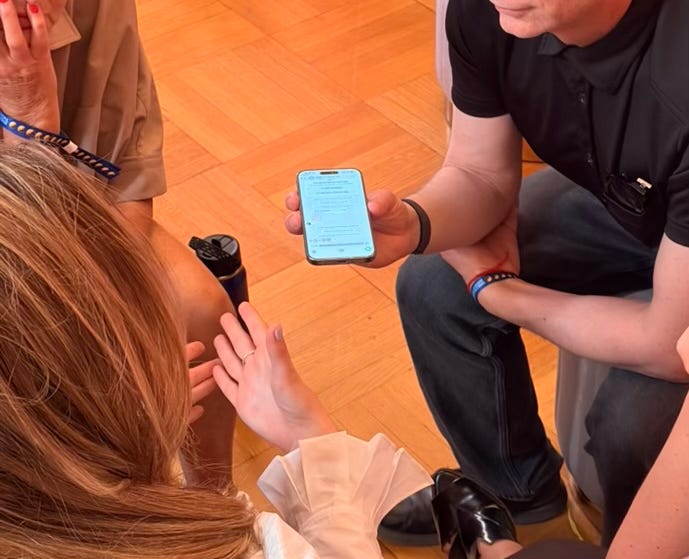
During the workshop, participants discussed the challenges they cared about most. Breakout groups recorded their conversations and shared the audio through a simple WhatsApp flow. Those recordings were then transcribed and matched back to the signals they engaged with.
In practice, the method created a loop:
- The program was analyzed to identify recurring themes and challenges.
- These challenges were translated into a signals poll.
- Participants voted on the signals they found most relevant.
- Breakout groups discussed selected challenges in more depth.
- Audio reflections were transcribed and anonymized.
- AI helped match the discussion back to the signals.
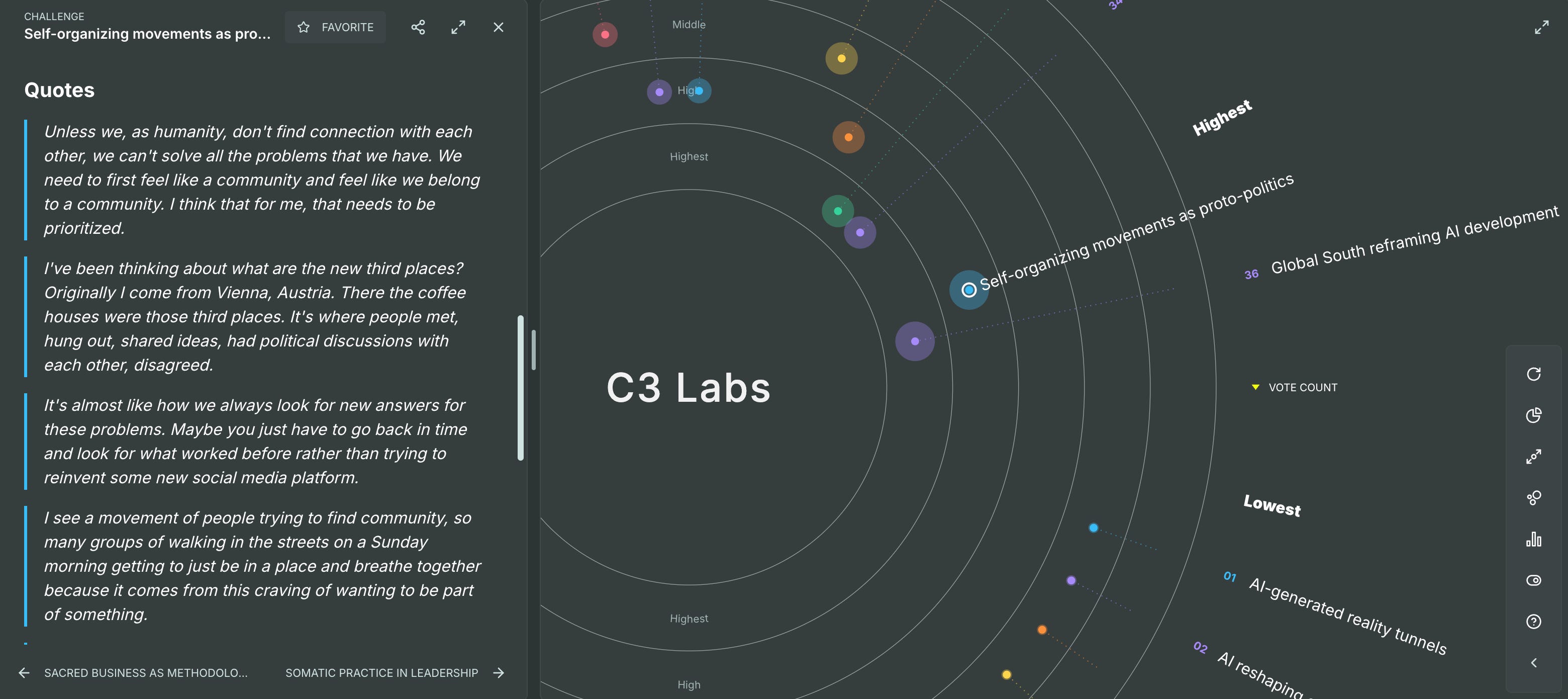
- The results were visualized as a heat map, combining vote counts with participant quotes.
The output was not a single ranking, but a map of collective attention. You can see it here.
Each signal included two types of evidence: the number of votes and the amount of discussion it generated. This allowed comparison between stated priorities and conversational depth.
What became visible
The workshop generated 590 votes across 36 signals. The top signals were closely ranked, indicating a cluster of shared concerns rather than a single dominant issue.
Three signals stood out, each reframing topics often seen as secondary or peripheral into central strategic questions:
- Relational intelligence in leadership
- Bioeconomy as industrial successor
- Intelligence beyond the artificial
Together, these signals revealed a broader pattern: participants were interested not only in new tools or technologies, but also in new operating logics.
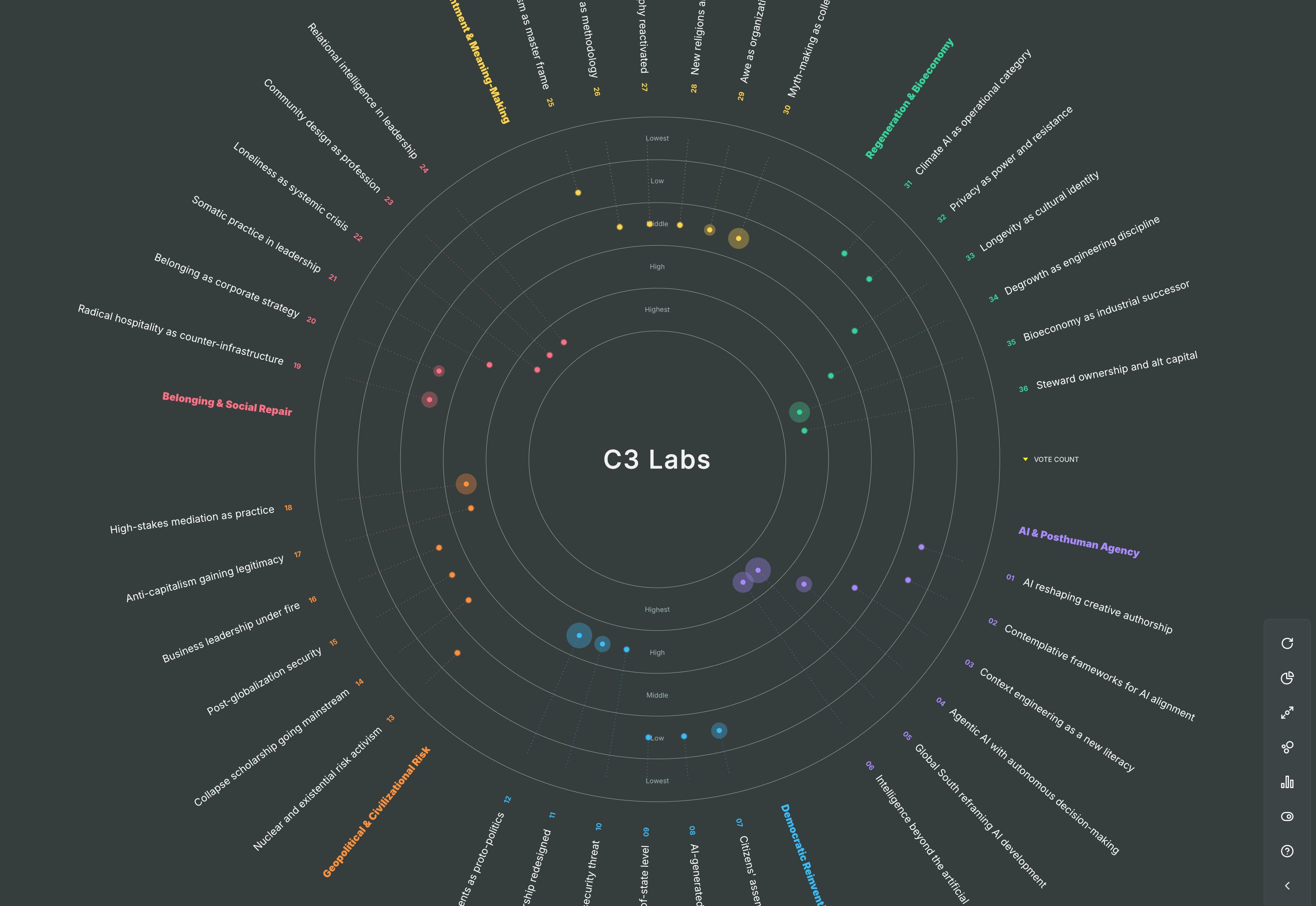
The theme of Belonging and Social Repair was especially prominent, with several highly ranked signals. In contrast, AI and Posthuman Agency appeared more polarized. Participants showed interest in expanding the meaning of intelligence, but were less engaged by topics perceived as saturated or overly abstract.
Lower-ranked signals also provided valuable insights. Topics like AI-generated reality tunnels, Climate AI, and contemplative frameworks for AI alignment received less attention. This may indicate participants sought more actionable or generative perspectives beyond familiar diagnoses.
What the method enabled
The experiment’s value lay not only in its results, but also in the speed and structure of its process.
Within a few days, a temporary group progressed from programme analysis to signal generation, live voting, group discussion, transcription, matching, and visualization. This process bridged qualitative insights with structured comparison.
This is important because many organizations attempt to address complex change using formats not designed for such complexity. Surveys capture preferences but often miss context. Workshops provide context but lack comparability. Reports synthesize findings, but typically after the fact.
This experiment brought those layers closer together.
It demonstrated how AI can make collective sensemaking more transparent without diminishing human input. Both quotes and vote counts were important, but their relationship was even more significant.
A method, not a template
The Athens workshop was intentionally experimental: small, fast, and context-specific. Its results should be considered directional rather than definitive. However, the method suggests a broader possibility: live research environments where participation becomes data, discussion becomes evidence, and collective attention is mapped in real time.
For Envisioning, this raises a broader question: How can research systems become more adaptive, participatory, and useful in real time? The answer is unlikely to come from AI alone. It requires designing better feedback loops among people, tools, interpretation, and action.
Michell Zappa shared a first-person account of the workshop, including the process, results, and live radar. Read the full newsletter here.
If you would like to explore a similar experiment for your organization, event, or community, get in touch.