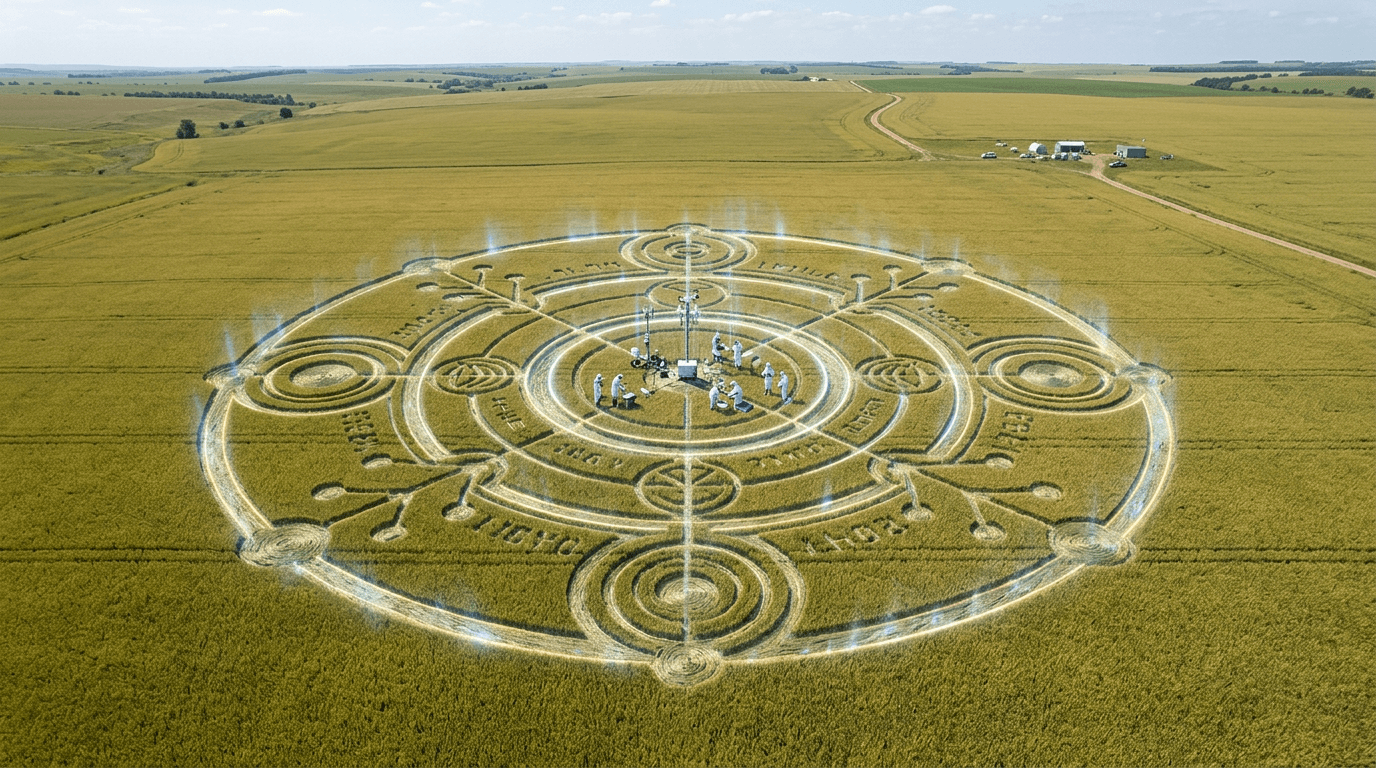
Agroglyph Resonant Interfaces
Agroglyph formations—popularly called crop circles—are treated here as xenotechnological environmental interfaces: large-scale glyphs imprinted into vegetation and soil through directed energy processes that appear to exceed conventional human fabrication.
Resonant Field Imprinting
Investigations document elongated plant nodes, expulsion cavities, dehydrated husks, and vitrified soil particulates pointing toward rapid heating or microwave exposure rather than mechanical flattening. Witnesses report transient electromagnetic anomalies, compass deviations, and localized static charge, suggesting standing-wave or plasma-based imprinting that couples atmospheric energy into biological tissue without combustion.
Information Encoding Hypotheses
The geometry frequently expresses mathematical constants, astronomical alignments, binary sequences, and fractal recursion at meter-scale precision. This supports the view that formations function as broadcast glyphs—data structures inscribed into the landscape where pattern, proportion, and orientation encode semantic payloads beyond aesthetic expression.
Environmental Communication Interfaces
Interpreted as xenotech, agroglyphs operate as non-destructive land-surface interfaces: signaling platforms visible from aerial vantage, resonant field nodes embedding energetic signatures into plant physiology, and potential consciousness triggers where observers experience altered states or intuitive downloads when entering the formations. The technology blurs ritual, geometry, and energy engineering into a single communicative medium.
Critical Assessment
Hoaxing has been demonstrably responsible for many formations, yet a subset retains unresolved biophysical markers and electromagnetic anomalies. The xenotechnology framing acknowledges both the speculative instrumentation capable of rapid field imprinting and the symbolic communication goals, while remaining agnostic about origin—unknown human groups, non-human intelligences, or an emergent natural resonance phenomenon.
Research this in Signals
Signals turns a topic into a sourced research record you can inspect and rerun. Your first scan is free, and this one starts with Agroglyph Resonant Interfaces already loaded, so edit it or scan as is.