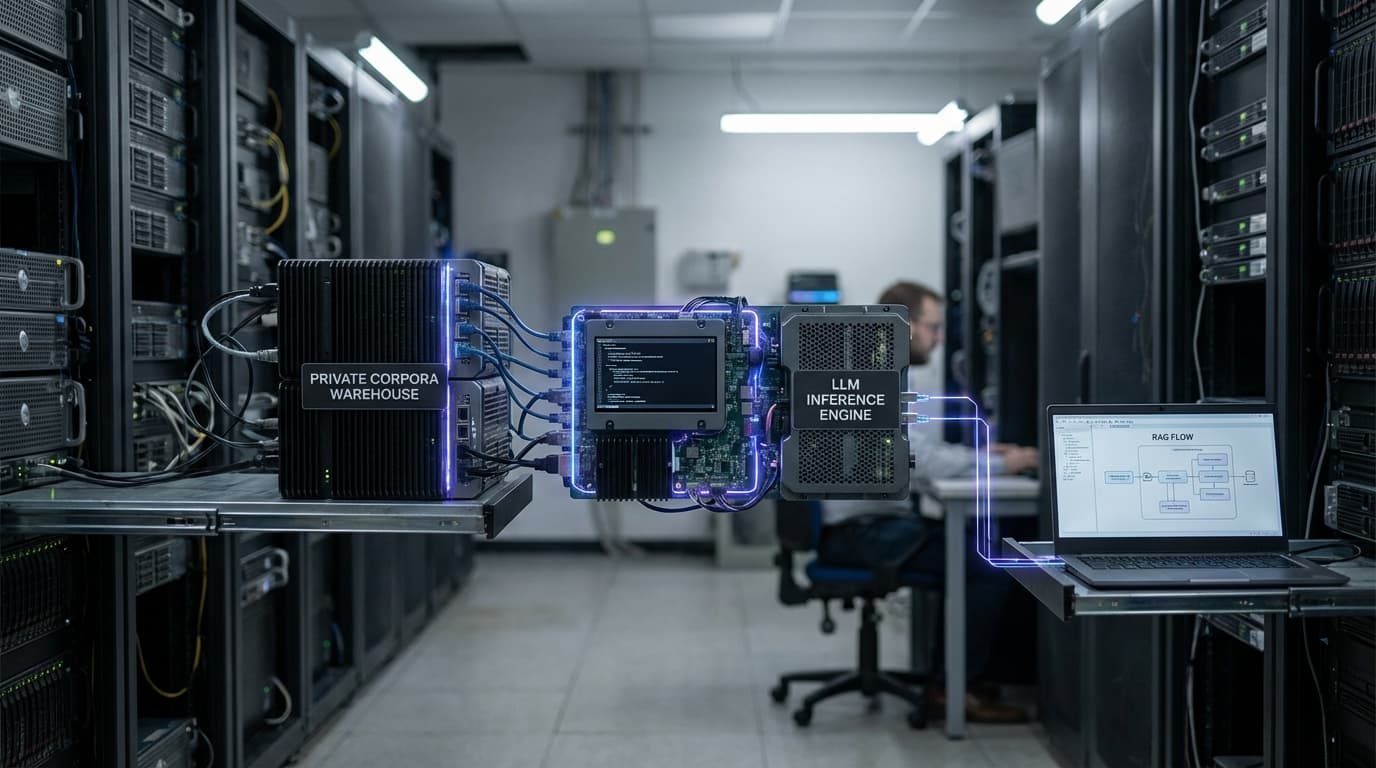
Retrieval-Augmented Generation Stack
Retrieval-augmented generation (RAG) stacks combine large language models with vector databases and retrieval systems to ground AI responses in specific, verifiable source material. These systems use semantic search to find relevant information from private document collections, then inject that context into language model prompts, enabling accurate, source-attributed responses while reducing hallucinations and enabling compliance with enterprise data requirements.
This innovation addresses critical limitations of standalone language models, including their tendency to hallucinate, lack of access to private or recent information, and inability to cite sources. By retrieving relevant information before generating responses, RAG systems enable enterprises to deploy AI assistants that can answer questions about proprietary data, provide citations, and maintain accuracy. The technology has become essential infrastructure for enterprise AI deployments, with platforms like LangChain, LlamaIndex, and various cloud providers offering RAG solutions.
The technology is fundamental to making AI useful in enterprise contexts, where accuracy, verifiability, and access to proprietary information are essential. As enterprises adopt AI more broadly, RAG stacks provide the foundation for compliant, accurate AI systems that can leverage organizational knowledge. The technology continues to evolve with improvements in retrieval quality, multi-step reasoning, and integration with various data sources, making it increasingly sophisticated and capable.
Related Organizations

Develops the leading open-source framework for orchestrating LLMs and retrieval systems.
United States · Startup
Data framework for connecting custom data sources to large language models.

Provides a managed vector database optimized for high-performance AI similarity search.
United States · Startup
Building 'RAG 2.0' systems that are end-to-end optimized for groundedness and attribution.
Germany · Startup
Creators of Haystack, an open-source framework specifically designed for building RAG pipelines.

Enterprise AI search platform that connects to internal apps to provide RAG-based answers.

Open-source vector search engine with out-of-the-box modules for vectorization and RAG.

Provides ETL tools to ingest and preprocess complex documents for LLM usage.


Maintainers of Milvus, an open-source vector database for scalable similarity search.
Supporting Evidence
Research this in Signals
Signals turns a topic into a sourced research record you can inspect and rerun. Your first scan is free, and this one starts with Retrieval-Augmented Generation Stack already loaded, so edit it or scan as is.