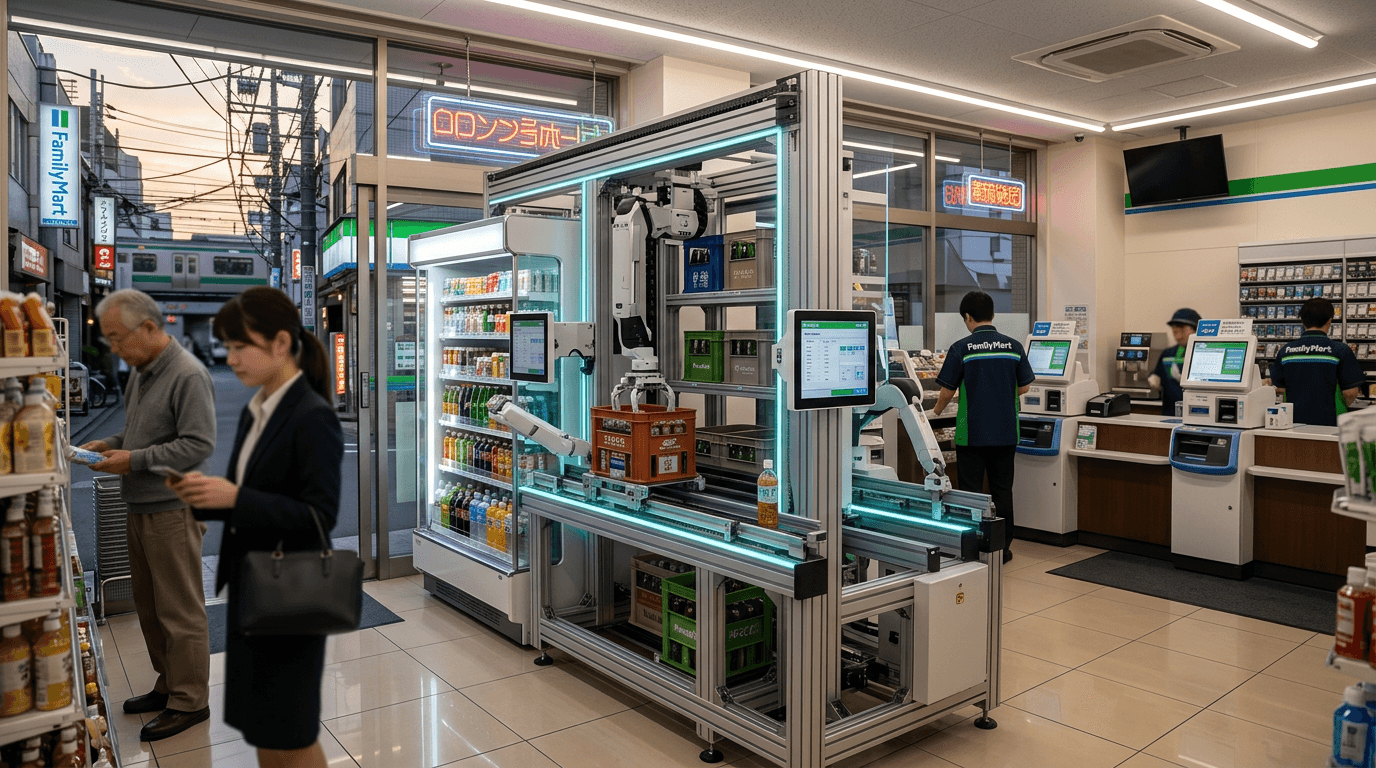
Convenience Store (Konbini) Automation
Geography: Asia Pacific · East Asia · Japan
Japan's 'Big Three' convenience store chains — 7-Eleven (21,000+ stores), FamilyMart (16,000+), and Lawson (14,000+) — operate the most technologically sophisticated retail networks on Earth. Each store manages 3,000+ SKUs in spaces under 100 square meters, with AI-driven demand forecasting that accounts for weather, local events, day of week, and time of day to optimize inventory down to individual onigiri varieties. Seven-Eleven's proprietary demand analytics system generates over 10 million data points daily across its network, achieving food waste rates far below Western convenience retailers.
The konbini is evolving from a store into a logistics and services platform. Stores function as parcel pickup/dropoff points for e-commerce, ATMs, bill payment terminals, government service kiosks, and emergency supply points during disasters. FamilyMart has deployed autonomous shelf-stocking robots, Lawson operates cashierless 'Lawson Go' stores using computer vision, and all three chains use RFID-tagged products for automated inventory tracking. The konbini model is being exported — 7-Eleven's Japanese operational technology now drives efficiency improvements in its US, Thai, and Chinese operations.
The strategic insight is that Japanese konbini represent an alternative model to Amazon Go-style cashierless retail. Rather than building technology-first stores from scratch, Japan is incrementally automating the world's densest convenience store network, optimizing for the constraints of aging staff, small footprints, and hyper-local demand patterns. The result is a retail technology testbed generating more real-world data on automated commerce than any Silicon Valley experiment.
Research this in Signals
Signals turns a topic into a sourced research record you can inspect and rerun. Your first scan is free, and this one starts with Convenience Store (Konbini) Automation already loaded, so edit it or scan as is.