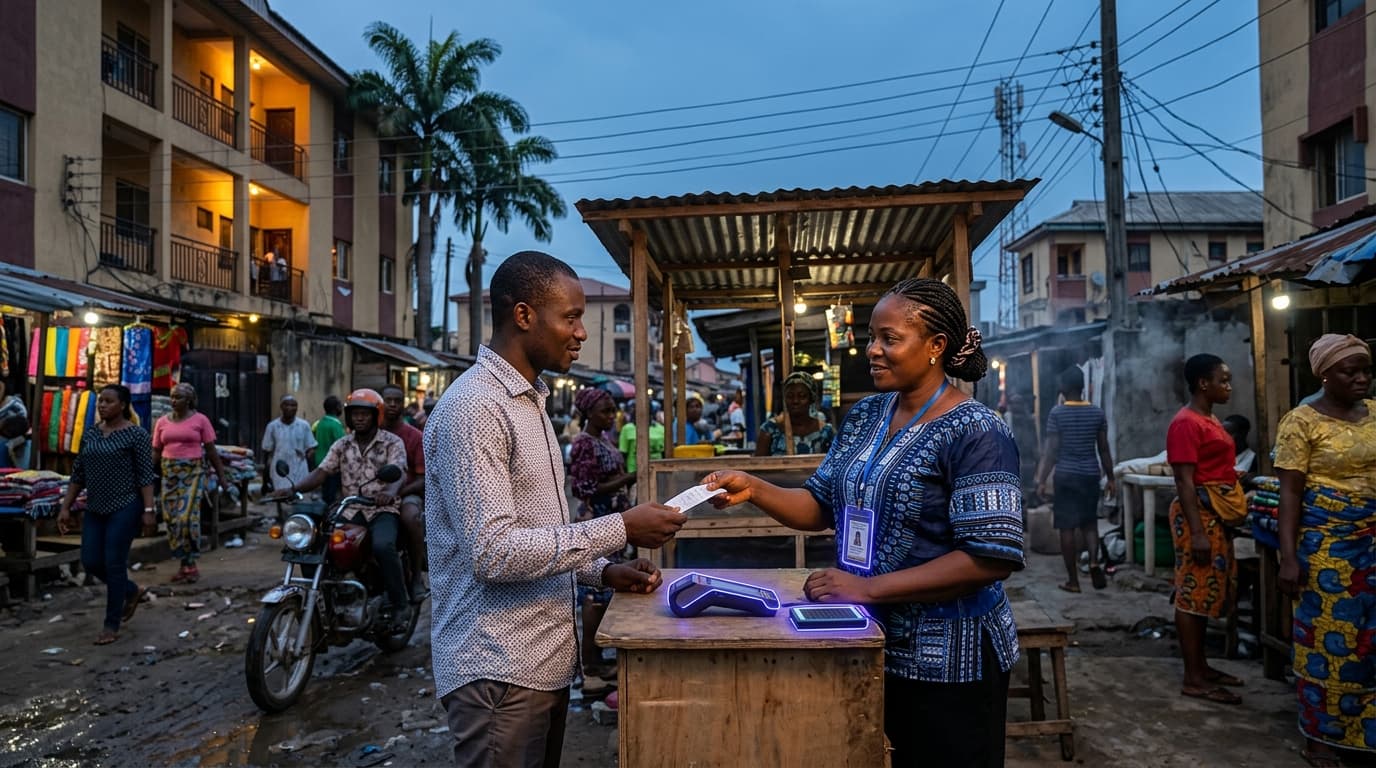
Agent Banking POS Terminal Networks
Geography: Emea · Africa · Africa
Agent banking uses a network of human agents — shopkeepers, market vendors, mobile phone sellers — equipped with POS terminals to provide basic banking services (cash-in, cash-out, transfers, bill payments) in locations where banks have no branches. In Nigeria, companies like Moniepoint, OPay, and PalmPay have deployed over 1.4 million POS terminals, processing billions in monthly transactions. The agents earn commissions on each transaction, creating a self-sustaining distribution model.
This solves a fundamental infrastructure gap. Nigeria has roughly 5,000 bank branches for 220 million people, concentrated in urban areas. Agent banking effectively multiplied the financial access points by 280x. The POS terminal becomes the bank branch — handling deposits, withdrawals, and transfers for communities that might be hours from the nearest ATM. Moniepoint alone processes over $18 billion monthly through its agent network.
The model is distinctly African in its design. Rather than waiting for digital infrastructure (internet, smartphones) to reach rural areas, agent banking meets people where they are — with cash and basic technology. It's a hybrid system that bridges the analog-to-digital transition, and its success has made Nigeria a reference case for last-mile financial inclusion globally.
Research this in Signals
Signals turns a topic into a sourced research record you can inspect and rerun. Your first scan is free, and this one starts with Agent Banking POS Terminal Networks already loaded, so edit it or scan as is.